Universal High Income: What If Everyone Gets Money But the Same People Keep the Power?

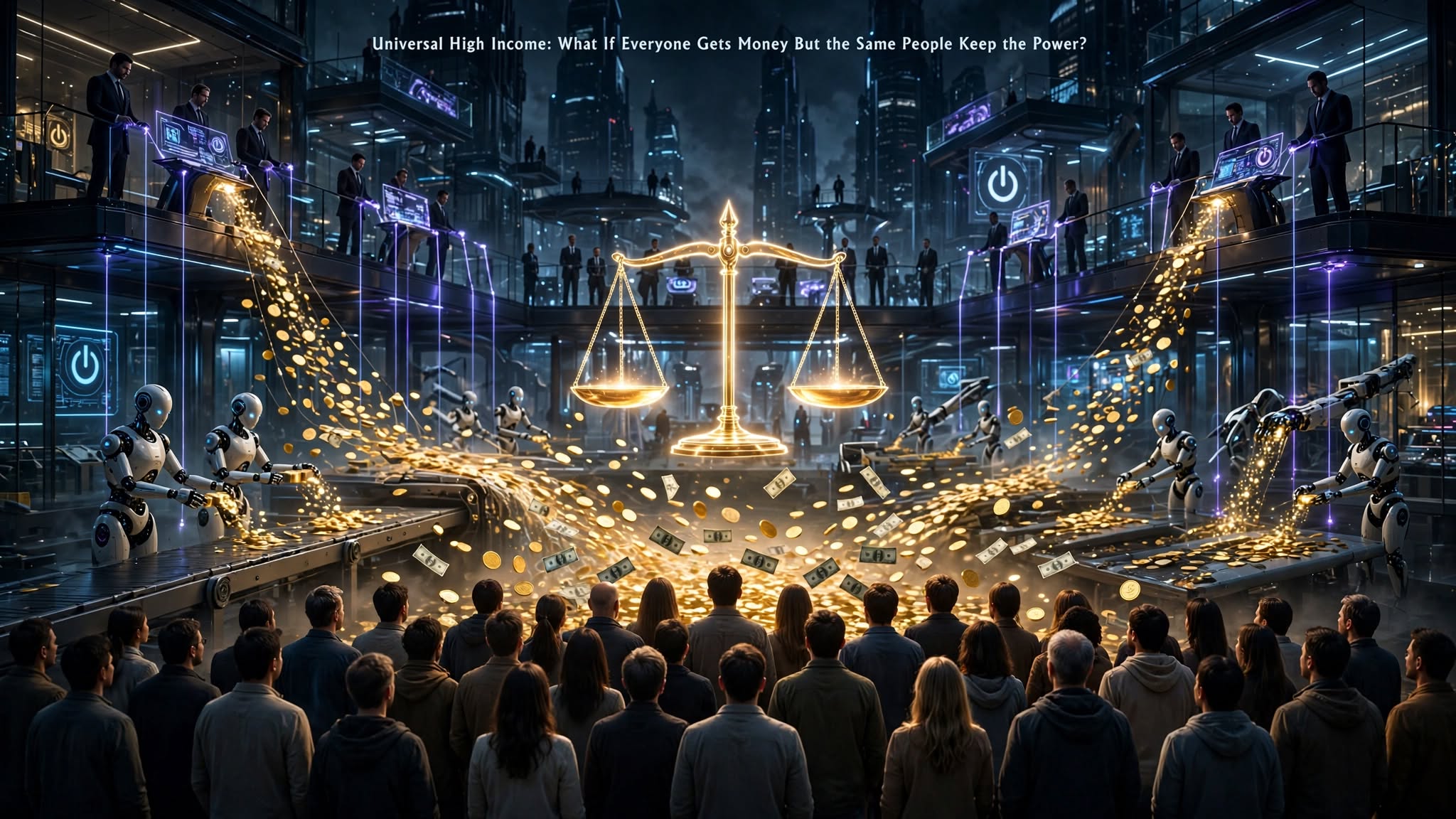
Universal High Income: What If Everyone Gets Money But the Same People Keep the Power?
Elon Musk has talked about a future where artificial intelligence and robotics could create such enormous levels of productivity that traditional employment becomes less necessary. In that vision, the conversation moves beyond Universal Basic Income toward what Musk has called Universal High Income.
It sounds futuristic.
It sounds abundant.
It sounds like everyone wins.
But there is another way to look at it.
WHAT IF UNIVERSAL HIGH INCOME DOESN'T ELIMINATE THE DIVIDE—WHAT IF IT AUTOMATES IT?
Imagine a future where everybody receives a large monthly payment.
The money arrives automatically.
No traditional paycheck is necessary.
AI and robots perform much of the work.
People have enough income to participate in the economy.
At first glance, that sounds like the end of the traditional economic struggle.
But there's a problem hiding underneath the check:
Who controls the system sending it?
Who controls the artificial intelligence?
Who owns the companies?
Who owns the infrastructure?
Who owns the energy?
Who owns the data centers?
Who owns the robots?
And who writes the rules determining how much everyone receives?
GIVING EVERYONE MONEY DOESN'T MEAN GIVING EVERYONE POWER
This is where the conversation gets uncomfortable.
Imagine two people receiving the exact same $5,000 every month.
One person owns billions in assets and has ownership stakes in the companies producing the technology.
The other person owns very little and depends on that $5,000 for housing, food, transportation, and everything else.
The payment is equal.
The power isn't.
One person owns part of the economic machine.
The other person depends on the machine.
That's not the elimination of inequality.
That's inequality operating underneath an equal payment system.
THE PERSON WRITING THE CHECK STILL HAS LEVERAGE
There's another issue that deserves attention.
If your income comes automatically from a centralized system, whoever controls that system possesses enormous influence over the economy.
Even if the system is designed with safeguards, the fundamental question remains:
Who has the authority to change the rules?
Can the payment increase?
Can it decrease?
Who qualifies?
Who doesn't?
What happens during a crisis?
What happens if the government changes?
What happens if the economic assumptions behind the program change?
What happens if the people controlling the infrastructure decide that access needs to be restricted?
The more important an automated payment becomes to everyday survival, the more important control over that payment system becomes.
DEPENDENCE CAN EXIST EVEN WHEN THE CHECK IS GENEROUS
This is the part that gets overlooked when people focus only on the amount of money.
A person can be financially better off and still be economically dependent.
If you don't own productive assets, you can receive a large income while remaining dependent on whoever owns the assets generating the wealth.
You aren't necessarily powerless because you receive money.
But receiving money is not the same thing as controlling the source of wealth.
And that's the distinction that matters.
UNIVERSAL HIGH INCOME COULD CREATE TWO DIFFERENT CLASSES OF PEOPLE
There could eventually be people who own the automated economy and people who receive income from the automated economy.
Both groups might live better than people today.
Both might have more purchasing power.
Both might have more leisure.
But one group could still own the productive infrastructure.
The other could still depend on access to it.
That's a different kind of class structure.
It isn't necessarily worker versus employer anymore.
It could become owner versus recipient.
THE MOST IMPORTANT WORD MAY NOT BE “INCOME.” IT MAY BE “UNIVERSAL.”
Universal High Income sounds universal because everyone supposedly receives it.
But what if everyone receives the same income while only a relatively small group owns the assets producing the wealth?
Then everyone participates in the distribution.
But not everyone participates equally in ownership.
And ownership is where long-term economic power tends to accumulate.
A person who owns an asset can potentially benefit from its future growth.
A person who receives a payment primarily gets the benefit of the payment itself.
Those are fundamentally different positions.
WHAT HAPPENS WHEN EVERYTHING IS AUTOMATED BUT OWNERSHIP ISN'T?
This may be the biggest question surrounding an AI-driven economy.
Technology can automate production.
It can automate payments.
It can automate decision-making.
It can automate distribution.
But technology doesn't automatically democratize ownership.
A robot doesn't care who owns it.
An AI system doesn't automatically distribute its stock value equally.
A corporation doesn't become collectively owned simply because its technology makes society more productive.
Automation changes how wealth is produced.
It does not automatically determine who owns that wealth.
AND THAT'S WHERE THE INEQUALITY COULD BECOME EVEN MORE INTERESTING
Suppose the government or another institution provides everyone with a substantial income.
Now suppose a smaller group continues accumulating companies, stocks, land, intellectual property, infrastructure, and AI systems.
The average person may have enough money to live.
But the asset owners continue becoming wealthier.
The gap could therefore shift from income inequality toward ownership inequality.
Everyone gets paid.
But not everyone owns.
And ownership can determine who has influence over what happens next.
THE FUTURE COULD MAKE PEOPLE RICHER WITHOUT MAKING THEM MORE POWERFUL
That's the uncomfortable possibility.
A person could have more money than their parents ever had.
They could work fewer hours.
They could have better technology.
They could have access to incredible services.
And they could still have relatively little influence over the infrastructure determining how the economy operates.
Higher living standards and greater economic power are not necessarily the same thing.
IF EVERYONE GETS THE SAME MONEY, WHY SHOULD ONLY SOME PEOPLE GET THE OWNERSHIP?
This is where the debate gets much bigger than UBI versus UHI.
If AI and robotics create enormous wealth, why should the conversation stop at distributing income?
Why not ask who owns the productive assets?
Why not ask who benefits from the appreciation of those assets?
Why not ask whether ordinary people should have opportunities to own part of the technology generating the wealth?
Because giving someone money every month doesn't necessarily give them a stake in the system.
It can give them purchasing power.
It doesn't automatically give them ownership.
THE DANGER IS CONFUSING COMFORT WITH POWER
A society can potentially become materially comfortable while remaining highly unequal in terms of ownership and influence.
Everyone could have a television.
Everyone could have a smartphone.
Everyone could have internet access.
Everyone could receive an automated income.
And there could still be a relatively small group controlling enormous amounts of productive capital.
Having access to the products of a system is not the same as having control over the system.
UNIVERSAL HIGH INCOME DOESN'T AUTOMATICALLY MEAN UNIVERSAL POWER
That is the question worth asking before celebrating the idea.
Maybe AI really will create extraordinary abundance.
Maybe automation really will make traditional employment less necessary.
Maybe some form of universal income eventually becomes economically possible.
Those are questions worth debating.
But the conversation should not stop at:
“How much money will everybody receive?”
It should continue with:
“Who owns the machines producing the money?”
“Who controls the infrastructure?”
“Who controls the rules?”
“Who owns the assets?”
“And who gets to change the system?”
THE FUTURE COULD AUTOMATE THE PAYCHECK WITHOUT AUTOMATING EQUALITY
Universal High Income might create a world where almost everyone receives money.
But if ownership remains concentrated, the fundamental hierarchy may remain too.
The poor might become less poor.
The middle class might become more comfortable.
And the wealthy could become even wealthier.
Everyone could receive the same check while having completely different levels of ownership, influence, and control.
That's why the real debate isn't simply about whether people should receive money from an automated economy.
It's about whether receiving money is enough when someone else still owns the machine.
Because a society can distribute the income from power without distributing the power itself.









Comments
No comments yet, be the first submit yours below.