Your Attention Is Being Auctioned Off While You Think You're Just Scrolling

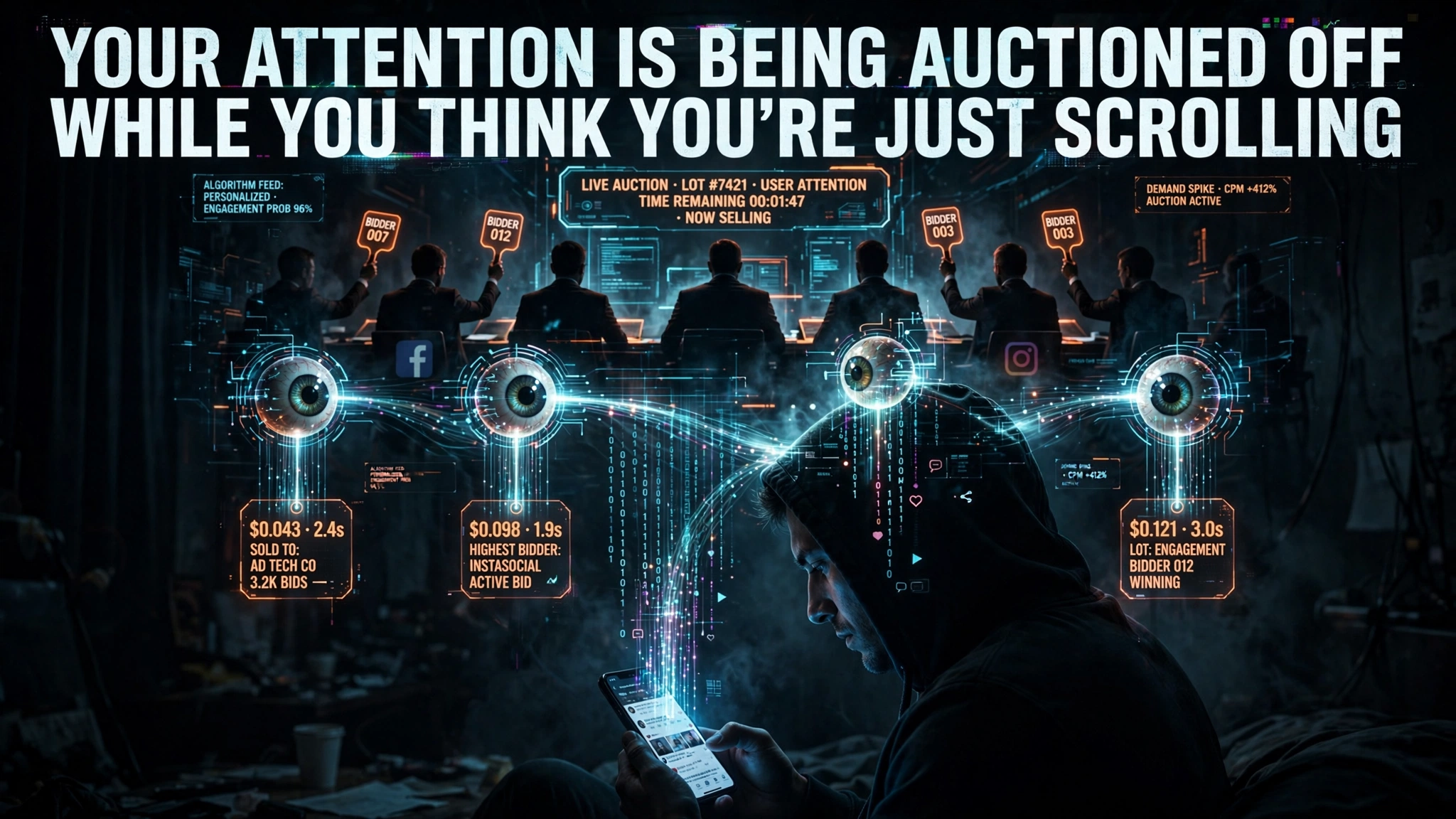
You think you're scrolling for entertainment. Somebody else may be measuring how long they can keep you there.
Open your phone for five minutes.
Check one notification.
Watch one video.
Read one comment.
Click another video.
Before you know it, thirty minutes disappeared.
Nothing was stolen from your wallet.
Nothing was physically taken from you.
But something extremely valuable was spent.
Your attention.
Attention is one of the most valuable resources in the modern economy because almost everything wants a piece of it.
Social media wants it.
Advertisers want it.
Streaming platforms want it.
News organizations want it.
Influencers want it.
Political campaigns want it.
Businesses want it.
Even your phone is designed around getting you to look at it again.
The battle isn't always over what you believe. Sometimes it's simply over what you will keep looking at.
That's an important distinction.
You don't have to agree with something for it to affect you.
You only have to keep consuming it.
Anger can hold your attention.
Fear can hold your attention.
Arguments can hold your attention.
Outrage can hold your attention.
Controversy can hold your attention.
And once something has your attention, there is an opportunity to show you another advertisement, another recommendation or another piece of content.
Your attention has economic value even when you aren't the one getting paid for it.
That's why the endless scroll is so powerful.
There is no natural stopping point.
You don't reach the bottom of the internet.
There is always another video.
Another post.
Another headline.
Another notification.
Another argument.
Another reason to stay.
And the longer you stay, the more opportunities there are to monetize your attention.
This doesn't mean every app is secretly plotting against you.
It means the basic economics of digital platforms are worth understanding.
Many services are built around engagement because engagement creates opportunities for advertising, subscriptions, purchases and data-driven recommendations.
Once you understand that, your relationship with your phone can change.
You stop asking only, “Is this entertaining?”
You start asking, “What is this costing me in attention?”
Because time isn't the only thing you're spending.
Spend two hours scrolling every day and you've spent roughly 730 hours a year.
That's more than thirty full days.
A month.
Every year.
Not necessarily because you consciously decided to give away a month of your life.
It happened five minutes at a time.
That's how attention disappears.
The answer isn't necessarily deleting every app and moving into the woods.
Technology can be incredibly useful.
Social media can build businesses, friendships, communities and careers.
The point is control.
Use the technology.
Don't automatically let the technology use your attention.
Turn off notifications that don't matter.
Put the phone down when you're working.
Give yourself periods where nothing is demanding your attention.
Choose what you consume instead of consuming whatever appears next.
Because the person who controls their attention has something increasingly rare in modern life: the ability to decide what deserves their mind.
Your attention is limited.
Every day you spend it somewhere.
The question is whether you're spending it deliberately—or whether somebody else is deciding where it goes.







Comments
No comments yet, be the first submit yours below.