Everybody Wants the Benefits—But Nobody Wants to Talk About Who Pays for Them

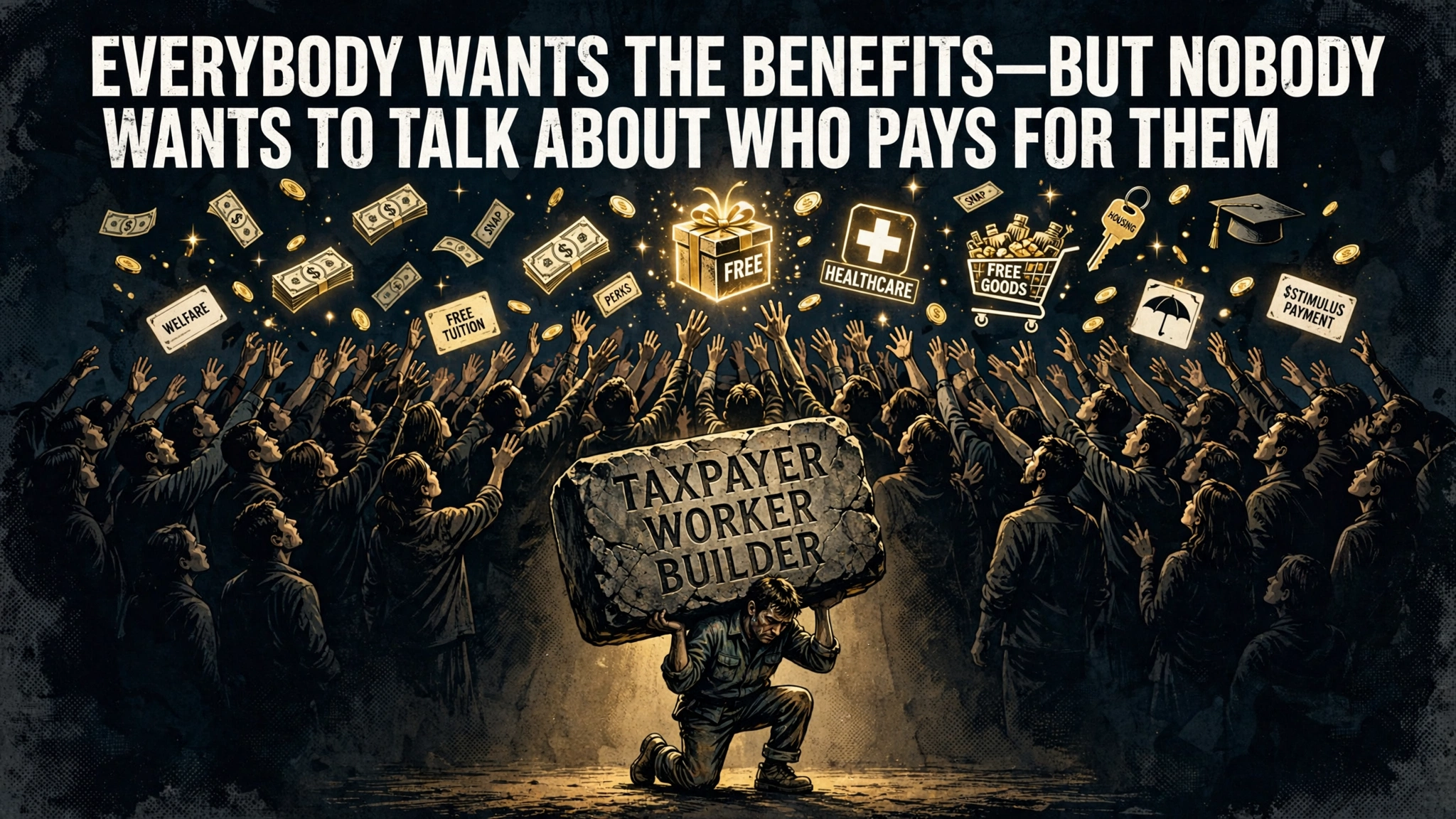
Modern life has created a strange habit: we talk constantly about what people deserve, but not nearly enough about who is expected to provide it.
People want affordable housing.
Affordable healthcare.
Better schools.
Reliable transportation.
Good wages.
Cheap food.
Low taxes.
Strong public services.
And honestly, most people can understand why.
Everybody wants a life that doesn't feel like one unexpected bill could knock everything over.
But there's a question that often disappears from the conversation:
Who pays for it?
That question isn't meant to dismiss anybody's needs.
It's the question that turns a slogan into an actual economic conversation.
Nothing is truly “free.” Someone is providing the labor, materials, infrastructure, funding or resources behind it.
That applies everywhere.
A public program requires funding.
A business providing a service needs revenue.
A landlord has property expenses.
A worker provides labor.
A government collects taxes and allocates money.
A company passes costs through its pricing structure.
Somebody is always carrying part of the cost.
The problem begins when people only look at one side of the equation.
“Lower my taxes.”
Okay—but what happens to the services funded by those taxes?
“Pay workers more.”
Okay—but how does the business absorb the additional labor cost?
“Make housing cheaper.”
Okay—but what changes the underlying cost of land, construction, financing and maintenance?
“Give people more benefits.”
Okay—but what is the funding mechanism?
Good policy questions don't end with “How much should people receive?”
They also ask:
How will it be funded?
Who qualifies?
What incentives does it create?
What happens if demand increases?
What happens if costs rise?
Who administers it?
What happens when the money runs out?
Those questions aren't cold.
They're necessary.
Because compassion without math can create promises nobody can sustain.
But the opposite is also true.
Math without compassion can create systems that technically balance the books while leaving real people unable to live.
That's why the conversation has to include both.
People need dignity.
Systems need sustainability.
Workers need compensation.
Businesses need to remain viable.
Families need stability.
Governments need revenue.
The real challenge is figuring out how all of those pieces fit together.
And this matters especially to ordinary people because the costs of economic decisions don't stay on paper.
They show up in rent.
They show up in grocery receipts.
They show up in insurance premiums.
They show up in wages.
They show up in taxes.
They show up in whether a family can save anything after paying its bills.
That's why we should stop treating economics like a collection of political slogans.
Ask the uncomfortable question.
Follow the money.
Look at the incentives.
Look at who benefits.
Look at who pays.
Look at what happens five years later—not just what sounds good today.
Because wanting something and figuring out how to sustainably provide it are two different conversations.
The adult version of the debate isn't “What do I want?”
It's “What do we want, what will it cost, and how do we build a system that can actually support it?”
That's where the real conversation begins.







Comments
No comments yet, be the first submit yours below.