The Product Isn't Always What You're Buying—Sometimes It's the Habit

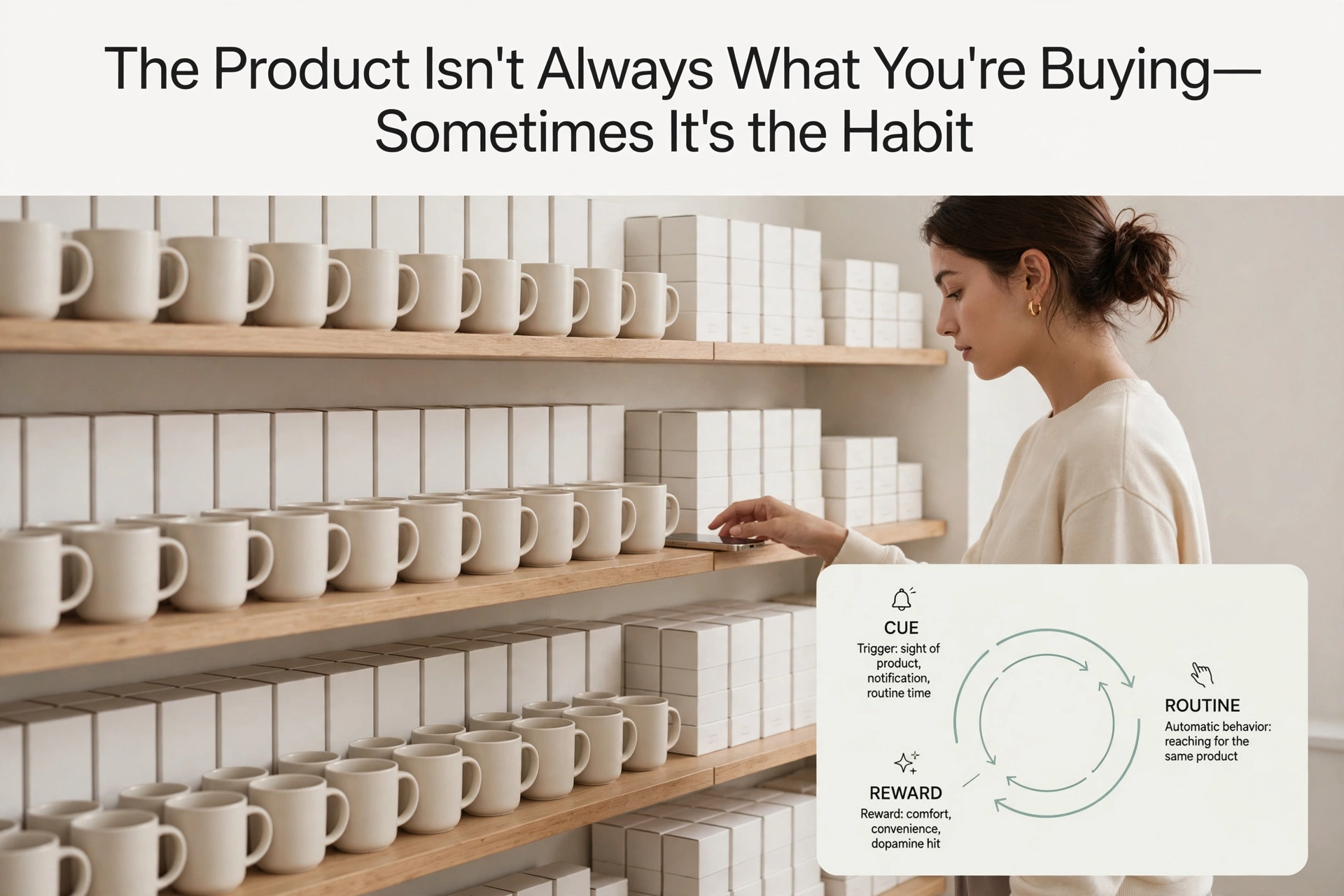
What if the most valuable customer isn't the person who loves the product—but the person who can't stop coming back?
We've become extremely good at identifying addiction when it involves obvious substances.
Drugs.
Alcohol.
Nicotine.
But modern life has developed another kind of dependency that can be much harder to recognize because it doesn't always look destructive.
It's built into ordinary behavior.
Check the phone.
Refresh the feed.
Open the app.
Check the notifications.
Watch another video.
Order something.
Check the bank account.
Check the likes.
Check the messages.
Repeat.
The most powerful loop may be the one that doesn't feel like an addiction.
The interesting part isn't simply that people spend hours online.
It's that many digital systems are built around keeping attention moving.
There is always another notification.
Another recommendation.
Another video.
Another post.
Another message.
Another product.
Another headline.
The experience rarely has a natural ending.
A book has a final page.
A movie has credits.
A meal ends.
A newspaper eventually runs out of pages.
But the infinite feed doesn't really end.
When there is no ending, there is no natural reason to stop.
That changes the psychology of consumption.
You aren't necessarily making a conscious decision every five minutes to continue.
The system simply gives you another reason.
And another.
And another.
Eventually, thirty minutes disappears.
Then an hour.
Then several hours.
And afterward you may not even remember what you consumed.
That's the strange thing about attention: you can spend it without ever knowing exactly where it went.
And attention has become incredibly valuable.
Your attention can be converted into advertising revenue.
It can be converted into purchases.
It can be converted into subscriptions.
It can be converted into political engagement.
It can be converted into data.
It can be converted into influence.
It can be converted into another metric that somebody else can monetize.
That means your attention isn't merely something you possess.
It is something other people compete for.
Every notification is a tiny argument for why you should stop doing what you were doing and look at the screen.
And once you recognize that, a lot of modern behavior starts looking different.
Why do you check your phone when nothing happened?
Why do you open an app before remembering why you opened it?
Why does silence sometimes feel uncomfortable?
Why do people reach for their phones while waiting in line for thirty seconds?
Why does boredom feel like something that must immediately be eliminated?
Because we've trained ourselves to expect stimulation.
Boredom used to be empty space. Now empty space feels like a problem that technology should solve.
That's where the addiction loop becomes bigger than social media.
It's shopping.
Gaming.
Short-form video.
Sports betting.
Streaming.
Notifications.
Dating apps.
Food delivery.
Even productivity apps can become part of it.
We're surrounded by systems that reward repeated engagement.
The reward doesn't even have to be large.
Sometimes it's just the possibility of something interesting happening.
Uncertainty can be more powerful than certainty because every refresh creates the possibility of a reward.
Maybe somebody liked the post.
Maybe somebody messaged you.
Maybe the next video is hilarious.
Maybe the next notification matters.
Maybe the next deal is better.
Maybe something happened while you were gone.
So you check again.
That's the loop.
And the loop becomes especially powerful when people are stressed.
When life feels uncertain, small predictable rewards can become incredibly attractive.
A notification gives you something to react to.
A purchase gives you something to anticipate.
A video gives you something to consume.
A like gives you a tiny social reward.
For a few seconds, you aren't thinking about the larger problem.
Sometimes distraction isn't about entertainment. It's about temporary relief.
And that's why simply telling people to “put the phone down” misses the deeper issue.
You have to understand what the phone is doing for you.
Is it helping you connect?
Helping you work?
Helping you learn?
Or helping you avoid being alone with your thoughts?
Those are very different functions.
If you remove the distraction without addressing what the distraction was protecting you from, something else usually takes its place.
That's why breaking an addiction loop isn't necessarily about eliminating technology.
It can be about putting friction back into your life.
Turning off unnecessary notifications.
Removing apps that constantly demand attention.
Creating periods where nothing is competing for your eyes.
Eating without a screen.
Driving without constantly checking something.
Walking without needing entertainment.
Letting yourself be bored.
Not because technology is evil.
Because your attention belongs to you.
The ability to sit in silence without immediately reaching for stimulation is becoming a form of independence.
And there is something else worth thinking about.
The companies building these systems don't necessarily need you to hate them.
They don't need you to believe you're being manipulated.
They simply need you to keep using the product.
That's a very different kind of power.
It doesn't require force.
It requires habit.
The strongest cage isn't always the one that locks the door. Sometimes it's the one that keeps giving you reasons to stay inside.
So the next time you reach for your phone without thinking, pause for a second.
Ask yourself why.
Not because checking your phone is automatically bad.
But because knowing why you're doing something is the beginning of taking control of it.
Because eventually the question isn't whether technology is addictive.
The better question is:
Who benefits when you can't stop paying attention?
And once you start asking that question, the entire digital world looks a little different.






Comments
No comments yet, be the first submit yours below.