Everybody Wants to Be Supported Until It's Their Turn to Support Somebody Else

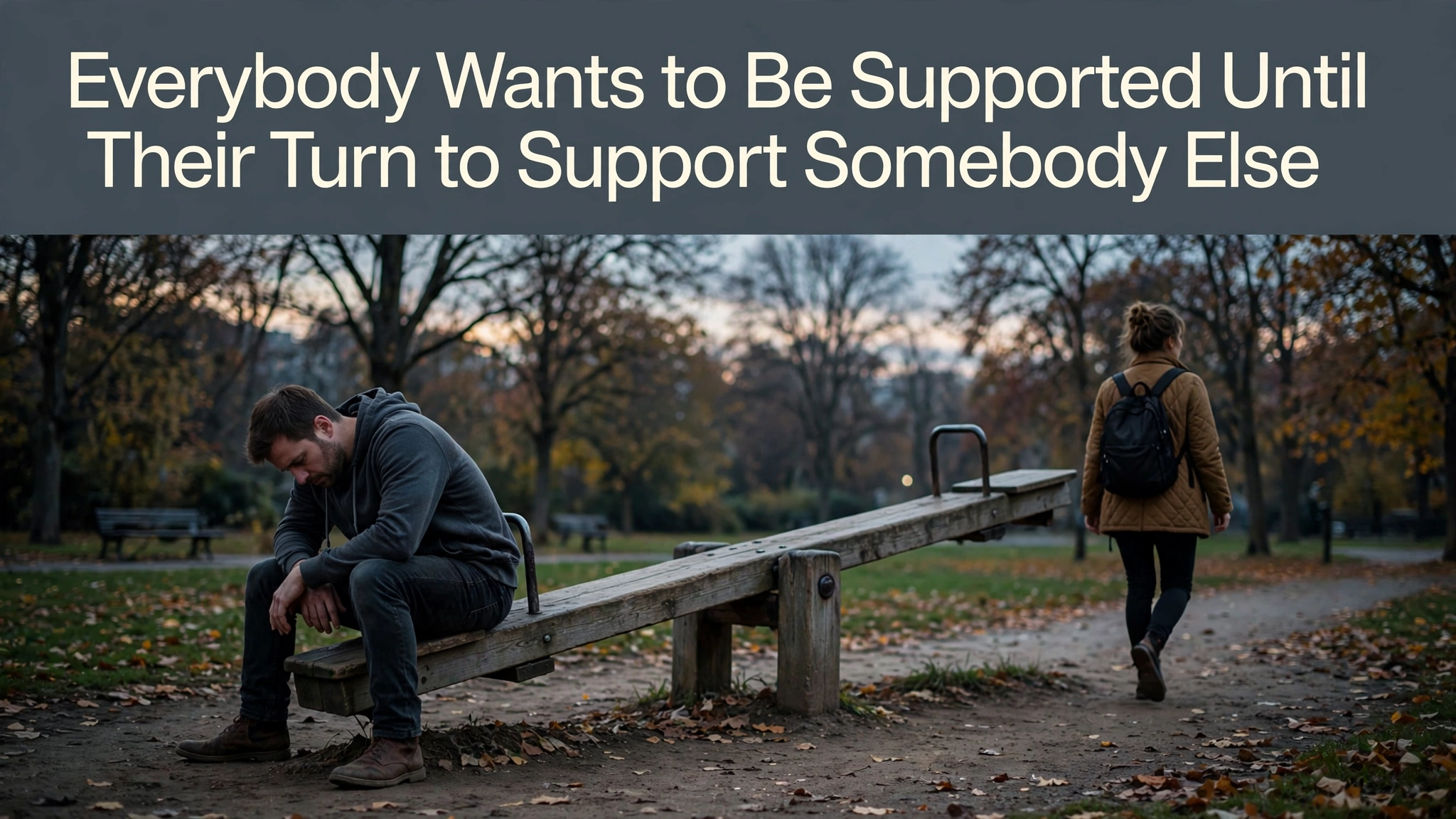
Everybody wants understanding when they're struggling, patience when they're failing, and support when they're trying to get ahead. But the moment somebody else needs that same energy, suddenly everybody has boundaries, bills, responsibilities, and a whole speech about why it's not their problem.
Let's talk about a double standard that shows up in friendships, families, relationships, workplaces, and even society as a whole.
Everybody wants somebody in their corner. Everybody wants to feel like somebody cares. Everybody wants the benefit of the doubt when life gets complicated.
But how many people are willing to give other people the same consideration they expect for themselves?
We live in a world where people can explain their own struggles in extraordinary detail while dismissing somebody else's struggles in a single sentence.
When they're broke, they want you to understand. When you're broke, they want to know what you did with your money.
When they need a favor, they want you to remember everything they've ever done for you. When you need a favor, suddenly the relationship has terms and conditions.
When they're overwhelmed, they need patience. When you're overwhelmed, they tell you that everybody has problems.
Apparently, compassion is unlimited when you're the one receiving it and strictly rationed when you're expected to give it.
WHY DO WE EXPECT PEOPLE TO UNDERSTAND OUR CIRCUMSTANCES BUT REFUSE TO CONSIDER THEIRS?
Part of the problem is that we experience our own lives from the inside. We know every bill we're paying, every responsibility we're carrying, every disappointment we've endured, and every sacrifice nobody saw.
We know why we made certain decisions. We understand what we're trying to accomplish. We know what it feels like to wake up worried about something that other people barely notice.
But when we look at someone else, we often see only the outcome.
We see somebody asking for help, not the months they spent trying to avoid needing it. We see somebody making a mistake, not the pressure they were under when they made it. We see somebody falling behind, not the responsibilities consuming their time and money.
We give ourselves context and give everybody else a verdict.
That's a dangerous way to judge people.
AND NO, THIS DOESN'T MEAN YOU OWE EVERYBODY EVERYTHING.
Let's make that clear before somebody turns this conversation into an argument about boundaries.
You are allowed to say no. You are allowed to protect your money, your time, your energy, and your peace. You don't have to rescue every friend, financially support every relative, or sacrifice your own stability to prove that you're a good person.
Helping people should not require destroying yourself.
But there is a difference between having healthy boundaries and expecting everyone else to accommodate you while refusing to accommodate anyone else.
There is a difference between being unable to help and simply not caring enough to consider helping.
And there is a difference between refusing a request respectfully and making someone feel worthless for asking.
You can say no without being cruel. You can protect your resources without acting as though another person's struggle is a personal insult.
THE REAL PROBLEM IS SELECTIVE EMPATHY.
Some people are incredibly compassionate toward people whose experiences resemble their own. They understand the single parent who is exhausted, the worker who is underpaid, the friend going through a breakup, or the relative who cannot seem to get ahead.
Until the situation requires something from them.
Then the conversation changes.
Suddenly, the struggling person should have planned better. They should have made better choices. They should have worked harder. They should have known better.
Maybe some of those criticisms are valid. Personal decisions do have consequences, and accountability matters.
But if your compassion disappears the moment somebody else's problem becomes inconvenient, was it compassion in the first place?
Or did you simply enjoy being the person who got to judge the situation from a comfortable distance?
FAMILIES CAN BE SOME OF THE BIGGEST EXAMPLES OF THIS CONTRADICTION.
One relative may be expected to help everybody because they're considered the responsible one. They lend money, provide transportation, babysit, offer a place to stay, and show up whenever there's a crisis.
Then one day, that same person needs help.
Suddenly, everyone has their own responsibilities. Everybody is dealing with something. Nobody has enough time, money, or energy to contribute.
And the person who spent years being dependable discovers that being dependable does not guarantee that anyone will dependably show up for them.
That experience can change how people view relationships.
They begin to question whether they were loved and appreciated or simply valued for what they provided.
They start recognizing that some relationships operate smoothly only because one person keeps absorbing the inconvenience.
And when that person finally stops, everybody acts surprised that the arrangement has changed.
SOMETIMES PEOPLE DON'T MISS YOUR PRESENCE UNTIL THEY LOSE ACCESS TO YOUR HELP.
They miss the rides, the loans, the advice, the favors, the emotional support, and the fact that you were always willing to make things easier for them.
But did they ever ask whether you were doing okay?
Did they notice when you were struggling? Did they offer to help without needing to be asked? Did they make room for your problems, or was the relationship always organized around theirs?
These are important questions because healthy relationships are not supposed to be permanent one-way transactions.
Balance does not mean keeping a spreadsheet of every favor. People go through different seasons of life, and one person may need more support at certain times than the other.
But over time, there should be some evidence that both people care about each other's well-being.
AND THIS PROBLEM EXTENDS BEYOND PERSONAL RELATIONSHIPS.
At work, employees may be expected to show loyalty to a company that treats them as replaceable. Employers may demand flexibility from workers while offering little flexibility in return.
In communities, people may call for unity but refuse to support local businesses, mentor younger people, or participate in solving shared problems.
Online, people demand kindness while insulting strangers. They demand accountability from public figures while making excuses for the people they personally support.
The pattern is the same: we want standards to apply when they benefit us and exceptions to apply when they inconvenience us.
We want fairness, but sometimes we define fairness as getting what we need without having to consider what anybody else needs.
SO WHAT WOULD CHANGE IF WE APPLIED THE SAME STANDARD TO OURSELVES THAT WE APPLY TO EVERYBODY ELSE?
Before judging somebody for needing help, we could remember that circumstances change. Before demanding patience, we could ask whether we have been patient with others. Before expecting people to show up for us, we could examine whether we have made an effort to show up for them.
We could learn to express gratitude without treating kindness as something we're automatically entitled to receive.
We could stop assuming that the person who appears strongest needs the least support.
And we could recognize that refusing to help is sometimes necessary, but refusing to care is an entirely different decision.
You will not always have the money to lend. You will not always have the time to spare. You will not always have the emotional capacity to solve somebody else's problem.
But sometimes, what another person needs is not money or a solution. Sometimes they need somebody who will listen without making them regret opening their mouth.
That costs nothing except a little consideration.
HERE'S THE CONTROVERSIAL QUESTION: DO PEOPLE REALLY WANT A SUPPORT SYSTEM, OR DO SOME PEOPLE JUST WANT A SYSTEM THAT SUPPORTS THEM?
Because there is a difference between building relationships where people look out for one another and surrounding yourself with people whose purpose is to make your life easier.
One involves mutual respect. The other involves entitlement.
And if you constantly expect people to understand your situation, make exceptions for your mistakes, celebrate your victories, and support your goals, you should be willing to consider that they have struggles and ambitions of their own.
You don't have to save everybody. You don't have to say yes to every request. You don't have to carry the world on your shoulders.
But don't demand a level of compassion from others that you refuse to practice yourself.
Because the world doesn't need more people who know how to ask for support. It needs more people who understand that being supported is a privilege, not a permanent entitlement.
And sometimes the clearest measure of your character isn't how you treat the people who can do something for you.
It's how you treat the people who need something from you when you have absolutely nothing to gain in return.




 (1) (1).jpg)




Comments
No comments yet, be the first submit yours below.