The Moon Is Not Humanity's Next Strip Mine: Why Are We So Eager to Exploit Another World?

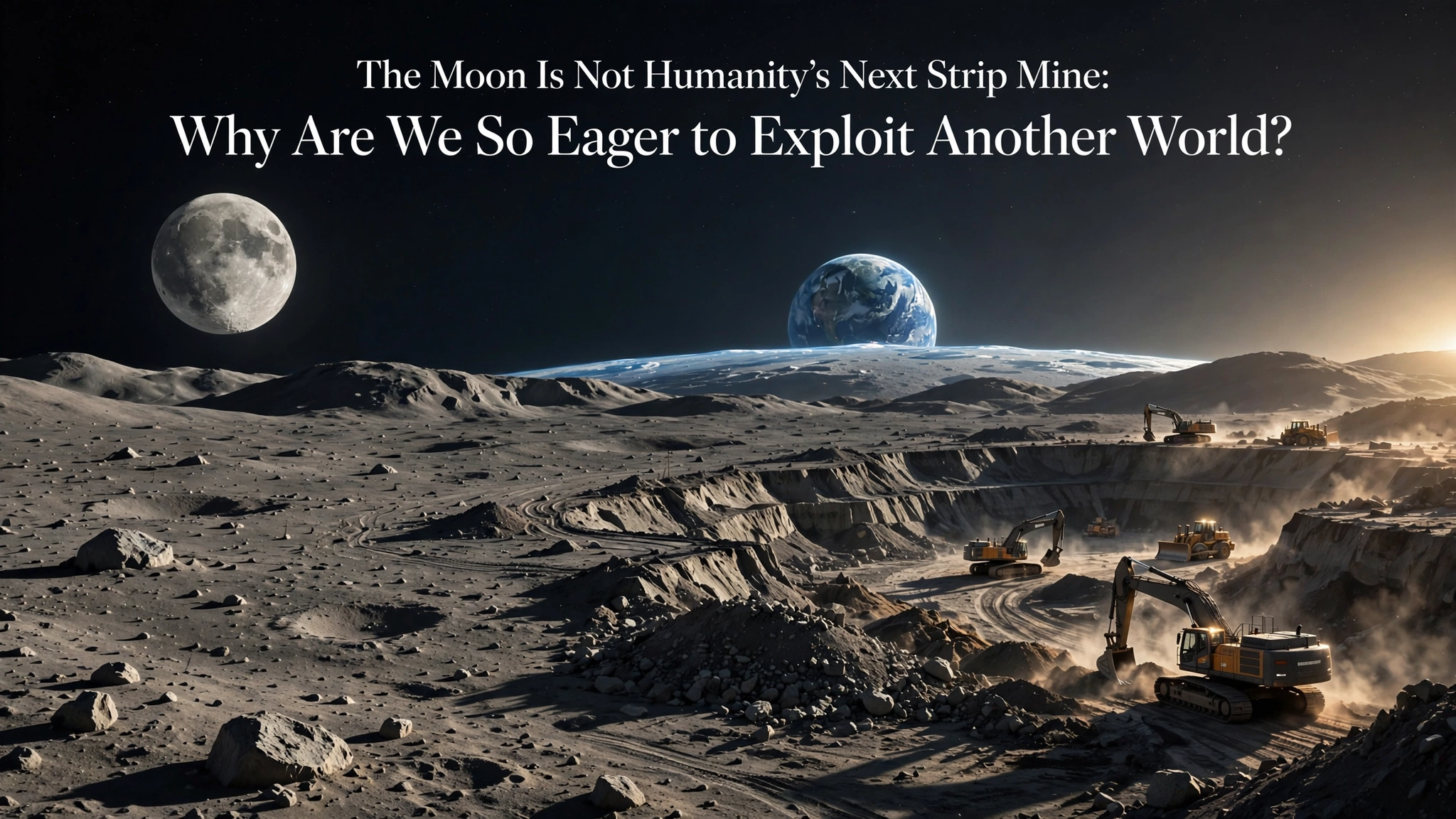
We haven't even figured out how to take care of Earth, and now we're talking about turning the Moon into a mining operation. At what point does humanity stop looking at everything in the universe and asking, "What can we take from it?"
Let's talk about Elon Musk, the push toward lunar development, and the growing interest in mining helium-3 from the Moon.
Before anybody gets upset, let's acknowledge the obvious: helium-3 is an interesting resource. Scientists have studied its potential as a fuel for nuclear fusion, and NASA has explored technologies that could eventually extract resources from lunar soil. The possibility of finding new ways to generate energy is worth investigating. NASA has even funded research into lunar resource-seeking technology.
But here's my question: just because something might be useful doesn't mean we should immediately start mining it.
Why is humanity so quick to turn every discovery into a business opportunity?
We find oil, and we drill. We find minerals, and we dig. We discover land with valuable resources, and suddenly everybody wants to claim a piece of it. Now we're looking toward the Moon, another world that has existed for billions of years, and we're already discussing how to extract its resources.
At what point do we stop treating the universe like an endless warehouse waiting for somebody to empty the shelves?
THE PROMISE OF HELIUM-3 DOESN'T MEAN THE PROBLEM IS SOLVED.
One argument for lunar mining is that helium-3 could someday help power fusion reactors. You will sometimes hear enormous claims about how much energy lunar helium-3 could provide, including claims that a relatively small quantity could meet America's energy needs for a year.
But there is a major detail people tend to skip: helium-3 fusion is not an established commercial power source. Mining the material, separating it from lunar soil, transporting it back to Earth, and using it economically would require major technological advances and enormous infrastructure.
In other words, we are discussing an ambitious possibility, not a proven energy solution. NASA's own technical proceedings have discussed the technological challenges and the more near-term prospects of other fusion approaches.
So why are we so eager to talk about extracting resources from another world before the technology needed to make the entire process practical has even been established?
Shouldn't we be asking harder questions before we start building the machinery?
AND WHAT HAPPENS TO THE MOON WHEN INDUSTRY ARRIVES?
People hear the word "Moon" and picture a giant gray rock floating in space. But the Moon is not an empty construction site simply because human beings cannot currently live there without specialized equipment.
It has a landscape, geological history, scientifically valuable locations, and a record of the solar system's past. Its surface preserves evidence that can help researchers understand how planets and other celestial bodies evolved.
Large-scale industrial activity could disturb lunar soil, alter landscapes, generate dust, and damage scientifically important locations. The extent of those effects would depend on the methods used and where the operations took place. We should not pretend every consequence is already known, but uncertainty is a reason to investigate carefully—not a reason to ignore the risks.
Imagine if we treated every untouched place on Earth the same way. Imagine finding a remote ecosystem and immediately asking how much money could be made from extracting everything valuable inside it.
Some places deserve protection precisely because they have not yet been transformed by us.
Why should the Moon automatically be excluded from that conversation?
WE KEEP CALLING IT PROGRESS, BUT WHO GETS TO DEFINE PROGRESS?
For a billionaire or a company investing in space technology, lunar resources may represent a future market. For scientists, the Moon may represent an opportunity to understand the universe. For humanity as a whole, it could represent a shared destination that should be explored responsibly.
Those interests do not always point in the same direction.
There is a difference between going to the Moon to conduct research and establishing an industrial operation designed to extract resources on a commercial scale.
There is a difference between learning how another world works and permanently altering the places we want to study.
And there is a difference between developing technology that could benefit humanity and assuming that every profitable opportunity automatically benefits everybody.
Who decides which areas can be mined? Who determines which locations should remain untouched? Who is responsible if industrial activity damages a site that future generations of scientists would have wanted to study?
Those questions deserve answers before large-scale extraction becomes normal.
THE MOON SHOULD NOT BECOME ANOTHER RACE TO SEE WHO GETS THERE FIRST.
The 1967 Outer Space Treaty establishes that the Moon and other celestial bodies are not subject to national appropriation by claims of sovereignty. It also calls for exploration and use to benefit all countries and requires consideration of the interests of other nations. However, the legal treatment of extracting and owning resources after removal remains a subject of interpretation and policy debate. Read the United Nations Office for Outer Space Affairs' summary of the treaty.
That means this conversation is bigger than one entrepreneur, one company, or one country.
If lunar mining becomes commercially viable, how do we prevent the benefits from being concentrated among a handful of powerful companies while the rest of the world has little say in how the Moon is transformed?
How do we establish meaningful environmental safeguards when the activity takes place hundreds of thousands of miles away?
How do we balance commercial freedom with humanity's shared scientific and cultural interest in the Moon?
These are not arguments against science. They are arguments for taking science, responsibility, and long-term consequences seriously.
AND BEFORE SOMEBODY SAYS WE NEED TO MINE THE MOON TO SAVE EARTH, LET'S FINISH THE CONVERSATION HERE ON EARTH FIRST.
We have energy technologies to develop, infrastructure to improve, pollution to address, and communities that need reliable access to affordable power. We should continue investing in better energy systems, including fusion research, without treating a hypothetical lunar fuel supply as though it will automatically solve our problems.
If helium-3 eventually becomes a practical fuel, that could be a significant scientific achievement. But its potential does not erase the need to evaluate the environmental costs, economic realities, and alternatives.
We should also ask whether extracting helium-3 from lunar soil would actually be the most practical way to generate energy compared with other technologies available now or in the future.
Exploration should expand our knowledge. Innovation should solve problems. Economic development should be judged by more than the amount of money it can generate.
And progress should include the wisdom to recognize when an opportunity needs limits.
MY POSITION IS SIMPLE: EXPLORE THE MOON, STUDY THE MOON, AND LEARN EVERYTHING WE CAN ABOUT THE MOON. BUT DON'T ASSUME WE HAVE TO INDUSTRIALIZE ITS SURFACE JUST BECAUSE THERE MIGHT BE MONEY IN IT.
We do not have to turn every discovery into a mining operation. We do not have to treat every untouched landscape as an untapped market. And we should not wait until damage has occurred before deciding that protecting something might have been worthwhile.
Humanity has spent centuries debating how to use Earth's resources responsibly. We are still dealing with the consequences of decisions made without enough consideration for the future.
Why would we rush to repeat that pattern somewhere else?
The Moon does not need to become a monument to our ability to extract resources. It can remain a place of discovery, scientific inquiry, and wonder while we carefully debate what forms of development, if any, are justified.
So here's the question I want people to think about: Does the possibility of powering a nation justify permanently disrupting another world's surface, or should some places remain protected even when they contain something valuable?
We have the technology to reach farther than any generation before us. Now we need the wisdom to decide what we should do when we get there.
Because being capable of taking something does not automatically make taking it the right decision.










Comments
No comments yet, be the first submit yours below.