Why Does Everything Become a Business Opportunity When Ordinary People Are Desperate?

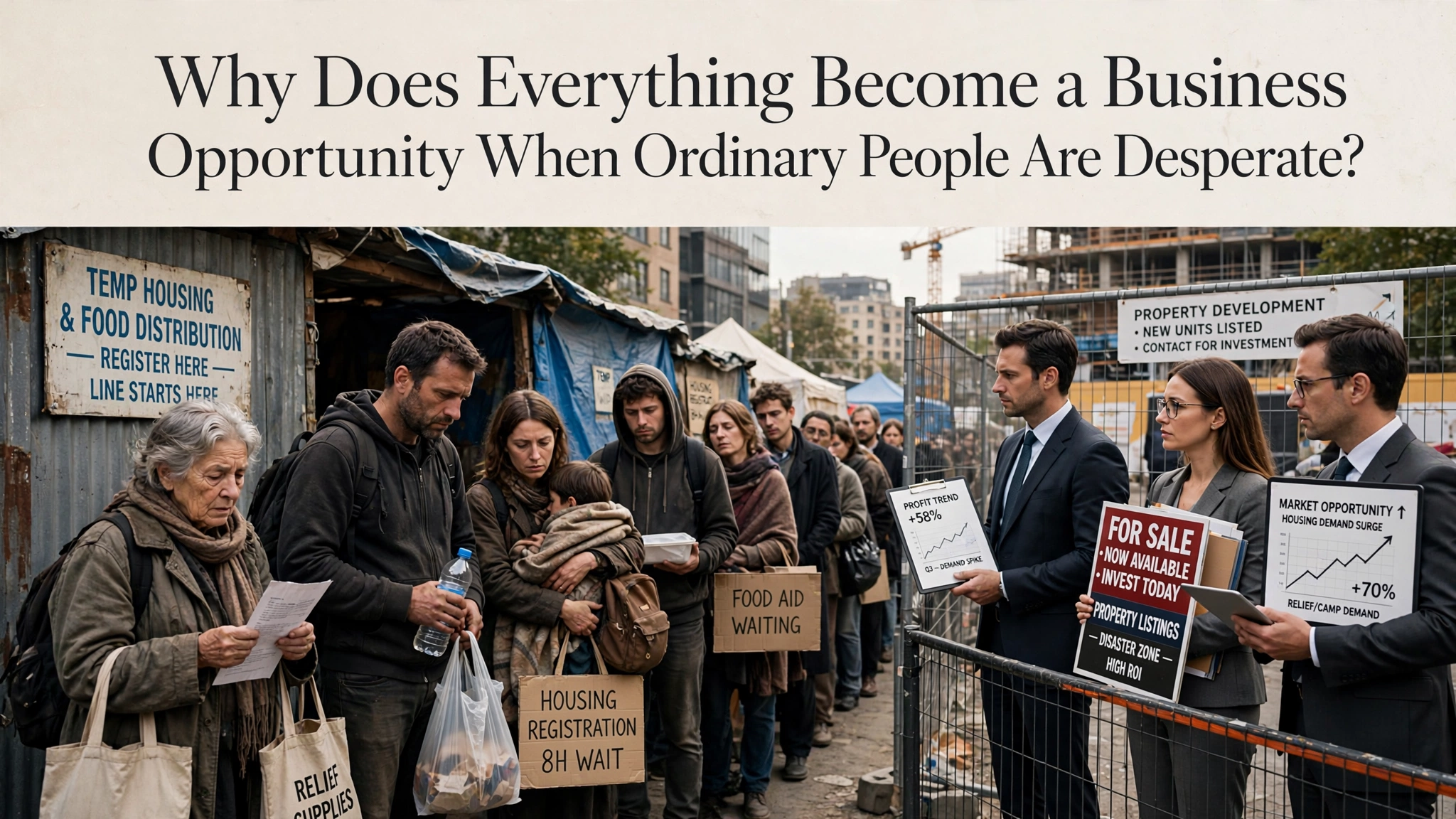
When people lose their homes, somebody sells them temporary housing. When people get sick, somebody sells them treatment. When people fall behind on bills, somebody sells them a loan. Apparently, there's no crisis so devastating that somebody can't look at it and ask, "How much money can we make from this?"
Let's talk about something that should bother more people: the way human suffering can become a profitable business model.
We live in a society where almost every problem has a price tag attached to the solution. Lose your job? Pay for training to become employable again. Fall behind on your bills? Borrow money and pay interest to catch up. Can't afford groceries? Search for assistance while somebody else profits from selling the food you need to survive.
And when disaster strikes, the business opportunities multiply.
Natural disasters create demand for contractors, building materials, temporary housing, insurance services, and emergency supplies. Some businesses step up and provide genuinely necessary services. Others may take advantage of shortages, confusion, or people's desperation.
The problem isn't that businesses earn money by helping people. The problem is what happens when making money becomes more important than helping the people who have nowhere else to turn.
WHY DOES SOMEBODY ELSE'S EMERGENCY HAVE TO BECOME YOUR FINANCIAL NIGHTMARE?
Imagine losing your home to a storm. You're already dealing with damaged property, missing belongings, paperwork, and the emotional stress of trying to figure out what happens next.
Now imagine discovering that temporary accommodation is suddenly much more expensive, repair estimates have skyrocketed, and basic supplies are difficult to find.
You didn't choose the disaster. You didn't create the shortage. But you're the person who has to pay the price of surviving it.
That's what makes emergency price gouging so troubling. When people have no realistic alternative, the normal relationship between a buyer and a seller changes. The buyer isn't necessarily choosing the best deal. They're trying to secure something they desperately need.
Food, water, fuel, shelter, and medicine aren't ordinary purchases when someone's safety is on the line.
They are necessities.
AND THIS DOESN'T STOP WITH NATURAL DISASTERS.
Look at the financial pressure people experience when they're trying to escape poverty.
Someone without enough money for an emergency may turn to a high-interest loan. Someone with poor credit may face more expensive borrowing options. Someone who needs a vehicle to get to work may have to finance a car even when the terms aren't favorable.
Sometimes these products provide access to money or transportation that people genuinely need. But the underlying problem is that financial vulnerability can make the available options more expensive.
The person with savings can wait for a better deal. The person whose electricity is about to be shut off may not have that luxury.
One person has time to negotiate. The other has a deadline.
And deadlines can be expensive.
THERE IS A DIFFERENCE BETWEEN PROFITING FROM A SOLUTION AND PROFITING FROM SOMEBODY HAVING NO CHOICE.
Businesses need revenue to pay workers, maintain operations, purchase supplies, and invest in better services. A company that helps rebuild homes after a storm should be compensated for its labor. A grocery store supplying food to a disaster area has legitimate costs.
Profit alone is not proof of exploitation.
But when companies deliberately exploit shortages, manipulate vulnerable customers, or use an emergency to justify unjustified price increases, we have a different problem.
The question becomes whether the price reflects real costs and risks or whether the seller is simply charging whatever desperate people can be forced to pay.
That distinction matters because markets don't operate in a vacuum. Competition, consumer protections, supply constraints, and the availability of alternatives all affect what happens when people need something urgently.
When customers have no practical alternative, the idea that they can simply take their business elsewhere becomes almost meaningless.
HERE'S ANOTHER UNCOMFORTABLE QUESTION: WHY DO WE WAIT UNTIL PEOPLE ARE SUFFERING BEFORE WE START TALKING ABOUT PREPARATION?
We know that emergencies happen. Storms damage homes. Fires destroy neighborhoods. Companies lay off workers. Medical expenses arrive unexpectedly. Supply chains experience disruptions.
Yet many households have little financial cushion because the cost of everyday life leaves limited room to prepare.
We tell individuals to build emergency funds, and that's sensible advice. But preparation also requires looking at the larger systems people depend on.
Do communities have reliable emergency shelters? Are essential supplies available during a crisis? Can people access temporary housing without being financially devastated? Are insurance claims handled fairly and promptly? Do workers have a realistic path to recovering after a sudden loss of income?
These questions deserve attention before the emergency arrives, not only after cameras show people standing in line for assistance.
BECAUSE A CRISIS CAN CREATE TWO COMPLETELY DIFFERENT REALITIES.
For one person, a disaster means lost income, damaged property, and months of uncertainty. For another, it may create new contracts, increased demand, or an opportunity to acquire assets at a discount.
Those outcomes aren't automatically evidence of wrongdoing. Contractors, suppliers, and investors may take genuine risks and provide valuable services.
But the difference in outcomes should make us examine who has the resources to benefit from a crisis and who is left struggling to recover from it.
People with cash reserves can often act when prices are favorable. People who have lost their income may be forced to sell belongings, take on debt, or accept unfavorable terms simply to get through the month.
The same crisis can create an opportunity for one household and a setback that lasts years for another.
That's why financial resilience matters, but so do fair rules, transparent pricing, and protections against exploitation.
WE SHOULD NOT HAVE TO CHOOSE BETWEEN A FUNCTIONING ECONOMY AND BASIC HUMAN DECENCY.
Businesses can earn reasonable profits while following clear rules against fraud and abusive practices. Governments can support emergency response while maintaining accountability for public spending. Communities can encourage preparation without shaming families who don't have enough money to stockpile supplies or save months of expenses.
And consumers can support businesses that act responsibly rather than automatically rewarding whoever charges the highest price during a shortage.
None of these measures will eliminate every hardship. But acknowledging that emergencies create opportunities for exploitation is a necessary first step toward reducing the damage.
The goal shouldn't be to punish every business that earns money during a crisis. The goal should be to ensure that people facing an emergency aren't treated as easy targets simply because they need help immediately.
SO HERE'S THE QUESTION: WHEN SOMEBODY IS AT THEIR MOST VULNERABLE, SHOULD THAT BE THE MOMENT A BUSINESS CAN MAKE THE MOST MONEY FROM THEM?
Or should there be limits on how far people can go when they know their customers have nowhere else to turn?
We can debate markets, regulation, personal responsibility, and economic freedom all day. But one principle should be difficult to argue against: people shouldn't have to surrender their financial future just to survive an emergency.
A business can be profitable without treating desperation as its greatest competitive advantage.
And a society that values human life should care about more than how quickly the market responds when people are in trouble.
Because the real measure of an economy isn't only how much money it can generate when times are good.
It's also what happens to ordinary people when everything goes wrong.




Comments
No comments yet, be the first submit yours below.