Everybody Wants Lower Property Taxes—But Who Is Fighting for the People Who Can't Afford the Property?

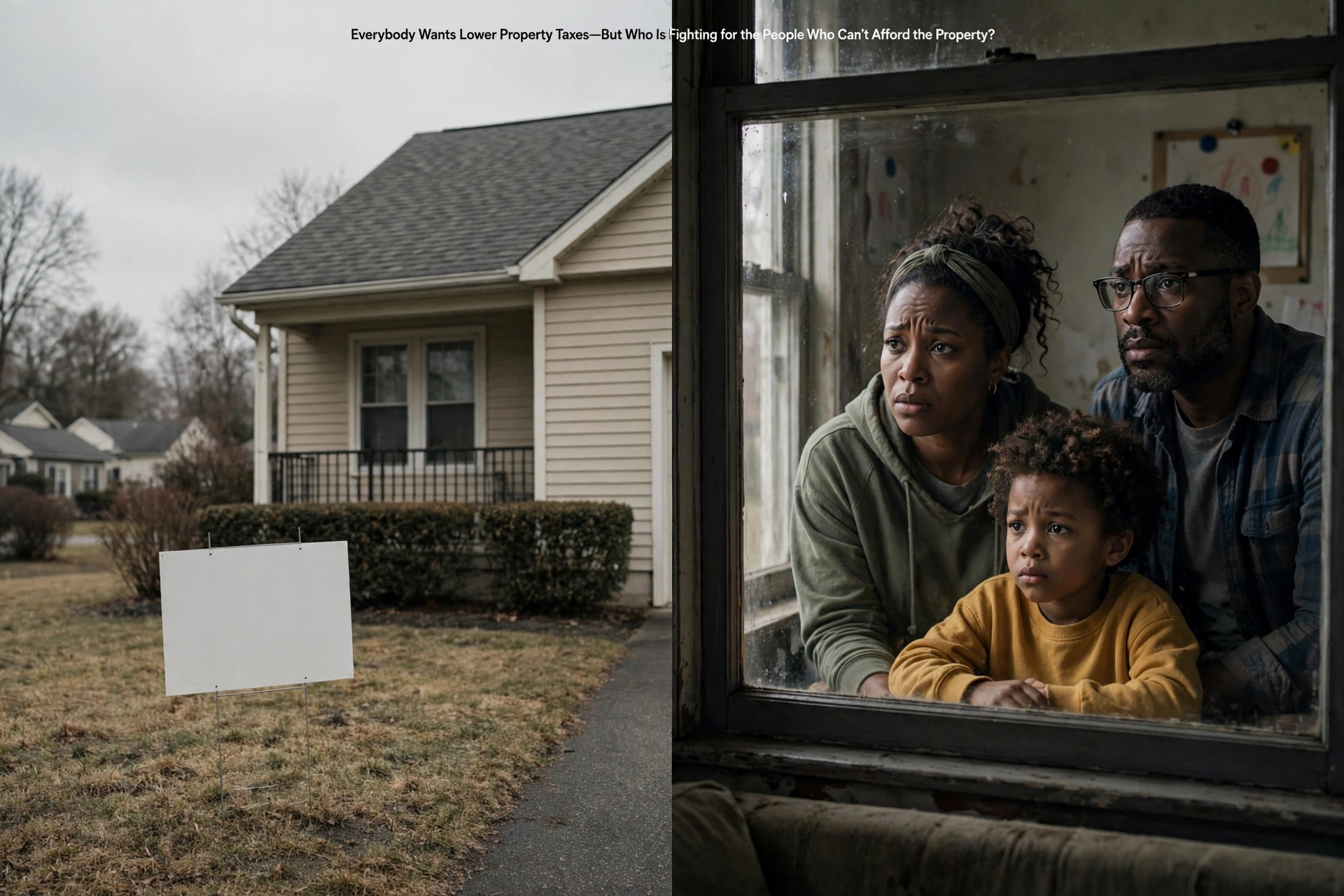
There's something strange about the housing conversation: millions of people are arguing about the cost of owning a house while an entire generation is still struggling to get through the front door.
Property taxes matter.
For homeowners, they're a real expense. When taxes rise, the monthly cost of keeping a home rises. For people living on fixed or limited incomes, that can create serious financial pressure.
So when homeowners organize around reducing property taxes, the concern isn't imaginary.
But there's another housing conversation happening at the same time.
Millions of younger adults aren't primarily asking how to reduce the taxes on the house they already own.
They're asking how they're supposed to afford the house in the first place.
That's the housing divide nobody should ignore: one group is fighting over the cost of owning property while another group is still trying to become an owner.
Recent data makes the problem difficult to dismiss.
Pew Research Center found that from 2019 to 2024, inflation-adjusted median home values increased 30%, from $269,600 to $350,000, while inflation-adjusted median household income for households headed by adults under 40 increased 9%.
Over that same period, the share of renter households under 40 with enough income to afford the calculated monthly cost of homeownership fell from 56% to 37%.
And in 2026, 87% of U.S. adults surveyed by Pew said buying a home is harder for young adults today than it was for their parents' generation.
The problem isn't simply that houses are expensive. It's that the relationship between housing prices and incomes has changed.
And that's where the generational argument gets uncomfortable.
If you already own a house, rising property taxes are visible.
You receive the bill.
You see the number increase.
You feel the expense.
But if you don't own property, the problem can be almost invisible to the political conversation.
Your problem is the down payment.
Your problem is the mortgage qualification.
Your problem is the interest rate.
Your problem is the insurance.
Your problem is the price of the house itself.
Your problem may be rent consuming money that could otherwise become savings.
And by the time you finally get enough money together, the market may have moved again.
It's hard to build wealth through homeownership when the entry fee keeps moving farther away from your income.
This is why simply asking whether property taxes should be higher or lower doesn't fully describe the housing problem.
Taxes are one piece.
Insurance is another.
Mortgage rates are another.
Construction costs matter.
Land costs matter.
Zoning matters.
Housing supply matters.
Local wages matter.
Existing homeowners' equity matters.
And the price of the house itself matters.
The Census Bureau reported that median monthly owner costs for homeowners with mortgages reached $2,035 in 2024, up from $1,960 in inflation-adjusted terms in 2023. The agency said the increase was driven primarily by higher mortgage costs and insurance fees.
Even after you manage to buy the house, affordability doesn't stop at the closing table.
That's important because homeownership is often presented as if buying the property is the finish line.
It isn't.
Then come the taxes.
Insurance.
Maintenance.
Repairs.
Utilities.
Interest.
And everything else that comes with owning an actual building.
So homeowners have legitimate financial pressures.
But renters have legitimate pressures too.
The difference is that homeowners at least have an asset attached to the expense.
A renter can spend years paying for housing and still have no ownership stake in the property when the lease ends.
Rent can keep you housed without necessarily moving you closer to ownership.
That's the part of the conversation that deserves more attention.
Because if an entire generation spends its prime earning years renting increasingly expensive housing, the consequences aren't limited to housing.
It affects retirement savings.
Emergency savings.
Investment contributions.
Family formation.
Mobility.
Business formation.
And the ability to accumulate assets.
Homeownership isn't the only path to wealth, and owning a home isn't automatically a financial victory.
But housing is one of the largest assets many American households ever own.
When access to that asset becomes harder, the wealth consequences can extend for decades.
The housing crisis isn't only about where people live. It's about who gets the opportunity to own something that appreciates while they're living there.
And this creates an uncomfortable political and economic tension.
Existing homeowners understandably want to protect the value and affordability of their homes.
Future homeowners need prices and financing conditions that allow them to enter the market.
Those interests can overlap.
But they aren't always identical.
A homeowner may benefit from rising property values.
A person trying to buy that same house experiences the rising price as a larger barrier.
What's an asset to the person who owns it can become a barrier to the person trying to buy it.
That's why the housing conversation needs to move beyond “homeowners versus renters.”
The deeper question is whether the economy is producing enough attainable paths into ownership for people who don't already have property.
Because if ownership keeps becoming something you need family wealth to enter, the system starts becoming increasingly dependent on inheritance.
Parents help with down payments.
Grandparents leave property.
Families transfer wealth.
People without that support start farther behind.
When buying a house requires wealth before it can create wealth, the people who already have assets gain a structural advantage.
And that doesn't mean homeowners are the enemy.
They're not.
Most homeowners are simply people trying to protect the largest investment they've ever made.
The issue is bigger than individual homeowners.
It's about how housing markets, wages, taxes, interest rates, construction, land use and wealth accumulation interact.
The danger is turning a structural problem into a generational blame game.
The real question isn't “Why do homeowners want lower taxes?” It's “Why has becoming a homeowner become so difficult for people who weren't already born into property?”
Those are two different questions.
Both deserve an honest conversation.
Because lowering property taxes might help an existing homeowner stay in their home.
But it doesn't automatically create an affordable home for someone who doesn't own one.
And building more affordable housing doesn't automatically solve the financial burden facing someone who already owns a home and is struggling with taxes, insurance or repairs.
There are multiple housing problems happening simultaneously.
The mistake is pretending there is only one housing crisis.
There is the affordability crisis.
There is the ownership crisis.
There is the rental burden.
There is the property-tax burden.
There is the insurance problem.
There is the shortage of attainable housing in many markets.
And there is the growing wealth gap between people who already own appreciating assets and people who are still trying to acquire their first one.
Recent Urban Institute research also found that renters are increasingly struggling to pay housing and utility costs, with high housing burdens leaving households with less financial cushion when unexpected expenses or income disruptions occur.
If the American dream still includes owning a home, the question isn't only whether people can keep the homes they have. It's whether people who don't have one still have a realistic path toward ownership.
Because eventually, a generation can get tired of being told to save for a down payment while the price of the house keeps moving faster than the savings account.
And that is where the housing debate becomes bigger than property taxes.
It's about access.
It's about assets.
It's about who gets to enter the ownership economy.
And ultimately, it's about whether housing remains something ordinary working people can realistically own—or something increasingly inherited, accumulated and protected by people who got there first.









Comments
No comments yet, be the first submit yours below.