Everybody Wants Freedom of Speech Until You Say Something They Don't Agree With

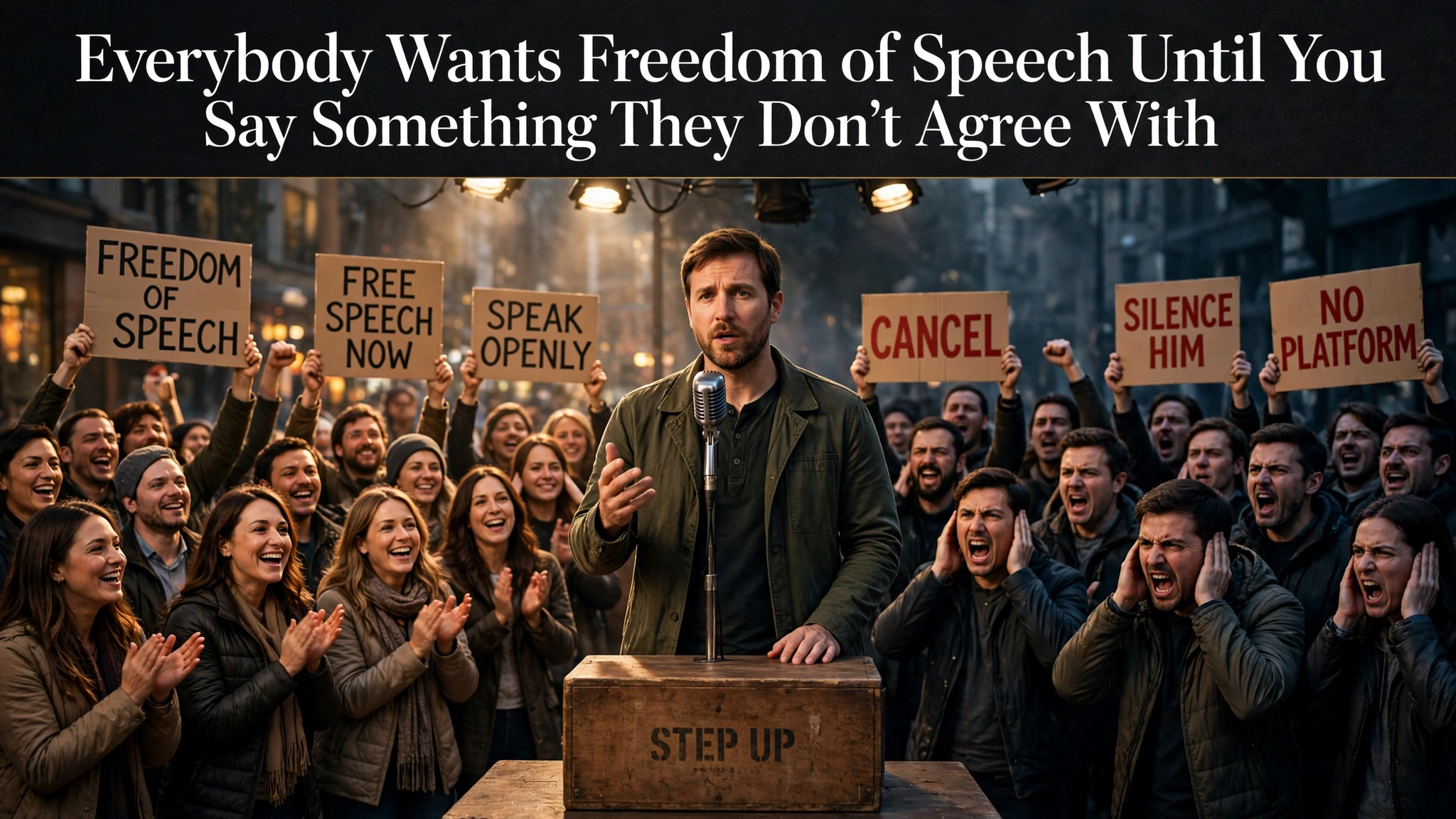
Everybody loves freedom of speech when you're saying what they believe. The moment you challenge their politics, question their religion, criticize their favorite celebrity, or expose a double standard they benefit from, suddenly your opinion becomes dangerous. Apparently, you're free to speak your mind—as long as your mind agrees with theirs.
Let's talk about one of the biggest contradictions in modern society. Everybody claims to support free speech, but a lot of people only support it when the speech makes them comfortable.
You can criticize a politician they hate, and they'll applaud your courage. Criticize their favorite politician, and now you're spreading misinformation. Question a celebrity they admire, and you're a hater. Question a celebrity they dislike, and you're holding people accountable.
Same action. Different reaction. The only thing that changed was whose feelings got involved.
For some people, free speech isn't a principle. It's a privilege they want reserved for people who agree with them.
And social media has made this contradiction impossible to ignore. Platforms encourage people to share opinions, debate ideas, and participate in public conversations. But once those opinions become controversial, the conversation can turn into a campaign to get somebody embarrassed, silenced, reported, or removed.
Now, let's be clear: freedom of speech doesn't mean freedom from criticism. If you express an opinion, other people have every right to challenge it. You don't get to say something offensive and demand that everyone applaud you. People can disagree, unfollow you, boycott your business, or explain why they think you're wrong.
But there's a difference between challenging someone's argument and trying to make sure they can never express it again.
One is a disagreement. The other can become an attempt to control the conversation.
And sometimes people don't even want to prove you wrong. They want to make you afraid to speak. They want the consequences of expressing your opinion to be so exhausting that you decide it's easier to stay quiet.
Think about how that changes public discussion. Instead of asking whether an argument has merit, people start asking whether it's safe to say it. Instead of examining uncomfortable facts, they worry about how the conversation might affect their reputation. Instead of correcting bad information with better information, they try to bury the person who said it.
When people become more concerned with punishing opinions than examining them, everybody loses an opportunity to think critically.
And this doesn't belong to just one political party. Conservatives can demand open debate until someone criticizes their beliefs. Liberals can defend expression until someone challenges their preferred causes. Businesses can celebrate customer feedback until the feedback becomes damaging. Influencers can encourage authenticity until somebody's authentic opinion threatens their image.
Different people. Different subjects. Same human temptation: we want the freedom to speak, but we also want the power to decide which opinions everyone else should hear.
Then there's the uncomfortable question of who gets to control the platforms where these conversations happen.
Social media companies are private businesses, not the government, and their rules and legal obligations are different. Not every moderation decision is censorship in the constitutional sense. Platforms have legitimate reasons to address threats, harassment, spam, and other harmful behavior.
But when a handful of platforms become central places for public discussion, their decisions can have a major impact on who gets heard. Account restrictions, content removals, recommendation systems, and moderation policies can shape what people encounter online.
That makes transparency important. Users should be able to understand the rules, know why significant enforcement actions happen, and have a meaningful way to appeal mistakes.
Because if a platform invites you to build an audience, establish a business, and create years of content there, losing access can mean more than losing a place to post pictures. It can mean losing connections, visibility, and opportunities you've spent years developing.
And yes, platforms need rules. But people are justified in asking whether those rules are applied consistently, whether decisions are explained clearly, and whether legitimate criticism is being confused with actual abuse.
We should also be careful not to confuse unpopular speech with automatically truthful speech. Just because somebody is being criticized doesn't mean they're right. Just because a claim is controversial doesn't make it courageous. Sometimes an unpopular opinion is simply a bad argument that deserves to be challenged.
The answer isn't to believe every contrarian voice. It's to evaluate claims based on evidence instead of deciding whether the speaker belongs to our side.
If your beliefs are strong, they should be able to survive questions.
You shouldn't have to agree with everybody. You shouldn't even have to respect every opinion as equally reasonable. But you should be willing to explain why you disagree instead of automatically assuming that the person expressing a different view must be stupid, evil, or deserving of silence.
And if somebody makes a legitimate point that exposes a flaw in your argument, the mature response is to reconsider your position—not to organize a campaign to destroy their reputation.
Imagine how much better public debate would be if people treated disagreement as an opportunity to test their thinking rather than a personal attack. Imagine if politicians had to answer difficult questions instead of dismissing every criticism as an attack from the opposition. Imagine if public figures could acknowledge mistakes without their supporters treating every admission as surrender.
We don't need a society where everybody agrees. We need a society where disagreement doesn't automatically become a war.
Because the right to express an opinion means very little if people are only willing to defend that right when the opinion benefits them.
You don't prove that you believe in free speech by defending the opinions you already agree with. You prove it when you defend the principle of open discussion for people whose opinions make you uncomfortable, while still challenging them with facts and arguments.
So here's the real question: Do people genuinely believe in freedom of speech, or do they just want the freedom to speak without having to hear anything that challenges their worldview?
And if somebody says something you strongly disagree with, would you rather debate them and prove them wrong—or have them silenced so you never have to hear it again?







Comments
No comments yet, be the first submit yours below.