I Was the Only Assistant Manager Working Overnight at QuikTrip—Doing Everybody's Job While My Manager Climbed the Corporate Ladder 😂

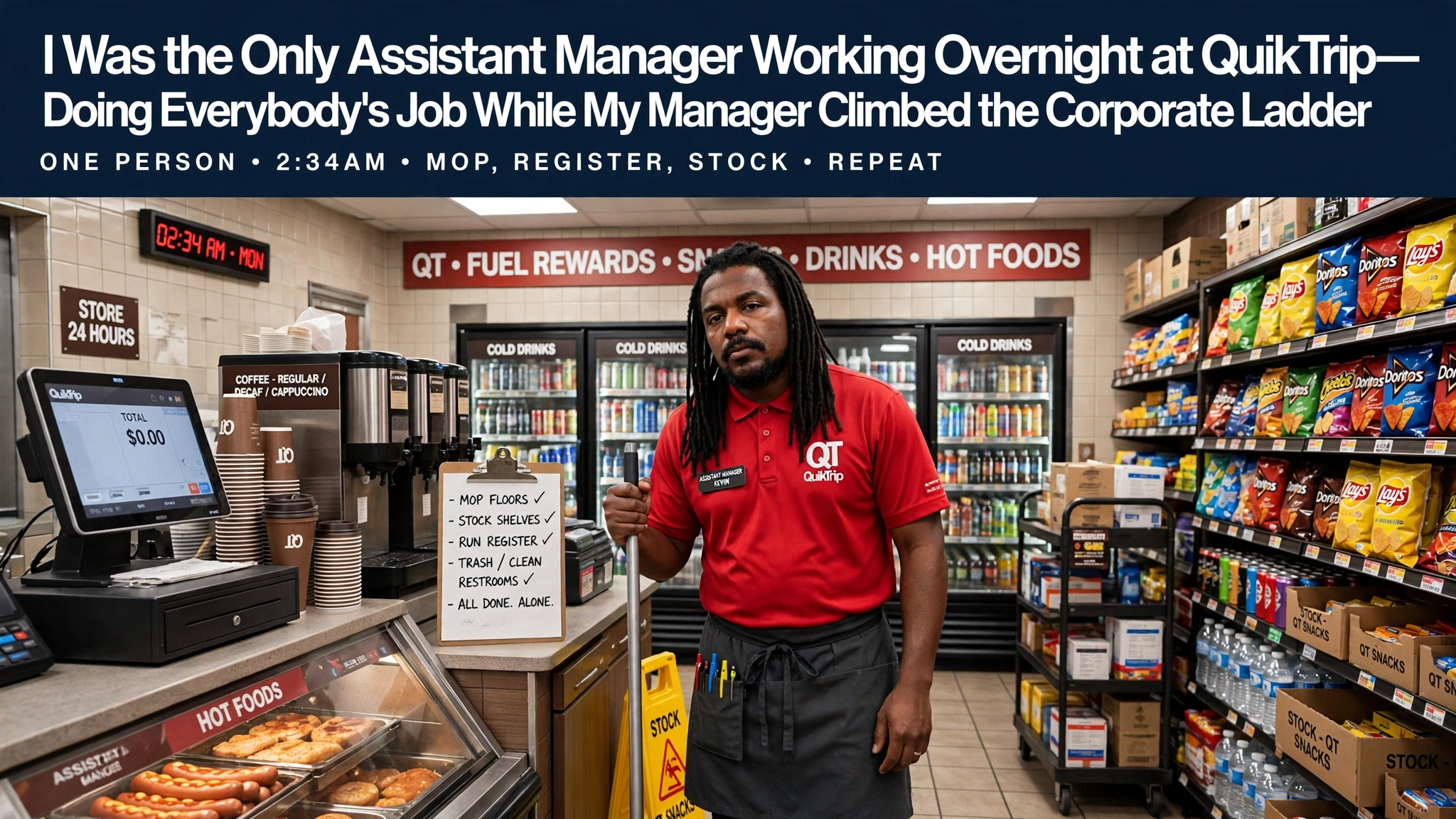
Have you ever worked so hard to help somebody else get promoted that you accidentally became the foundation of their entire career? That's what makes workplace politics so dirty. Sometimes you're doing the work that makes somebody look like a great manager, while that same manager is documenting every little mistake to make sure YOU never get promoted. 😂
I remember working at QuikTrip as an assistant manager on the overnight shift, from 11 p.m. to 7 a.m. And when I say I was working, I mean I was WORKING.
I was the only one in the store handling the overnight operation. I had orders to put up, roller grills to clean, coffee pots to wash, fountain drink dispensers to clean, tea dispensers to maintain, bathrooms to scrub, and the entire store to mop. And while I was trying to get all that done, I still had to run a register and take care of customers.
Think about that for a second. I'm cleaning equipment, restocking products, mopping floors, handling customers, running the register, and trying to make sure the store is ready for the morning crew. All between 11 p.m. and 7 a.m.
I'm not a cleaning robot with an assistant manager badge. I don't have eight arms. I can't be in the bathroom cleaning, at the register checking somebody out, in the back putting up an order, and in the kitchen cleaning roller grills at the exact same time. 😂
But somehow, the expectation was that everything should be done.
And I was doing my best to make it happen.
You would think that when a manager walked into the store every morning and saw somebody who had spent the entire night trying to keep the place running, the conversation might start with, "Good job. I appreciate you handling all that overnight."
Nope.
Here comes the inspection. Here comes the list of complaints. Here comes somebody looking for something to criticize.
"The baseboards aren't clean."
THE BASEBOARDS?! 😂
I've been putting up orders, cleaning coffee equipment, scrubbing bathrooms, mopping the entire store, serving customers, and running a register all night—and you're standing there conducting a forensic investigation into the baseboards?
At that point, I wanted to ask whether the baseboards had filed a formal complaint against me.
Because apparently, after eight hours of keeping the store moving, the one thing that could define my entire performance was a strip of trim along the wall.
Now, let me be clear: cleanliness matters in a convenience store. Customers deserve a clean environment, and standards are important. I'm not arguing that the baseboards should never be cleaned. I'm talking about the bigger picture: when one person is expected to handle an enormous workload, why does the feedback sometimes focus exclusively on whatever wasn't finished instead of acknowledging everything that was?
That's where the frustration comes in.
It felt like no matter how much I accomplished, there was always something else to criticize. And when you believe someone is constantly looking for reasons to write you up, the job stops feeling like an opportunity to grow and starts feeling like a test you can never pass.
What made it worse was that I wanted to move up. I was already an assistant manager. I wanted the opportunity to advance, take on more responsibility, and build a career. But from my perspective, it seemed like every little issue could become another reason to write me up and hold me back from promotion.
Meanwhile, I believed my overnight labor was helping the store succeed—and helping the manager above me look good.
That is the part people don't always talk about when they discuss workplace advancement.
Sometimes the person doing the work and the person receiving the credit are not the same person.
The store has to be ready when the next shift arrives. The shelves need attention. The equipment needs cleaning. The customers need service. The orders need to be handled. When those things get done, the store can look like it's operating smoothly.
But the person who walks in during the morning can be the one who gets to present that smooth operation to higher management. They get to talk about store performance, staffing, procedures, and results. They may get recognized for leading a successful location, even though somebody else spent the night doing the physical work that helped make that success possible.
And in my experience, it felt like I was putting in the labor while the manager was using the results to move up into a regional role.
Let that sink in.
I'm working the overnight shift, handling the register, cleaning the store, putting up orders, and trying to keep everything together. Meanwhile, the person who gets to evaluate my performance is also advancing in their own career.
And I'm left wondering why the person doing all this work keeps getting written up instead of moving forward.
I'm not claiming I can know every decision that went into a promotion or every reason management had for documenting performance issues. But I know how the situation felt from my side: I was going above and beyond, yet I felt like I was being held back while my work helped someone else advance.
That creates a special kind of frustration. It's one thing to work hard and not get promoted. It's another to feel as though your own hard work is helping somebody else climb the ladder while you're being told you're not ready to take the next step.
And this is why workplace accountability needs to go both ways.
If employees are expected to meet standards, managers should also be accountable for how they train, evaluate, schedule, and support those employees. If an overnight shift has one person responsible for numerous tasks, management should consider what can reasonably be completed during that shift. If a task is repeatedly missed, the conversation should include staffing, workload, priorities, and expectations—not just another write-up.
And if somebody is being considered for promotion, the evaluation should reflect their overall performance, not become a collection of every minor imperfection someone can find.
Because nobody is perfect. Not the overnight assistant manager. Not the store manager. Not the regional manager. Nobody.
The difference is that some employees feel like every mistake is being added to their permanent record, while the accomplishments they deliver every single night barely get mentioned.
And let's talk about those write-ups for a second.
Documentation can be legitimate. Businesses need standards, and employees should be held accountable for their work. But when an employee believes write-ups are being used selectively to prevent advancement, trust starts to disappear. Every correction becomes suspicious. Every inspection feels personal. Every conversation about performance starts to feel like another obstacle instead of an opportunity to improve.
Good management should help people understand what needs to improve and give them a fair opportunity to do it. If the employee is doing the work, meeting expectations, and showing leadership, the path toward promotion should be clear enough that they know what they're working toward.
Employees shouldn't have to wonder whether their supervisor wants them to succeed—or whether their success might interfere with the supervisor's own plans.
Because here's the uncomfortable reality: a manager can benefit from having a hardworking employee without necessarily being motivated to help that employee advance. An employee who consistently handles difficult shifts can be incredibly useful in their current position. Promoting that employee means finding someone else who can perform the work just as reliably.
That doesn't prove every manager deliberately holds people back. But it does explain why employees should pay attention to whether their employer is actually developing them or simply benefiting from keeping them where they are.
If you're so valuable in your current position that management doesn't want to lose you, make sure that value doesn't become a permanent reason to deny you an opportunity.
And if you are a manager, ask yourself a question: Are you developing the people who work under you, or are you simply using their effort to make your own performance look better?
Because leadership isn't just about getting a store to run smoothly. It's also about building a team that can grow, recognizing the people who contribute, and making sure credit and accountability aren't distributed according to who has the highest title.
I learned that working hard doesn't guarantee that people will recognize your effort fairly. You can be dependable, productive, and willing to go beyond your basic duties, and still find yourself dealing with workplace politics you never signed up for.
That's why you have to keep track of what you accomplish, understand the promotion criteria, ask for specific feedback, and document your own work. If you believe you're being treated unfairly, keep factual records of assignments, completed duties, performance feedback, and promotion discussions. That gives you something more concrete than frustration when it's time to address the issue.
And remember: being a great employee doesn't mean you have to accept an arrangement that never allows you to grow.
I'm not ashamed of working hard. I'm not ashamed of cleaning the store, serving customers, putting up orders, or doing whatever needed to be done. There's nothing wrong with honest work, and no task is beneath somebody who takes pride in what they do.
But I do believe people deserve a fair chance to advance based on their contributions.
Because if I'm the person helping keep the operation together from 11 p.m. to 7 a.m., don't tell me I'm not capable of more without giving me a fair explanation of what I need to improve.
And please, before you write me up over the baseboards, at least acknowledge the rest of the store I cleaned while running a register and handling customers all night. 😂
My biggest question is this: How many hardworking employees are stuck in the same position because they're too busy making their managers look successful to build their own careers?
Have you ever had a boss who seemed to find every little reason to criticize you while benefiting from all the work you did? Did you feel like your hard work helped you advance—or did it help somebody else get promoted while you stayed exactly where you were?
Let's talk about it.









Comments
No comments yet, be the first submit yours below.