Some People Don't Want an Apology—They Want You to Admit They're Allowed to Treat You Any Kind of Way 😂

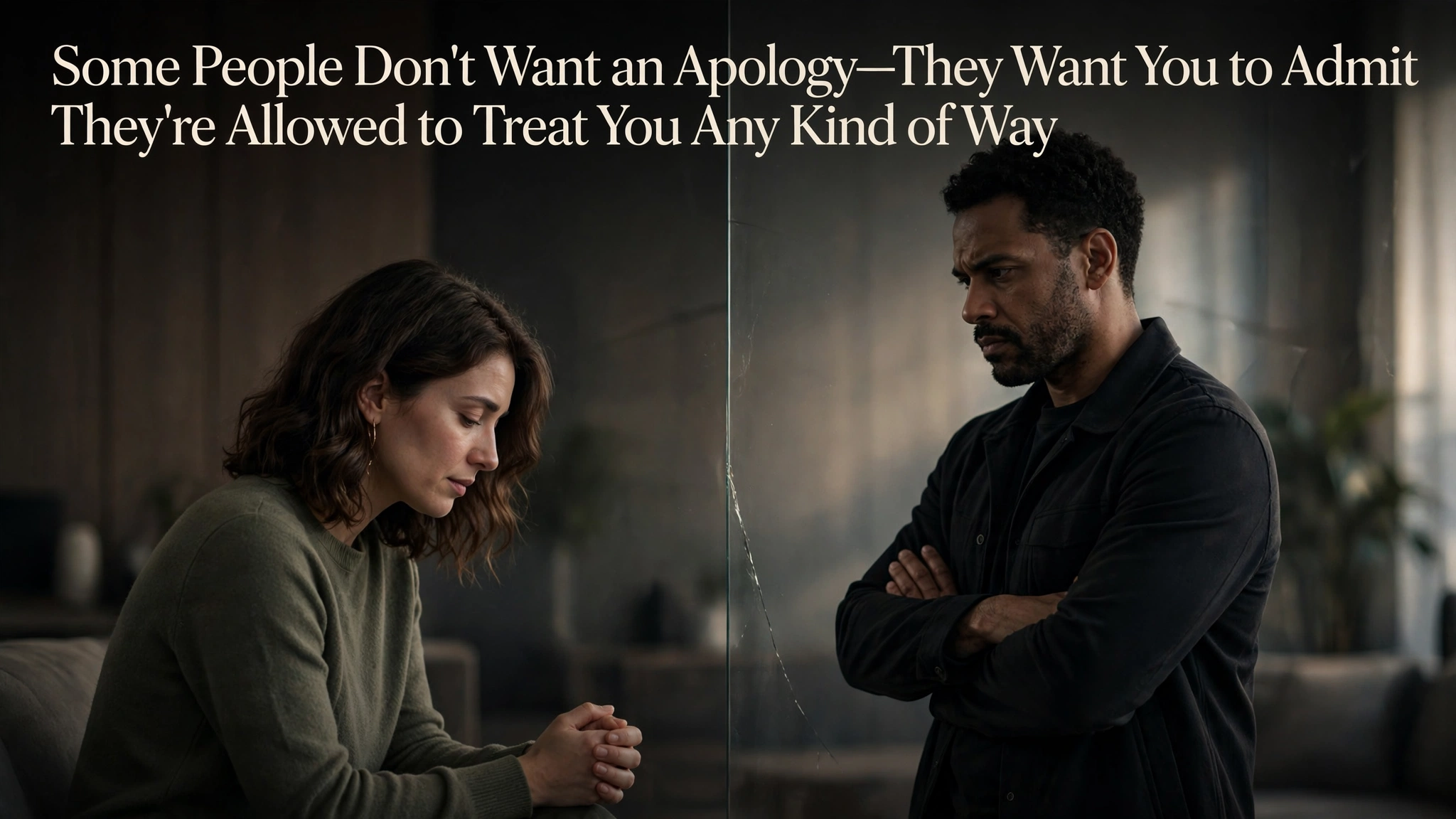
Have you ever noticed that some people demand an apology from you but never seem to owe anybody one themselves? They can disrespect you, cross your boundaries, talk crazy to you, and act like nothing happened. But the moment you respond with the same energy, suddenly YOU'RE the problem. 😂
Let's talk about one of the biggest double standards in human relationships: people who expect accountability from everybody except themselves.
They can say whatever they want because they're "just being honest." They can get an attitude because they've "had a long day." They can ignore your feelings because you're "too sensitive." But let that same energy come back in their direction, and now you're disrespectful, toxic, immature, and apparently the reason the entire relationship is falling apart.
Wait a minute. So your feelings deserve protection, but mine came with a free trial that expired? 😂
Some people don't want equal respect. They want permanent special treatment.
They want you to understand their stress, their past, their struggles, their intentions, and every reason they behaved the way they did. They'll give you a 45-minute explanation of why they hurt your feelings, as if the explanation itself is supposed to erase what happened.
But when you explain why their behavior hurt you? Suddenly, you're making excuses, starting drama, or refusing to let things go.
Funny how understanding only becomes important when they're the ones who need it.
Now, everybody makes mistakes. Everybody gets frustrated. Sometimes we say things we shouldn't say, react badly, or misunderstand another person's intentions. A healthy relationship leaves room for mistakes, honest conversations, forgiveness, and growth.
But there's a difference between making a mistake and repeatedly doing something while expecting the other person to keep accepting it.
An explanation can help you understand someone's behavior without making that behavior acceptable.
You can understand why somebody has trust issues without agreeing to be interrogated every day. You can understand why somebody is stressed without accepting constant disrespect. You can recognize that someone had a difficult childhood without giving them unlimited permission to make everybody else's life difficult.
Compassion is not a contract requiring you to tolerate everything.
And here's where things get uncomfortable: sometimes the person who gets labeled "changed" is simply the person who finally stopped accepting the arrangement.
They used to answer every phone call. They used to lend the money. They used to drop everything to help. They used to forgive every offense and explain themselves until they were emotionally exhausted.
Then one day, they say no.
Suddenly, they've changed. They're acting funny. They think they're better than everybody. They don't care about anyone anymore.
No. Maybe they finally realized that being a good person doesn't mean being available for unlimited mistreatment.
People can become uncomfortable when the version of you they benefited from is no longer available.
But let's be fair: setting boundaries doesn't mean you can never be challenged. Sometimes people tell us uncomfortable truths because we genuinely need to hear them. Sometimes we really are the ones who owe an apology. And sometimes what we call disrespect is simply someone refusing to agree with us.
Accountability has to work in both directions. You cannot demand that everybody respect your boundaries while refusing to respect theirs. You cannot insist that your intentions matter while declaring that everyone else's intentions are irrelevant.
If you want grace, you need to be willing to offer it. If you want honesty, you need to be willing to hear it. And if you expect an apology when somebody hurts you, you should be able to apologize when you hurt somebody else.
That's what mutual respect looks like. Not one person constantly explaining themselves while the other person sits in judgment like they're the Supreme Court of Everybody's Feelings. 😂
And one of the clearest signs of maturity is being able to say, "I was wrong. I understand why that hurt you, and I'll work on it."
No courtroom defense. No list of everything the other person did wrong three years ago. No "I'm sorry you feel that way" disguised as an apology.
Just accountability.
If every disagreement somehow ends with you apologizing, even when you were the one who got hurt, it's worth asking whether the relationship has room for both people's feelings.
You don't have to win every argument. You don't have to prove that the other person is a terrible human being. Sometimes the healthiest thing you can do is acknowledge your part, communicate clearly, and decide what you will no longer accept.
Because peace built on one person swallowing every problem isn't really peace. It's just a conflict that keeps getting postponed until somebody finally gets tired.
And when that person finally walks away, everybody acts surprised. 😂
They'll say, "I never saw it coming!" Meanwhile, the other person has been explaining the same problem since the first season of a television show that has already been canceled.
Stop demanding apologies you aren't willing to give. Stop asking for understanding you refuse to offer. And stop confusing someone's willingness to forgive you with permission to keep hurting them.
Let's debate it: Do some people genuinely struggle with accountability, or do we sometimes use the word "boundaries" to avoid taking responsibility for our own behavior?
And be honest: Have you ever been called the problem simply because you finally stopped tolerating something you had been putting up with for years? 😂








Comments
No comments yet, be the first submit yours below.