Your Smartphone Knows More About You Than Your Own Family—And You Paid for It. 😂

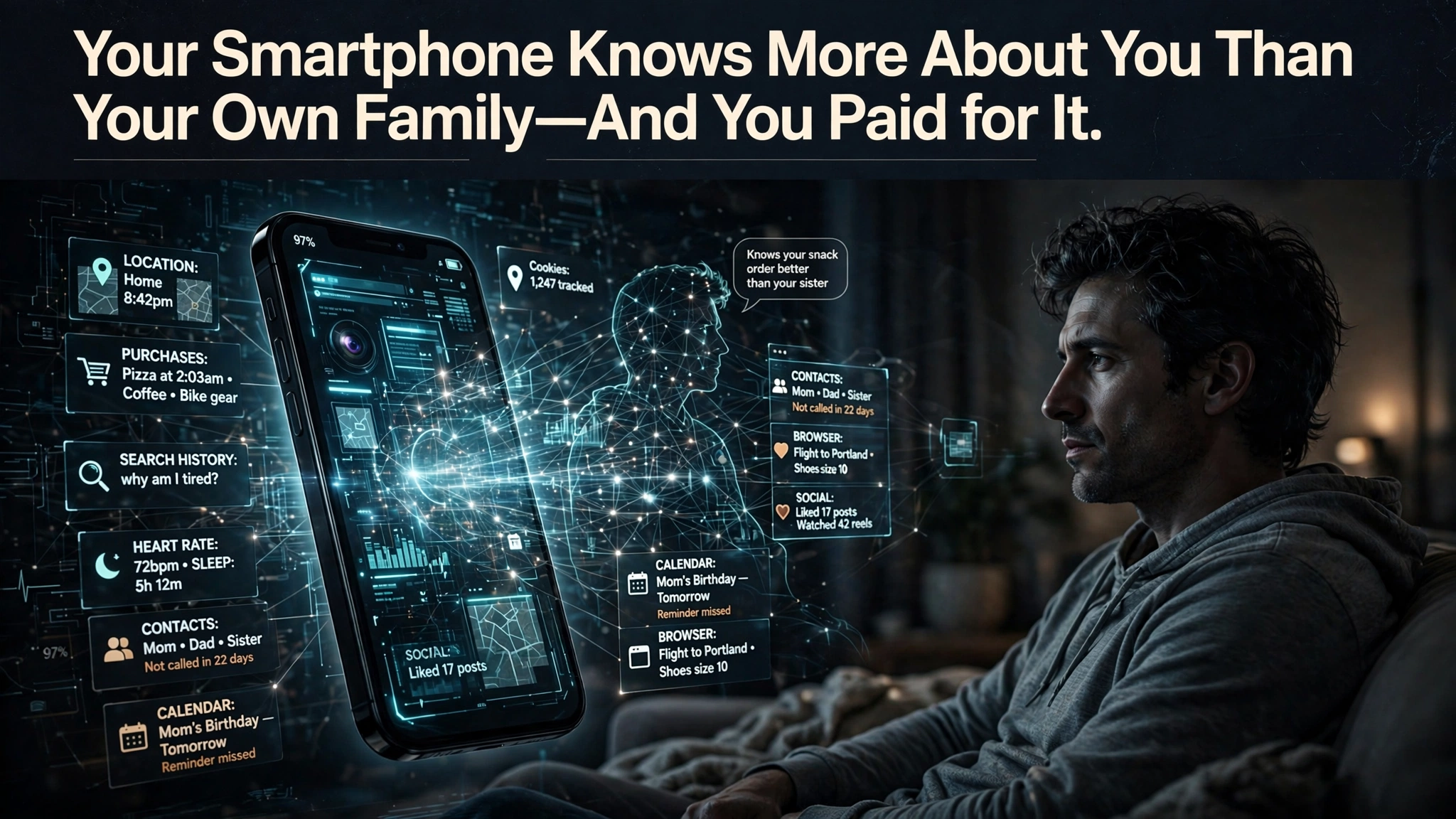
You bought a smartphone to communicate with people. Somewhere along the way, you purchased a tracking device, a shopping profiler, a location history generator, and a microphone-equipped personal assistant. And the funniest part? You agreed to the terms and conditions without reading them.
Let's talk about how comfortable we've become carrying surveillance technology everywhere we go.
Your phone knows where you sleep, where you work, which restaurants you visit, what websites you browse, what products you search for, and sometimes even how long you spend looking at something before scrolling away.
You can have a conversation about buying a new couch, open an app ten minutes later, and suddenly you're seeing furniture advertisements. Maybe it's tracking, maybe it's your browsing behavior, maybe it's a coincidence. Either way, the experience is enough to make people wonder just how much information their devices are collecting.
And we're not just talking about advertising.
Apps request access to your location, contacts, camera, microphone, photos, and files. Some permissions are necessary for the service to function. Others deserve a serious question: why does a flashlight application need access to my contacts?
We have normalized clicking "Allow" just to get past the screen. People will hand over their location to an application they've never heard of because they want to see a funny filter.
Then they get upset when privacy becomes a conversation.
Here's another uncomfortable reality: your personal information has economic value. Companies can use collected data to understand audiences, personalize advertisements, measure behavior, and build detailed profiles. Depending on the company, the data, and applicable laws, information may also be shared with third parties.
And before somebody says, "I have nothing to hide," privacy isn't just about hiding something embarrassing. It's about having control over information about your life.
You might not care if somebody knows where you bought lunch yesterday. But would you be comfortable with every movement, purchase, search, and personal conversation being permanently accessible to companies you never intended to share it with?
We protect our houses with locks. We protect our vehicles with keys. We sometimes cover laptop cameras. Yet we carry devices that collect enormous amounts of personal information and rarely check which applications have permission to access it.
The solution isn't throwing your phone into a lake and returning to carrier pigeons. It's understanding permissions, reviewing privacy settings, limiting unnecessary location access, and being more selective about the services we trust.
Technology should make life easier without requiring us to surrender every detail of our lives in exchange.
Here's the debate: Have smartphones made us more connected, or have we willingly traded personal privacy for convenience without fully understanding the consequences?
Because if somebody knows your location, shopping habits, interests, and daily routine better than your closest friends do, maybe it's time to review who actually has access to your life. 😂









Comments
No comments yet, be the first submit yours below.