Everybody Wants to Go Viral on Social Media—But Nobody Talks About What Happens When a Monetized Website Goes Viral!

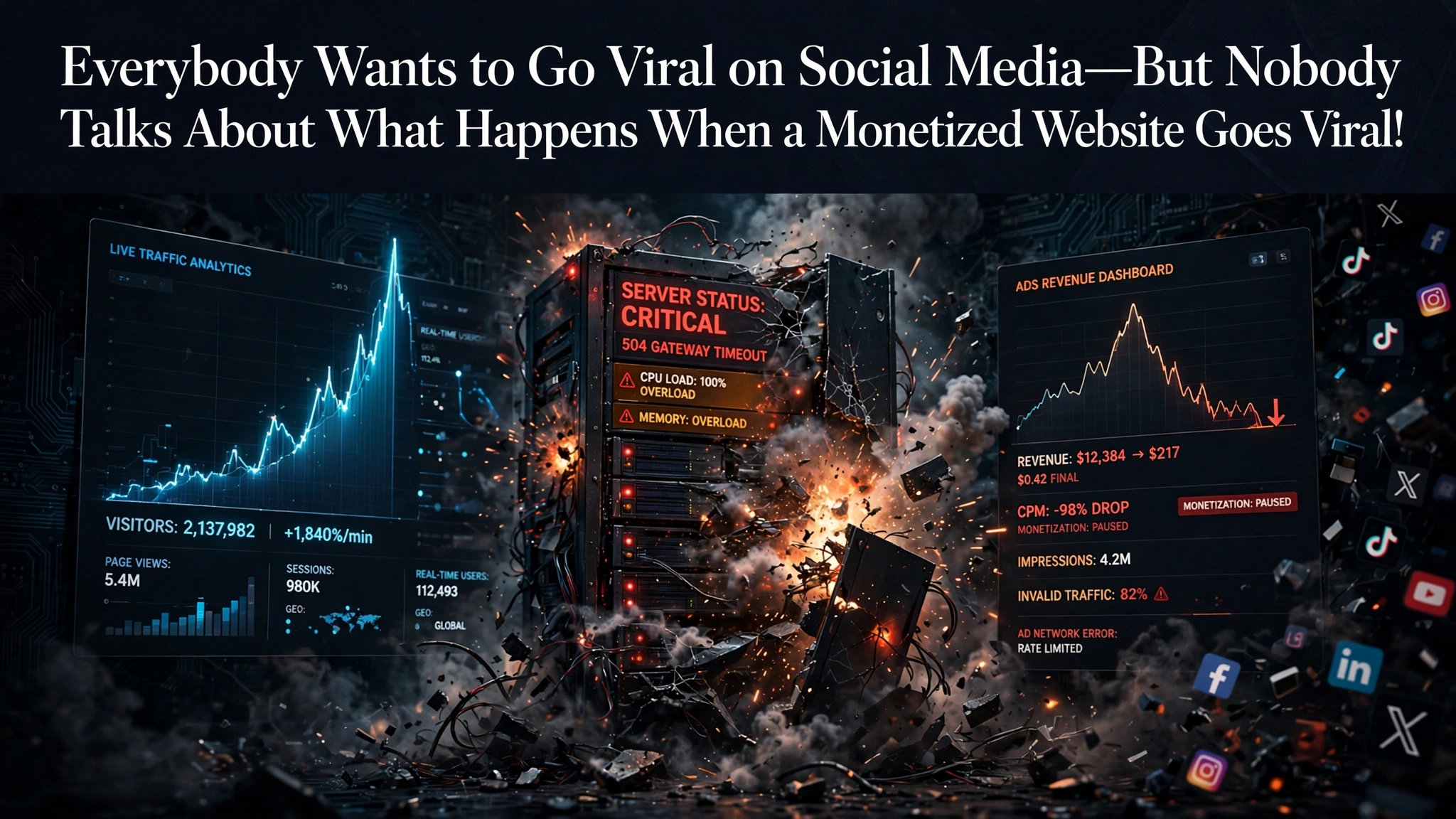
Everybody wants to go viral on Facebook, TikTok, Instagram, and YouTube. Everybody wants millions of views, thousands of comments, and a notification that says their post is blowing up. But let's talk about something different: WHAT HAPPENS WHEN A MONETIZED WEBSITE GOES VIRAL? Because getting a million views on somebody else's platform might get you attention. Getting a million visitors to a website you own could turn that attention into a real business opportunity. And there's a BIG difference between the two!
Social media has convinced everybody that going viral is the ultimate achievement. You post a video, it gets 500,000 views, your phone starts blowing up, and suddenly you're checking your notifications every five minutes like you're waiting for the lottery commission to call.
But here's the question: After all those views, what do you actually own?
Did you build an audience you can reach outside that platform? Did you create a business that can generate revenue? Did you turn those viewers into customers, subscribers, readers, or supporters? Or did you simply give a billion-dollar company another reason to sell advertising while you hope your next post performs just as well?
Now imagine that same attention landing on a website you own.
When a monetized website goes viral, you're not just chasing engagement. You're bringing traffic to digital real estate that you control.
Think about it. You've spent months or years building a website, publishing articles, improving your pages, attracting readers, and figuring out how to monetize your content. Maybe you've got display advertising, affiliate links, memberships, digital products, or other legitimate ways to earn revenue.
Then one day, an article takes off.
Somebody shares it on Facebook. Someone else posts it on LinkedIn. People start sharing screenshots, quoting your headline, and sending the link to their friends. Suddenly, traffic that normally arrives over several days starts showing up in a matter of hours.
Your analytics start looking different. Your server logs are moving. Page views are climbing. People are discovering articles you published months ago because one popular post led them deeper into your website.
And if your site is properly monetized, eligible visits and ad impressions may generate revenue while your content is reaching people. Exactly how much you earn depends on factors like advertising rates, visitor location, viewability, page performance, advertiser demand, and the terms of your monetization program. Viral traffic does not automatically guarantee a payday—but it creates an opportunity.
That's the part I want people to understand. A viral social media post can be exciting, but a viral article on your own monetized website can potentially do more than entertain people for 24 hours. It can introduce readers to your entire library of content, build your direct audience, and create opportunities long after the initial spike ends.
One viral article can become the front door to an entire digital business.
And here's where ownership matters. Social media platforms can change their algorithms, restrict your account, reduce your reach, or change their monetization policies. You can spend years building a following and still have limited control over how that audience sees your next post.
When you own your website, you have more control over the content, the design, the structure, and how visitors experience your business. You can build internal links, recommend related articles, invite people to subscribe to your newsletter, and give readers a reason to return.
Of course, owning a website doesn't mean you control the entire internet. Search engines can change their rankings, hosting providers can experience outages, and advertising networks have their own rules. But you have an asset that isn't entirely dependent on one social media profile staying in good standing.
That's why I think creators need to stop treating their websites like digital business cards and start treating them like businesses.
If you're a musician, your website can feature your music, articles, merchandise, mailing list, and upcoming releases. If you're a writer, it can house your articles, build your readership, and support advertising or subscriptions. If you're a comedian, your site can become a library of your work instead of leaving every joke buried in a social media feed.
Social media can help people discover you. Your website can give them somewhere to go after they discover you.
And let's talk about the economics for a second. Suppose a website receives 100,000 page views in a month. If its effective page RPM were $5, that would equal approximately $500 in advertising revenue. At a $10 page RPM, the same number of page views would equal approximately $1,000.
Those are hypothetical examples, not guaranteed earnings. Actual results can be much lower or higher, and page RPM is not the same thing as a platform paying you for every social media view. The point is that website traffic can be connected to a measurable business model.
Now imagine what happens if that traffic grows, readers return, and the site has additional ways to earn revenue beyond advertising. The opportunity becomes bigger than one viral post.
But there's a catch: traffic can become a problem if your website isn't ready for it. A cheap hosting plan, inefficient database queries, unoptimized images, or poorly designed advertising scripts can turn a big opportunity into an error page. If thousands of visitors arrive at once and your site crashes, all that attention may leave before your pages even load.
That's why website owners need to think about performance, caching, database efficiency, backups, and hosting capacity before they get their big moment. You don't want your first million visitors to be the reason you discover your server can't handle your own success.
There's also the question of what visitors do after they arrive. If they read one article and leave, you've gained exposure. If they explore several pages, subscribe to your newsletter, bookmark the site, or return next week, you've started building a relationship.
The real goal isn't just to get people to your website. It's to give them a reason to come back when the algorithm stops sending them.
And for anybody creating content, this is where the strategy changes. Instead of asking only, "How do I get this post to go viral?" start asking, "If this post goes viral, what have I built to benefit from the attention?"
Do you have related content ready? Is your website fast enough? Is your monetization configured correctly? Are you giving readers a way to stay connected? Does the site have something valuable beyond the one article that brought them there?
Because going viral without a plan can be like throwing a huge party where everybody shows up, eats your food, and leaves without remembering whose house they were in.
Meanwhile, a website owner who understands their audience can turn that same attention into a lasting digital asset.
That's why I respect creators who build on platforms they own. It takes more work. You have to think about hosting, security, maintenance, design, content, and monetization. You're responsible when something breaks. But you're also building something that can continue to exist beyond the lifespan of a single social media trend.
Everybody wants the world to see their content. I'm asking a different question: What happens when the world actually does?
Because going viral is attention. Owning the destination is strategy. And when that destination is a properly monetized website, the attention has a chance to become something more than likes and comments.
Let's debate this: Would you rather get one million views on a social media post you don't control, or one million page views on a website you own and have monetized? And if your website went viral tomorrow, would it be ready to turn that traffic into a real business opportunity?






Comments
No comments yet, be the first submit yours below.