Why Does Everything Require a Subscription Now? Apparently, Even Owning Something Is Becoming a Monthly Expense. 😂

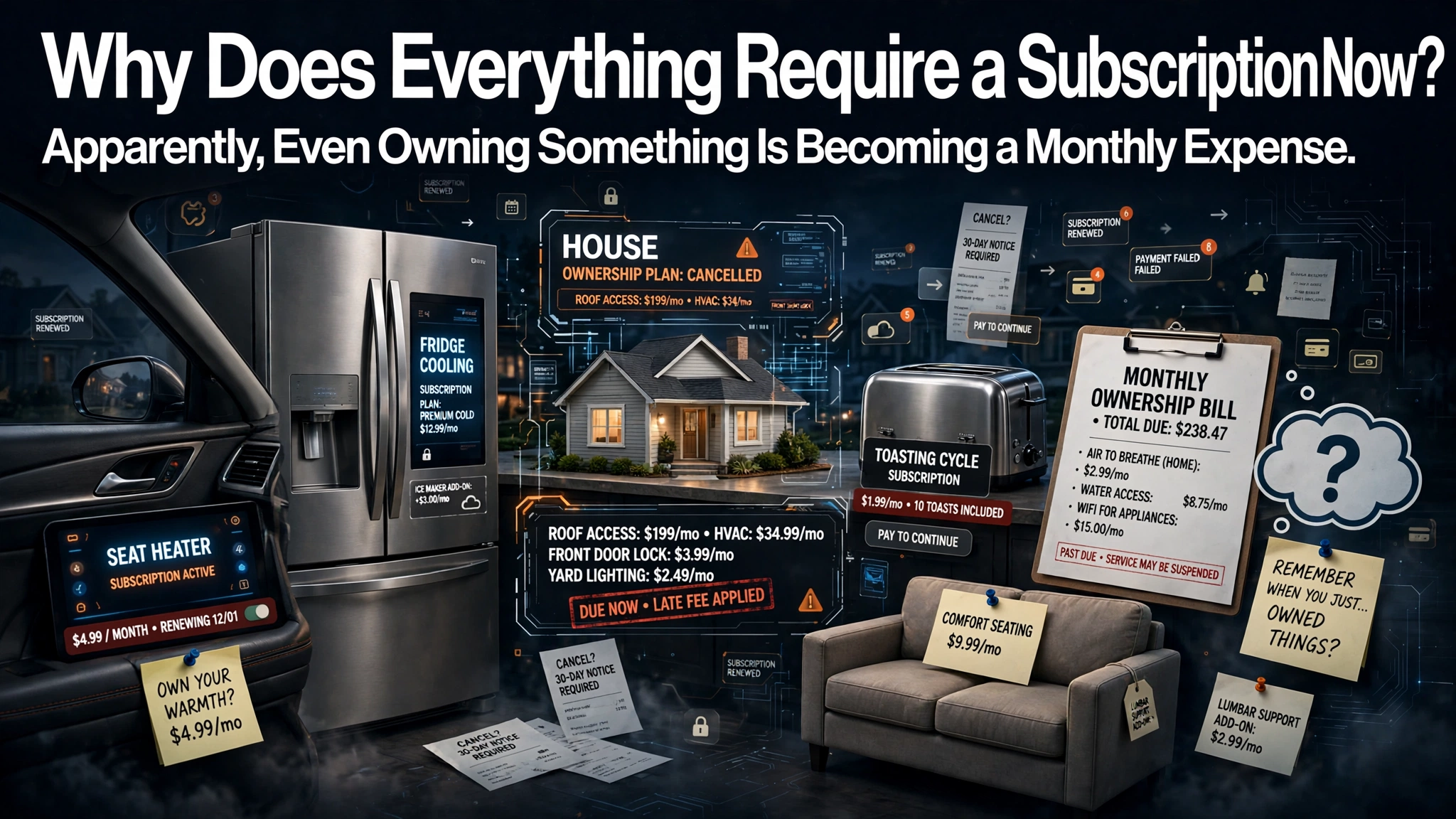
Remember when you bought something and it belonged to you? Those were beautiful times. Now companies want you to pay monthly just to keep using the things you already purchased. Your car has features behind a subscription, your television wants another subscription, your phone is packed with subscriptions, and pretty soon somebody is going to charge you $4.99 a month to unlock the other half of your refrigerator. 😂
We've entered an era where companies don't just want your money at the checkout. They want a permanent relationship with your bank account.
You buy a product, take it home, and discover that some of its features require an additional monthly payment. The purchase price gets you through the front door, but apparently the good stuff is living behind a paywall.
Streaming services started normalizing this behavior. Instead of purchasing movies or music, people began renting access to enormous libraries. Then subscriptions spread into software, gaming, fitness equipment, security systems, household devices, and even automobiles.
It's no longer enough for a company to sell you something. It wants to keep billing you long after the original transaction is over.
YOU'RE NOT BUYING THE PRODUCT. YOU'RE RENTING PERMISSION TO USE IT.
Some subscription services provide legitimate ongoing value. Cloud storage costs money to maintain. Software requires updates and security support. Streaming platforms license content and operate infrastructure. Monthly pricing can make expensive services more accessible.
But there's a difference between paying for an ongoing service and paying repeatedly to unlock functionality already built into something you own.
Imagine buying a vehicle with heated seats installed, only to discover that activating them requires a monthly subscription. The hardware is already sitting inside the car. You paid for the vehicle. The company simply controls whether you're allowed to use a feature that's physically present.
That changes the relationship between consumers and manufacturers. Instead of selling you a finished product, companies can sell you access to a collection of features they continue to control.
THE MONTHLY PAYMENTS LOOK SMALL UNTIL YOU ADD THEM TOGETHER.
Five dollars here. Ten dollars there. Fifteen dollars for another service. Suddenly you're spending hundreds of dollars a year on things that individually seemed affordable.
And the problem isn't always the price. It's the accumulation.
Your entertainment has a subscription. Your music has a subscription. Your storage has a subscription. Your security cameras have a subscription. Your fitness app has a subscription. Your productivity software has a subscription.
At this point, your paycheck doesn't even reach your checking account before several companies have already scheduled a meeting with it.
Companies love recurring revenue because it makes income more predictable. Customers, meanwhile, are left trying to remember which services they signed up for three months ago.
And canceling can sometimes feel like escaping a hostage negotiation. The sign-up process takes seconds, but canceling requires navigating several screens, answering questions, and explaining why you no longer want to donate money to a service you barely remember using.
WHAT HAPPENS WHEN YOU STOP PAYING?
This is where the ownership question becomes important.
If you stop paying for a streaming service, you lose access to its library. That's understandable because you're paying to access licensed content. But what happens when a product you've purchased becomes dependent on a company's servers, account system, or subscription platform?
What happens if the company shuts down? What happens if it changes its pricing? What happens if it discontinues support? What happens if the service stops working even though the physical product is sitting right in front of you?
Consumers are increasingly discovering that buying hardware doesn't necessarily mean controlling the software that makes it useful.
That's a serious issue for products that depend on remote services. A company can change the terms of access, discontinue features, or make decisions that affect how a product works after the customer has already paid.
Ownership should come with reasonable expectations. If a product requires an ongoing subscription, customers deserve to know that before purchasing it—not after they've already invested hundreds or thousands of dollars.
COMPANIES ARE TURNING CUSTOMERS INTO PERMANENT REVENUE STREAMS.
From a business perspective, recurring revenue is attractive. A company that sells a product once gets paid once. A company that attaches a subscription can continue generating revenue from the same customer for years.
That creates an incentive to move more products toward subscription-based models, even when customers might prefer a one-time purchase.
And let's be honest: businesses aren't doing this because they suddenly became passionate about making your household budget easier to manage. They're doing it because predictable monthly revenue is valuable.
The danger is that convenience can slowly become dependency. Instead of owning a product that works independently, you become dependent on the company maintaining your access.
THE CONSUMER NEEDS TO START ASKING DIFFERENT QUESTIONS.
Before buying a product, ask whether its core features work without a subscription. Find out what happens if the company discontinues its service. Check whether you can use the product offline, export your data, or access its basic functionality without maintaining an account.
Companies should also make subscription terms clear, provide straightforward cancellation options, and avoid advertising products in ways that hide essential recurring costs.
Not every subscription is a scam. Some are worth every penny. But consumers should be able to decide whether they're purchasing a product, renting access to a service, or entering a long-term financial relationship.
Because those are three very different transactions.
THE BOTTOM LINE:
We're becoming accustomed to paying monthly for things previous generations could purchase once and use for years. Some of that change comes from technology and legitimate operating costs. Some of it comes from businesses discovering that recurring payments are more profitable than one-time sales.
The question is how much control consumers are willing to surrender in exchange for convenience.
Because if everything requires a subscription, eventually you won't own much of anything. You'll just have a collection of monthly payments and a password manager working overtime.
And if somebody ever introduces a subscription that lets me use my own front door, I'm moving into the woods. 😂







Comments
No comments yet, be the first submit yours below.