What If Demons Really Exist—and They're Already Ahead of Major Corporations? 👁️

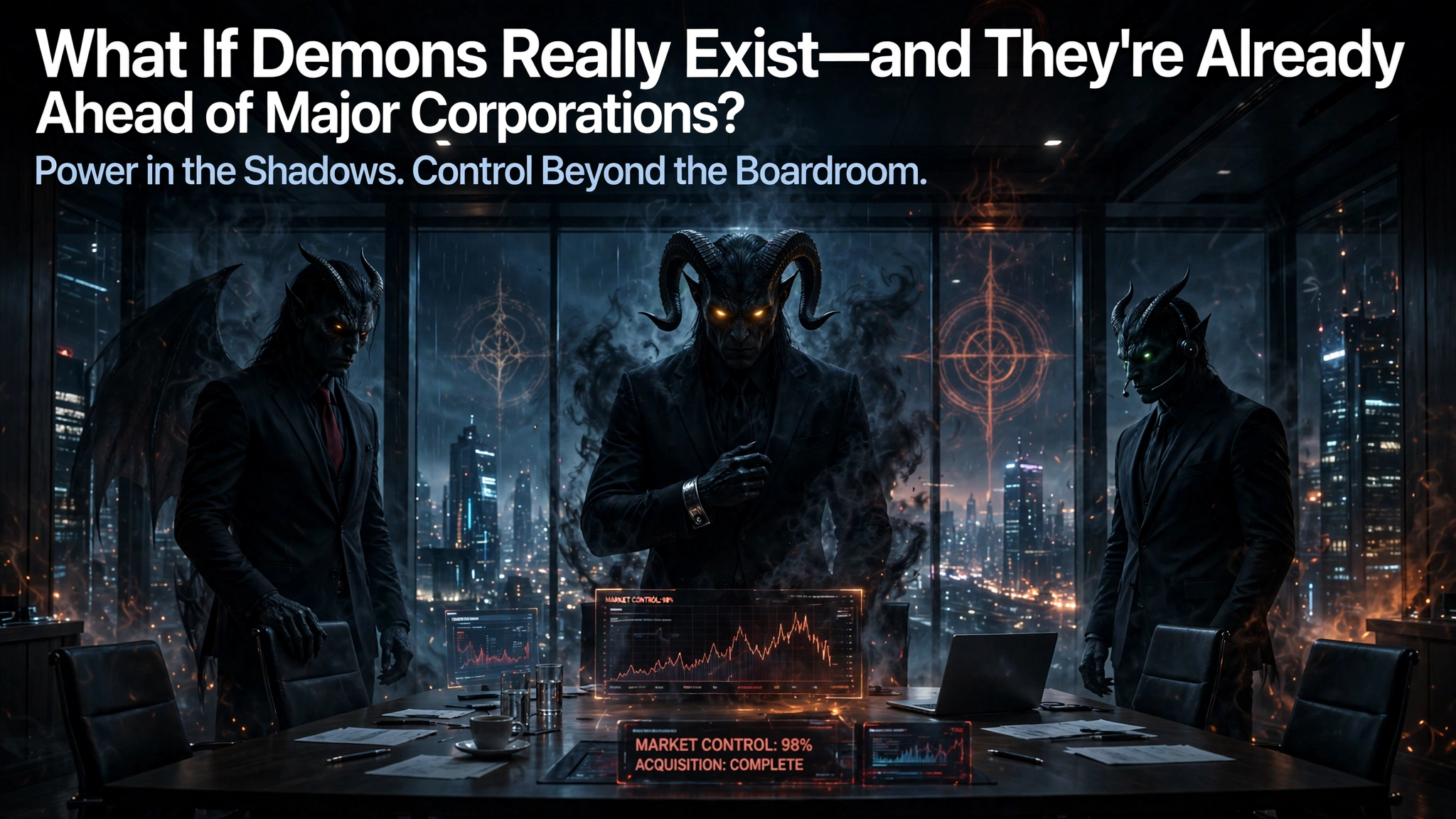
What if the most advanced intelligence in the room isn't sitting in a Silicon Valley laboratory, running artificial intelligence experiments, or developing the next generation of technology? What if something far older has already mastered the one thing corporations are spending billions trying to figure out: human behavior? 👁️
Let's entertain an uncomfortable hypothetical for a moment. What if demons really do exist? Not necessarily the Hollywood version with horns, red skin, and somebody crawling across the ceiling. What if the concept of demons represents something much more intelligent, strategic, and capable of influencing human decisions than we have ever considered?
And what if they're already ahead of major corporations?
Think about what the biggest technology companies are trying to accomplish. They're collecting behavioral data, studying attention spans, developing recommendation algorithms, building predictive systems, and using artificial intelligence to understand what makes people click, buy, watch, argue, and return.
They're spending billions trying to understand human psychology.
But what if an intelligence that has existed for centuries—or, according to certain religious traditions, much longer—already understands the human mind better than any algorithm ever could?
CORPORATIONS ARE STUDYING HUMAN BEHAVIOR. WHAT IF SOMETHING ELSE HAS BEEN STUDYING IT FOR MUCH LONGER?
Consider how temptation works. You don't always need to force someone to make a bad decision. Sometimes you just need to make the bad decision look attractive enough that they convince themselves it was their idea.
That's a fascinating concept when you compare it with modern marketing.
Companies don't necessarily have to force you to purchase something. They create desire, attach emotion to products, manufacture urgency, and make you believe that buying something will improve your life.
Limited-time offers. Artificial scarcity. Status symbols. Endless notifications. Personalized advertising. The promise of instant gratification.
Sound familiar?
Of course, none of this proves supernatural involvement. These are well-established techniques in marketing, behavioral psychology, and product design. But the similarities make an interesting thought experiment: if temptation were a strategy, how effective would it be when combined with modern technology?
WHAT IF THE REAL BATTLE IS OVER ATTENTION?
One of the most valuable resources in the modern economy isn't oil, gold, or cryptocurrency. It's human attention.
Social media platforms compete for it. Streaming services compete for it. Advertisers compete for it. Gaming companies compete for it. Even news organizations compete for the few seconds someone is willing to spend looking at a headline.
Why?
Because attention influences behavior. Behavior creates data. Data helps companies predict what people might do next.
Now imagine looking at that through a spiritual lens. Many religious traditions describe evil as something that distracts, deceives, tempts, divides, or encourages people to abandon their values.
There's an interesting parallel between that description and an economy built around keeping people distracted and emotionally engaged.
But there's an important distinction: a business exploiting attention doesn't automatically mean a supernatural force is behind it. Human beings are perfectly capable of creating harmful systems without needing demons to explain the business model.
WHAT IF THEY DON'T NEED TO CONTROL YOU WHEN THEY CAN INFLUENCE WHAT YOU WANT?
Think about it. You don't have to physically control somebody if you can influence their desires, fears, insecurities, and impulses.
You can make them afraid of missing out. You can make them feel inadequate. You can convince them that happiness is one purchase away. You can keep them comparing their lives to people they don't even know.
And the most effective influence doesn't always feel like influence.
It feels like personal choice.
That's one reason media literacy, critical thinking, and self-awareness matter. People need to recognize when their emotions are being used to steer their decisions.
THE CORPORATE WORLD WANTS TO PREDICT YOU. SPIRITUAL TRADITIONS WARN ABOUT WHAT CAN TEMPT YOU.
There are religious traditions that describe demons as intelligent spiritual beings capable of deception and temptation. Other people interpret demons symbolically, as representations of destructive impulses, human cruelty, addiction, greed, or the darker sides of human nature.
Those are different interpretations, and there isn't scientific evidence establishing that demons exist or that they are coordinating with corporations.
But the question raises an interesting philosophical point: what happens when technology becomes sophisticated enough to exploit the same weaknesses that spiritual teachings have warned people about for generations?
Whether you interpret those warnings spiritually or psychologically, the practical lesson is similar. Protect your judgment. Understand your impulses. Be careful about what you allow to influence your decisions.
AND WHAT IF THE MOST EFFECTIVE FORM OF CONTROL IS MAKING PEOPLE BELIEVE THEY'RE COMPLETELY FREE?
You choose what to watch, but recommendations influence what appears. You choose what to purchase, but advertising influences what you desire. You choose who to follow, but ranking systems influence whose voices you encounter.
None of that eliminates personal agency. You can still question, reject, disconnect, and make independent decisions.
But it does mean the environment in which you make decisions matters.
And perhaps that's the most important part of this entire discussion. Whether the influence comes from a corporation, an algorithm, another person, or something someone believes is spiritual, you shouldn't surrender your ability to think critically.
THE BOTTOM LINE:
What if demons really exist? What if they're not competing with technology companies because they don't need to? What if the things humanity is only beginning to measure—attention, temptation, persuasion, and behavior—have been central to spiritual discussions about good and evil for centuries?
We can't establish that supernatural beings are ahead of corporations, and we shouldn't confuse an interesting theory with evidence.
But we can observe that modern businesses are becoming increasingly sophisticated at influencing human behavior.
Maybe the bigger question isn't whether demons are working with corporations.
Maybe it's why humanity keeps building systems that are so effective at exploiting the very weaknesses we've been warned about for generations.
Because if temptation had a marketing department, I'm pretty sure it would have an unlimited advertising budget by now. 😂







Comments
No comments yet, be the first submit yours below.