Why Does Society Find It Easier to Validate a Woman's Feelings Than a Man's?

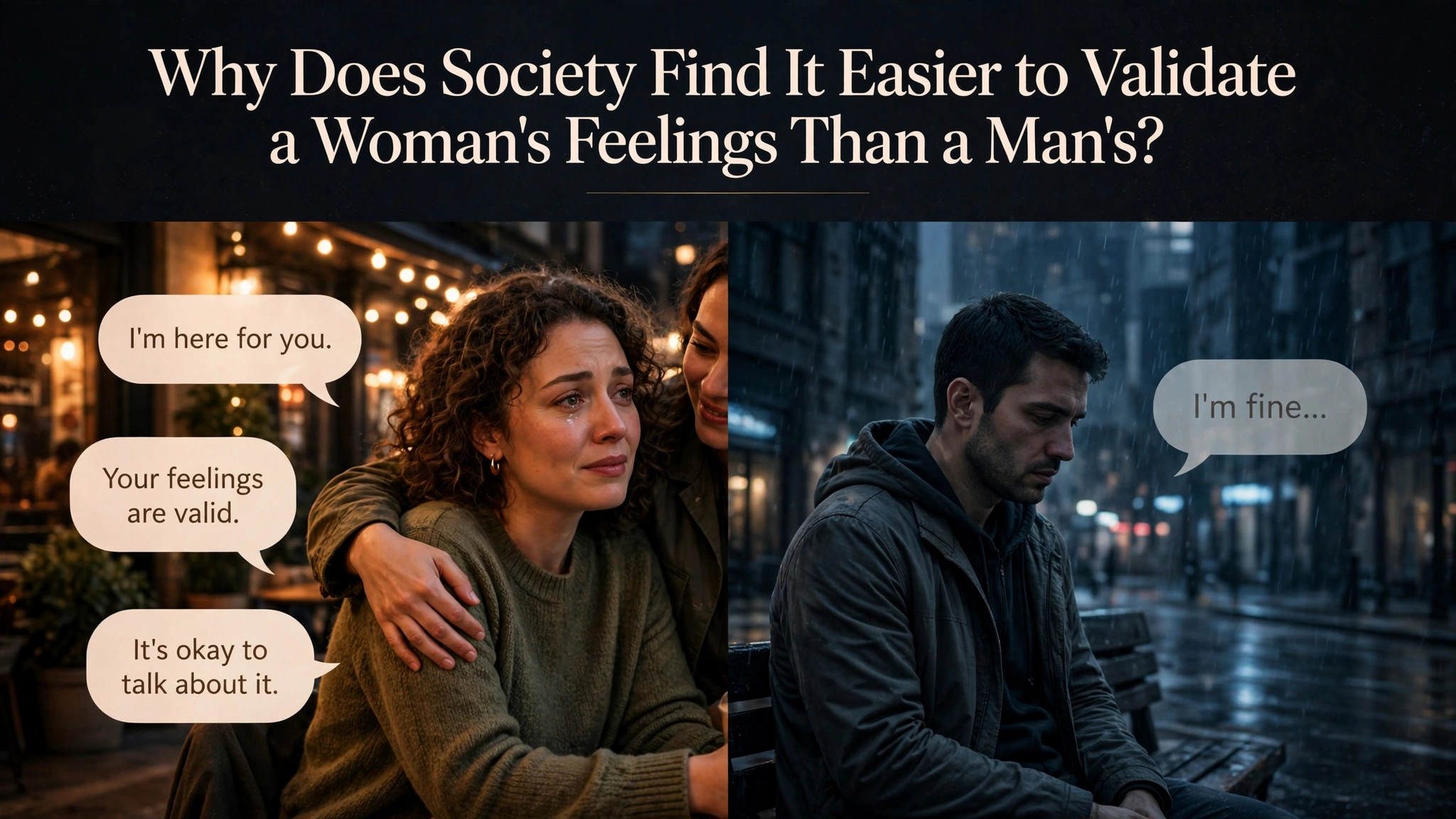
Apparently, a woman can say she's overwhelmed, exhausted, emotionally drained, or struggling, and the conversation immediately becomes about understanding her. A man can express the same feelings, and suddenly he's being told to toughen up, stop complaining, or figure it out. When did emotional support become a gender-specific privilege?
Let's have an uncomfortable conversation. Why does it sometimes seem easier for society to validate a woman's emotions than a man's?
I'm not suggesting women have it easy. They face their own expectations, dismissals, discrimination, and emotional burdens. But there's a noticeable double standard in how people can respond to men and women when they admit they're struggling.
When a woman says she's tired of carrying everything, people might ask who is supporting her. When a man says he's tired of carrying everything, somebody might remind him that he's supposed to be strong.
Apparently, men come with a factory-installed emotional support subscription that nobody bothered to activate.
Men are expected to be emotionally available, but not necessarily emotionally vulnerable.
We're told to communicate. We're told to open up. We're told that healthy relationships require emotional intelligence. But what happens when a man actually follows that advice?
Sometimes his vulnerability gets treated like evidence that he's weak. Sometimes his feelings become ammunition during the next disagreement. Sometimes the person he trusted to hear him becomes the person he has to defend himself against.
And after enough experiences like that, he learns to keep things to himself.
Then everybody wonders why he doesn't communicate.
You can't repeatedly punish someone for opening up and then complain that they stopped opening up.
Men are often valued for what they provide before they're appreciated for who they are.
Think about how many conversations surrounding men revolve around their earning potential, career, financial stability, protection, ambition, and ability to solve problems.
Can he provide? Can he fix it? Can he handle the pressure? Can he keep everything together?
Those expectations can make a man's identity feel like a job description.
He can be having a terrible day, questioning his future, feeling lonely, or dealing with personal problems, but the responsibilities don't necessarily pause because he's struggling.
The bills still arrive. The children still need attention. The workplace still expects results. The world doesn't automatically offer him a break because he's emotionally exhausted.
And sometimes the people closest to him don't recognize that he needs support, too.
Why is his strength celebrated more than his humanity?
There's another uncomfortable part of this conversation: men sometimes contribute to the problem themselves.
Many men were raised to believe that showing emotion is embarrassing, asking for help is weakness, and admitting something hurts is an invitation for disrespect.
Some men dismiss other men's feelings because they were taught that suffering silently is what makes somebody a man.
We can't demand emotional validation while refusing to give it to one another.
And women aren't a single group with one attitude toward men's emotions. Plenty of women genuinely support vulnerable men. Plenty of men have loving partners who make them feel safe enough to be honest. The issue is the social expectations that make vulnerability feel risky in the first place.
Validation isn't agreement. It's acknowledging that somebody's experience matters.
You don't have to agree with everything a man says to recognize that he's hurting. You don't have to solve his problems to let him know he's being heard.
Sometimes he doesn't need a motivational speech. He doesn't need another lecture about discipline. He doesn't need somebody explaining how much worse other people have it.
He might simply need someone to ask, "Are you okay?" and actually be prepared to hear the answer.
And men need to extend that same courtesy to women. Emotional support shouldn't be a competition over who has the harder life.
We should stop treating emotional support like a reward people earn by meeting gender expectations.
A woman shouldn't have to prove she's struggling enough to deserve compassion. A man shouldn't have to reach a breaking point before somebody takes his feelings seriously.
Being strong doesn't mean never needing help. Being a provider doesn't mean you don't need support. Being a father doesn't mean you can't have difficult days. Being a man doesn't mean your emotions are optional.
And if the only time people acknowledge a man's emotional needs is when he's no longer able to function, we haven't built a culture of strength. We've built a culture that waits until people break before offering them compassion.
Maybe the question isn't why men don't talk about their feelings. Maybe we should ask why so many men have learned that being honest about those feelings comes with consequences.






Comments
No comments yet, be the first submit yours below.