We've Made Everything Easier—So Why Does Life Feel Harder?

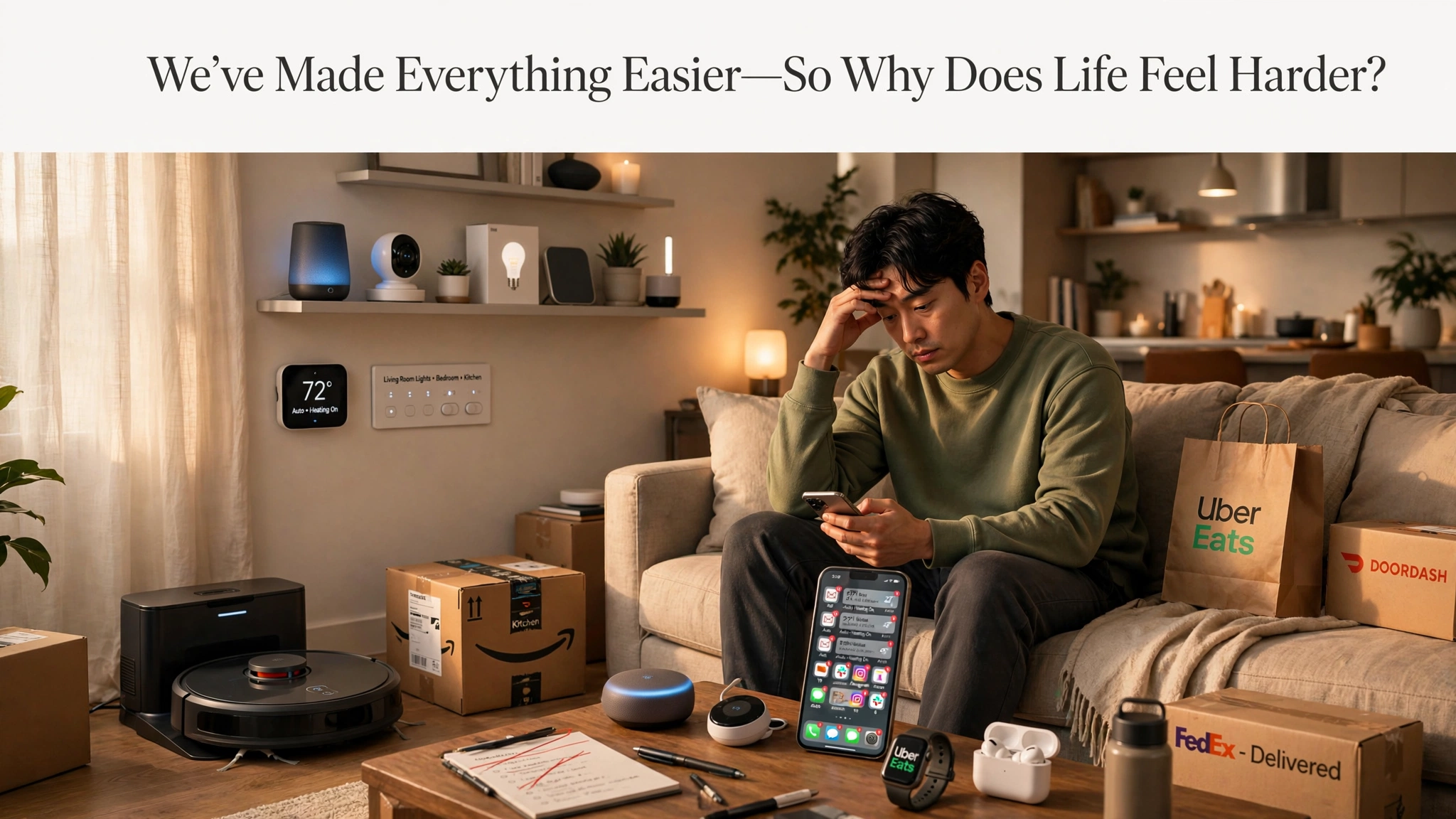
We live in a world where food can arrive at your door, entertainment never ends, and almost anything can be purchased with a few taps. Yet people are exhausted, financially stressed, distracted, and struggling to find time for the things that actually matter. What if making everything convenient has created a few problems we never expected?
Think about how much the world has changed. You don't have to leave your house to order dinner. You don't have to visit a store to buy clothes. You can watch thousands of movies without getting off the couch, talk to somebody across the planet instantly, and have a car show up to take you somewhere without ever meeting the driver beforehand.
Technology has made many parts of life genuinely better. It saves time, expands access, and helps people handle responsibilities that used to require considerably more effort.
But there's another side to convenience that deserves attention.
When everything becomes easier to access, it also becomes easier to overconsume. When every service promises to save time, you can end up paying multiple companies to manage tasks you once handled yourself. And when entertainment is available around the clock, doing nothing can become a habit without you ever consciously choosing it.
The danger isn't convenience itself. It's forgetting that every convenience has a cost, and that cost isn't always measured in dollars.
Let's start with food.
Ordering delivery is useful when you're busy, tired, working late, or unable to get out. But when convenience becomes the default, the costs can accumulate quickly. Delivery fees, service charges, tips, and menu markups can turn an ordinary meal into a much more expensive purchase.
One meal might not seem like a big deal. But repeated several times a week, those extra costs can compete with money you need for groceries, savings, or other bills.
The service solves an immediate problem: you don't have to cook or drive to pick up your food. However, it doesn't eliminate the financial consequences. It simply exchanges your time and effort for money.
Sometimes that's a reasonable trade. Sometimes it's a habit worth reconsidering.
The same thing happens with subscriptions. Music, movies, storage, gaming, premium memberships, software, and other digital services can each seem affordable individually.
But when every company wants a small recurring payment, your paycheck can become a collection of automatic deductions.
You may not even remember everything you're paying for. The convenience of automatic billing makes it easy to continue spending without making an active decision every month.
That's an interesting feature of modern consumer life: buying something can require only a second of attention, while canceling unnecessary expenses may require you to slow down, find the settings, and make a deliberate choice.
Convenience makes spending effortless. Financial responsibility still requires attention.
Now consider entertainment.
There was a time when watching a television show meant waiting for it to air. Movies required a trip to the theater or a rental store. If you wanted to listen to music, you might have needed a physical album or a radio.
Today, an endless supply of entertainment is available whenever you want it.
That access is incredible, but unlimited availability can make it harder to recognize when you've had enough. One video becomes twenty. A quick check of social media becomes an hour. You sit down to relax for a few minutes and suddenly discover that the evening is almost gone.
Meanwhile, the project you wanted to work on remains unfinished. The book stays closed. The workout gets postponed. The business idea receives another promise that you'll start tomorrow.
It's not always a lack of ambition. Sometimes your attention is competing against systems designed to make the next distraction incredibly easy to access.
And the longer you practice reaching for instant entertainment whenever you're bored, the less comfortable ordinary moments can become.
Waiting in line feels irritating. Sitting quietly feels unproductive. A difficult task feels unbearable because your phone offers an immediate escape.
Over time, you may begin expecting every uncomfortable moment to come with a convenient way out.
But not every worthwhile thing in life works that way.
Learning a skill takes repetition. Building a business takes patience. Getting physically stronger requires effort. Developing meaningful relationships takes time. Saving money requires making decisions that may not provide immediate satisfaction.
You can't always automate your way through the difficult parts of becoming the person you want to be.
When you become accustomed to everything being easy, ordinary effort can start feeling like an unnecessary burden.
Then there's the financial side of convenience that often gets overlooked: people can pay more money to avoid spending time, even when that time could be used productively.
Paying for a service isn't automatically a bad decision. If you're working long hours, caring for children, managing a disability, or dealing with other responsibilities, convenience can be essential. Time has value, and spending money to protect it can be completely rational.
The question is whether you're making that decision intentionally.
Are you paying because the service genuinely improves your life, or because you've become so accustomed to convenience that doing something yourself feels unacceptable?
Are you saving meaningful time, or simply moving from one distraction to another?
Are you purchasing a tool that helps you accomplish more, or accumulating services that quietly consume your income?
Those distinctions matter.
Convenience can also create dependence. When a navigation app handles every route, you may stop paying attention to where you're going. When digital tools remember every detail, you may practice remembering less. When services take care of every small task, you can lose opportunities to develop skills and confidence through doing things yourself.
That doesn't mean technology makes people less capable by default. Good tools can improve our abilities dramatically. The issue is whether the tools support our judgment or replace it entirely.
There is a difference between using technology to become more capable and relying on it so completely that you feel helpless without it.
The same principle applies to artificial intelligence. AI can help people write, research, organize, learn, and create. Used thoughtfully, it can free up time for higher-value work. Used without reflection, it can also become a substitute for practicing skills, checking facts, or developing independent judgment.
The most useful question isn't whether we should reject convenient technology. It's whether we're using it to expand our abilities or simply to avoid every opportunity to think.
And perhaps the biggest irony is that the pursuit of convenience can create an entirely new kind of work.
You need to manage passwords, track subscriptions, monitor notifications, update devices, maintain accounts, verify information, and navigate complicated digital systems. Services promise to simplify life, but each new platform can introduce another set of settings, obligations, and problems to manage.
Everything is connected, everything needs attention, and everything seems to have an alert that demands a response.
We're saving minutes in one area while allowing our attention to be divided across dozens of others.
So what can we do about it?
First, become intentional about which conveniences actually deserve your money. Review recurring subscriptions, delivery habits, and automatic payments. Keep the services that provide real value, and question the ones you barely use.
Second, protect some of your time from constant stimulation. You don't need to eliminate entertainment, but you can decide when to use it instead of allowing every notification to make the decision for you.
Third, continue practicing useful skills even when a shortcut exists. Cook occasionally. Learn how to solve basic problems. Read something challenging. Take a walk without needing to document it. Give your mind opportunities to work without immediately reaching for a digital escape.
Finally, remember that convenience is supposed to serve your life. Your life is not supposed to revolve around maintaining access to every convenient service available.
You don't have to reject progress to live intentionally. You can appreciate technology, enjoy modern comforts, and still recognize that some effort is valuable.
Sometimes cooking a meal gives you more control over your spending. Sometimes taking the long way helps you understand where you live. Sometimes sitting with a difficult problem teaches you something that an instant answer never could.
And sometimes the best thing you can do for your future is choose the slower option because it builds a skill, saves money, or helps you pay attention to the world around you.
A convenient life isn't automatically a fulfilling life. The real question is whether all these conveniences are giving you more freedom—or simply making it easier to spend your money, surrender your attention, and avoid the work that matters.
Technology will continue improving. Services will become faster. Purchases will become easier. More tasks will be automated.
That's not necessarily something to fear.
But as the world makes it easier to do almost everything without effort, we should become more deliberate about deciding which efforts are still worth making.
Because saving time only matters if you do something meaningful with the time you save.
And making life easier only helps if the life you're building actually becomes better.










Comments
No comments yet, be the first submit yours below.