The Truth About Data Centers: They're Not Just Building Warehouses for Computers—They're Building the Infrastructure That Collects, Processes, and Profits From Our Lives.

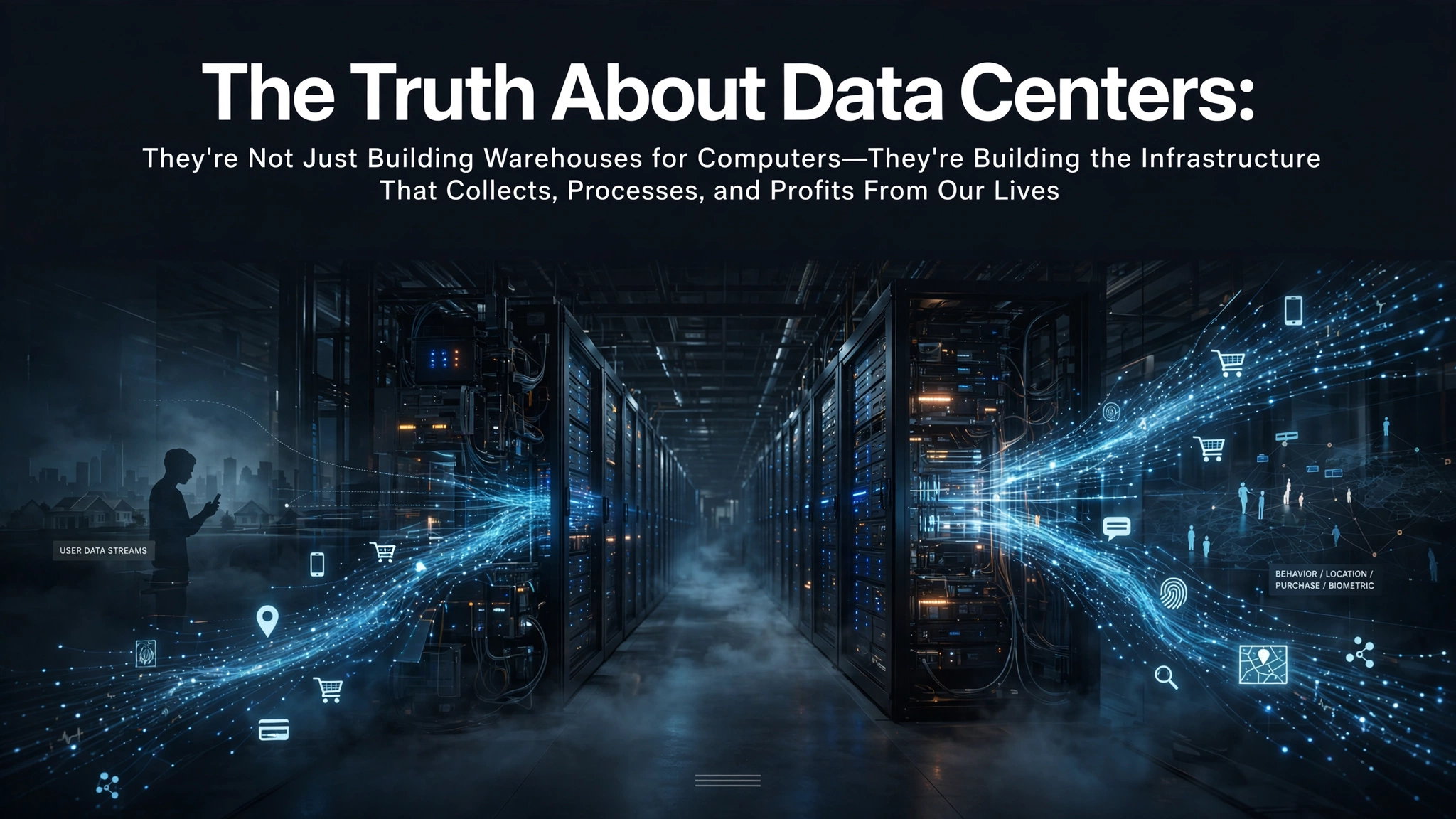
Everybody is talking about the massive data centers being built across America. They need enormous amounts of electricity, water, land, and infrastructure. But here's the question nobody seems to ask loudly enough: What exactly are these facilities processing, who owns the information, and who's making money from everything we do online? Because those buildings aren't being constructed just to store vacation pictures. 😂
Drive past a massive data center and you might think you're looking at an industrial warehouse. No shopping carts, no customers walking through the doors, no retail shelves. Just enormous buildings, security fencing, cooling equipment, electrical infrastructure, and rows upon rows of computers.
But those buildings are becoming some of the most important pieces of infrastructure in the modern economy.
So what are they actually doing?
FIRST, WHAT IS A DATA CENTER?
A data center is a facility that houses computer servers, storage systems, networking equipment, and other technology used to operate digital services.
Every time you send an email, stream a movie, upload a photograph, make an online purchase, use a navigation app, or interact with an AI chatbot, computers somewhere are processing information to make that experience possible.
Those computers need somewhere to live. They need electricity, cooling, network connections, physical security, and constant maintenance. That's what data centers provide.
Some are operated by companies to support their own services. Others are operated by cloud providers that rent computing and storage capacity to thousands of businesses. AI-focused facilities are increasingly designed to support powerful processors that train and run artificial intelligence models.
But the real story isn't just what these buildings store. It's what they make possible.
WHAT EXACTLY ARE THEY FARMING?
When people use the phrase data farming, they're usually talking about the collection, processing, organization, and analysis of information generated by human activity.
Data centers themselves aren't necessarily collecting your personal information. Websites, applications, advertisers, retailers, social networks, and connected devices collect information through their own systems. Data centers provide much of the infrastructure used to store and process it.
Think about the digital footprint people create every day.
Your searches reveal what you're interested in. Your purchases reveal what you spend money on. Your location history can reveal where you travel. Your viewing habits reveal what keeps your attention. Your interactions with social media reveal what makes you engage, comment, share, or leave.
Individually, these activities might seem insignificant. Combined, they can provide businesses with valuable information about consumer behavior.
That information can be used to personalize advertisements, recommend products, improve services, measure customer activity, and build predictive models.
It's not necessarily somebody sitting in a room watching you through a screen. The more important reality is that automated systems can analyze enormous amounts of activity without a human ever looking at an individual record.
YOUR ATTENTION IS AN ECONOMIC RESOURCE.
Think about how much time people spend scrolling through social media. Every video watched, advertisement displayed, link clicked, and interaction can generate information that helps platforms understand what keeps users engaged.
Companies use analytics and recommendation systems to determine which content is likely to hold your attention. Advertisers pay to reach audiences they believe are valuable.
Your attention becomes part of the business model.
And here's the interesting part: You don't have to purchase anything for your activity to have commercial value.
Sometimes simply watching, searching, clicking, or interacting helps generate the information that makes an advertising platform profitable.
The product isn't always what you're buying. Sometimes the business value comes from understanding what you're likely to buy next.
NOW ADD ARTIFICIAL INTELLIGENCE TO THE EQUATION.
Traditional data centers already supported banking systems, online stores, entertainment platforms, government databases, and millions of websites. AI is dramatically increasing the demand for computing power.
Training AI models requires processing enormous collections of information. Running AI services requires powerful processors to respond to user requests. Companies also use AI to analyze documents, images, customer interactions, business operations, and other datasets.
That means the demand for specialized computing infrastructure is growing.
And here's where things get interesting: Data centers aren't just supporting the internet we already have. They're helping build the infrastructure for an economy increasingly dependent on artificial intelligence.
More computing capacity means more opportunities to process information, develop AI products, automate work, and build services that were previously impossible or too expensive.
But it also means more electricity demand, more infrastructure investment, and more questions about who controls the technology.
THE ELECTRICITY AND WATER QUESTION
These facilities can consume enormous amounts of electricity. Servers generate heat, and cooling systems must keep equipment within safe operating temperatures.
Some facilities use water-based cooling systems. Others rely more heavily on air cooling, chilled-water loops, or other technologies. Their actual water consumption varies significantly depending on their design, location, weather, and cooling method.
But the electricity demand is a serious issue.
When a company builds a massive facility in a community, the local electrical grid may need upgrades, new transmission infrastructure, or additional power generation.
That raises a question residents should be asking before approving these projects: Who pays for the additional infrastructure?
If a private company needs more electricity than an entire neighborhood, should ordinary customers be expected to absorb higher utility costs because the grid needs expansion?
Companies may negotiate their own power arrangements, and utility regulators can establish rules to protect other customers. But residents deserve transparency about the actual costs, not vague promises about economic development.
And water deserves the same scrutiny. Communities experiencing drought or water shortages should know how much a proposed facility expects to consume and where that water will come from.
WHO ACTUALLY BENEFITS?
Data centers can bring construction contracts, investment, property-tax revenue, and specialized technical jobs. They can also support local businesses and provide infrastructure that companies depend on.
But we should be realistic about employment.
A facility costing billions of dollars to construct doesn't necessarily employ thousands of permanent workers once it opens. Construction employment can be substantial, while ongoing operations may require a much smaller specialized workforce.
So when politicians announce a billion-dollar data center project, residents should ask how many permanent jobs will exist after construction is finished.
How much tax revenue will the community actually receive? What tax incentives are being offered? What happens to utility rates? How much water will be consumed? What happens if the company leaves?
A billion-dollar investment sounds impressive. But the important question is how much of that investment benefits the people who already live there.
AND WHAT ABOUT YOUR PRIVACY?
This is where the conversation becomes even more important.
Data centers can store and process information that businesses and institutions collect about people. That information may include financial records, medical records, account details, browsing activity, photographs, communications, and location-related information.
However, not every data center has access to every person's information. Access depends on which organization operates the facility, what systems it hosts, what information those systems contain, and what legal and technical protections apply.
Encryption, access controls, retention policies, and privacy laws matter. So does knowing which companies are responsible for the information being collected.
We should also remember that artificial intelligence can make information analysis much more powerful. Data that once required considerable human effort to examine can potentially be processed at enormous scale.
That doesn't mean every company is secretly monitoring every individual. It means the ability to analyze human activity is becoming more sophisticated, and the public should understand how that power is being used.
THE BIGGER QUESTION IS WHO OWNS THE INFRASTRUCTURE.
Think about it. Businesses increasingly depend on cloud services, AI platforms, digital payment systems, and remote storage. Governments depend on digital infrastructure. Hospitals, banks, schools, and communication networks depend on computing systems.
Whoever controls important infrastructure has influence over how services are delivered, what resources are available, and what businesses must pay to operate.
That doesn't automatically make data centers dangerous. They are essential infrastructure for much of modern society.
But it does make competition, transparency, privacy protections, and accountability extremely important.
We shouldn't be blindly celebrating every massive technology development just because somebody attached the words artificial intelligence to it.
Ask questions. Read the development agreements. Examine utility projections. Find out how much water is involved. Look at the permanent job numbers. Understand what information is being processed and which organizations control it.
Technology is supposed to make life better, not leave communities paying the bill while somebody else collects the profits.
HERE'S THE QUESTION: Are data centers becoming the next essential infrastructure that communities should welcome, or are we allowing private technology companies to build enormous operations without demanding enough transparency about their electricity use, water consumption, employment promises, and control over our digital lives?
Because the future of the internet isn't just about who creates the next application. It's also about who owns the buildings, computers, energy, and infrastructure that make the entire digital economy possible.











Comments
No comments yet, be the first submit yours below.