In This Economy, Moving Out Isn't Always the Goal—Building Up Is

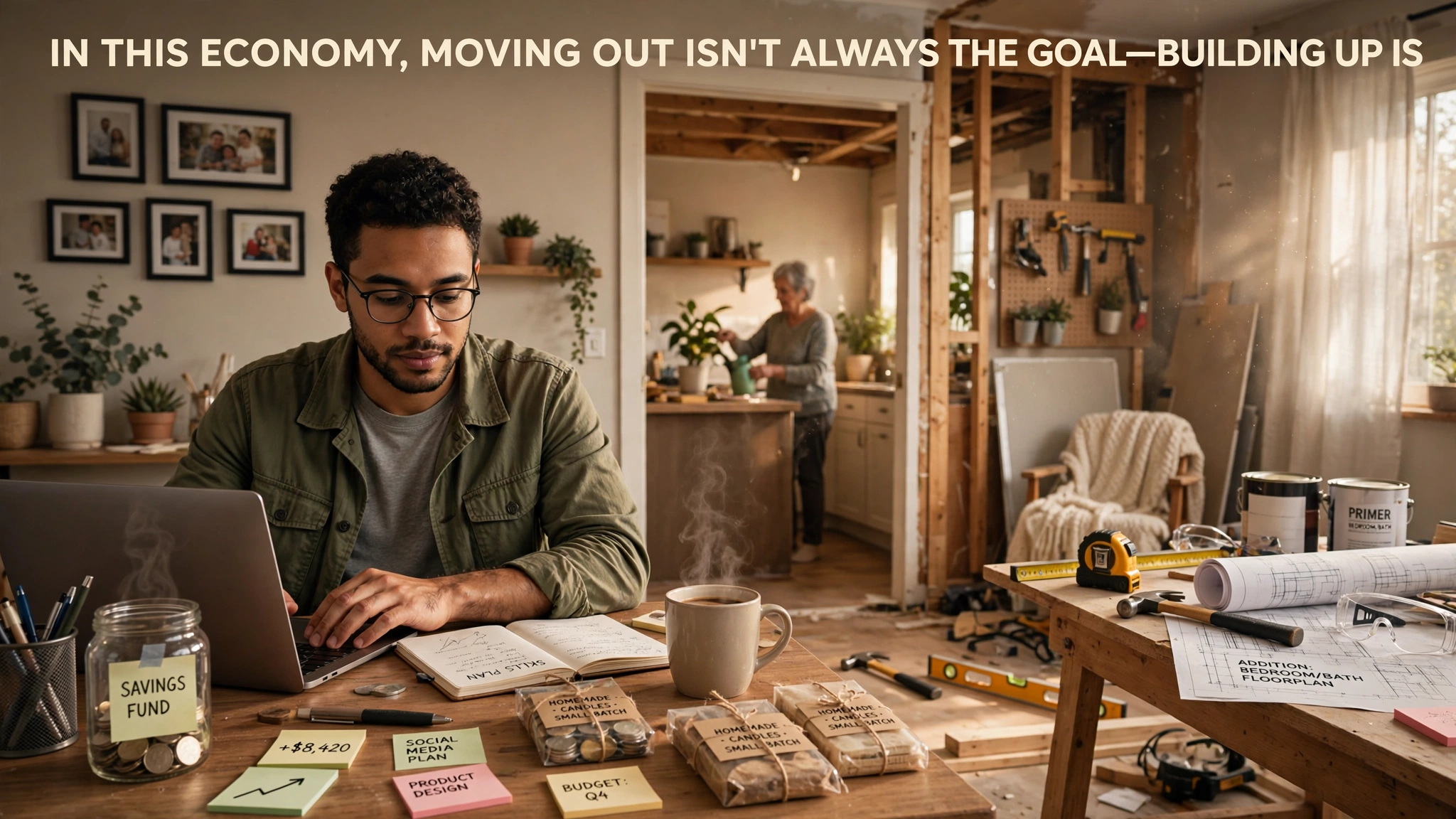
We need to stop acting like moving out at 18, 20, or 22 is automatically a sign that you've made it.
There was a time when getting your first apartment could feel like the natural next step into adulthood. Get a job, pay your rent, buy your groceries, and figure life out on your own.
But the economy has changed.
Housing costs, transportation, food, insurance, education, and everyday expenses can consume a huge portion of a young person's income before they even have a chance to build savings.
So maybe we need to stop asking, "Why are you still living with your parents?"
And start asking, "What are you doing while you're there?"
LIVING AT HOME CAN BE A STRATEGY
If a young adult can live with their parents while working, going to school, paying a reasonable share of household expenses, learning financial responsibility, and saving money, that situation can create something extremely valuable: time.
Time to build an emergency fund.
Time to pay down debt.
Time to learn a trade.
Time to finish college or certifications.
Time to build a business.
Time to invest.
Time to figure out what kind of life they actually want instead of accepting the first apartment they can barely afford.
THE REAL PROBLEM ISN'T LIVING WITH YOUR PARENTS
The problem is staying there without a plan.
There is a major difference between a 23-year-old living at home and building toward independence and a 30-year-old refusing to contribute anything while expecting their parents to handle everything.
One is preparation.
The other is dependency.
Parents don't have to choose between throwing their children into an expensive world and enabling them forever. There is a middle ground: use the household as a launchpad.
WE SHOULD BE TEACHING CHILDREN HOW TO BUILD BEFORE WE TEACH THEM HOW TO LEAVE
Imagine a young adult staying home for a few additional years but putting hundreds of dollars every month into savings instead of sending that same money toward rent.
Imagine leaving home with money in the bank, good credit, useful skills, reliable transportation, and an understanding of how bills actually work.
That's a completely different starting point.
Independence shouldn't simply mean having your own address.
Independence means having the ability to support yourself.
THE CULTURE OF "GET OUT OF MY HOUSE" CAN HAVE A PRICE
Sometimes parents treat adulthood like a deadline: graduate, get a job, move out.
But life doesn't operate on the same timeline for everybody.
Some people need more time to establish themselves. Some are dealing with expensive education. Some are entering careers that take years to become financially stable. Some are helping their families while trying to build their own future.
There is nothing inherently immature about recognizing that two generations can sometimes become stronger by sharing resources.
THE HOUSE CAN BECOME A FAMILY'S FIRST INVESTMENT STRATEGY
Instead of thinking about the family home as a place children eventually escape from, think about it as a place where financial habits are developed.
Parents can teach budgeting.
Children can contribute.
Everyone can save.
Older generations can pass down knowledge instead of simply passing down bills.
And eventually, the young adult can leave because they're financially prepared—not because everyone decided they had reached an arbitrary birthday.
WE DON'T NEED MORE PEOPLE LOOKING INDEPENDENT. WE NEED MORE PEOPLE WHO ACTUALLY ARE.
There is a difference between appearing successful and becoming financially stable.
Moving into an apartment with no savings, living paycheck to paycheck, using credit cards to survive, and spending years trying to catch up might look independent from the outside.
But staying home temporarily, saving aggressively, contributing to the household, and preparing for the next stage can look less impressive while actually putting someone in a much stronger position.
Maybe adulthood shouldn't be measured by how quickly someone gets away from their parents.
Maybe it should be measured by how effectively they prepare to stand on their own.
In this economy, there is nothing wrong with taking longer to leave the nest if you're using that time to build wings.










Comments
No comments yet, be the first submit yours below.