When the Game Becomes a Gambling Business: Can Fans Still Trust Professional Sports?

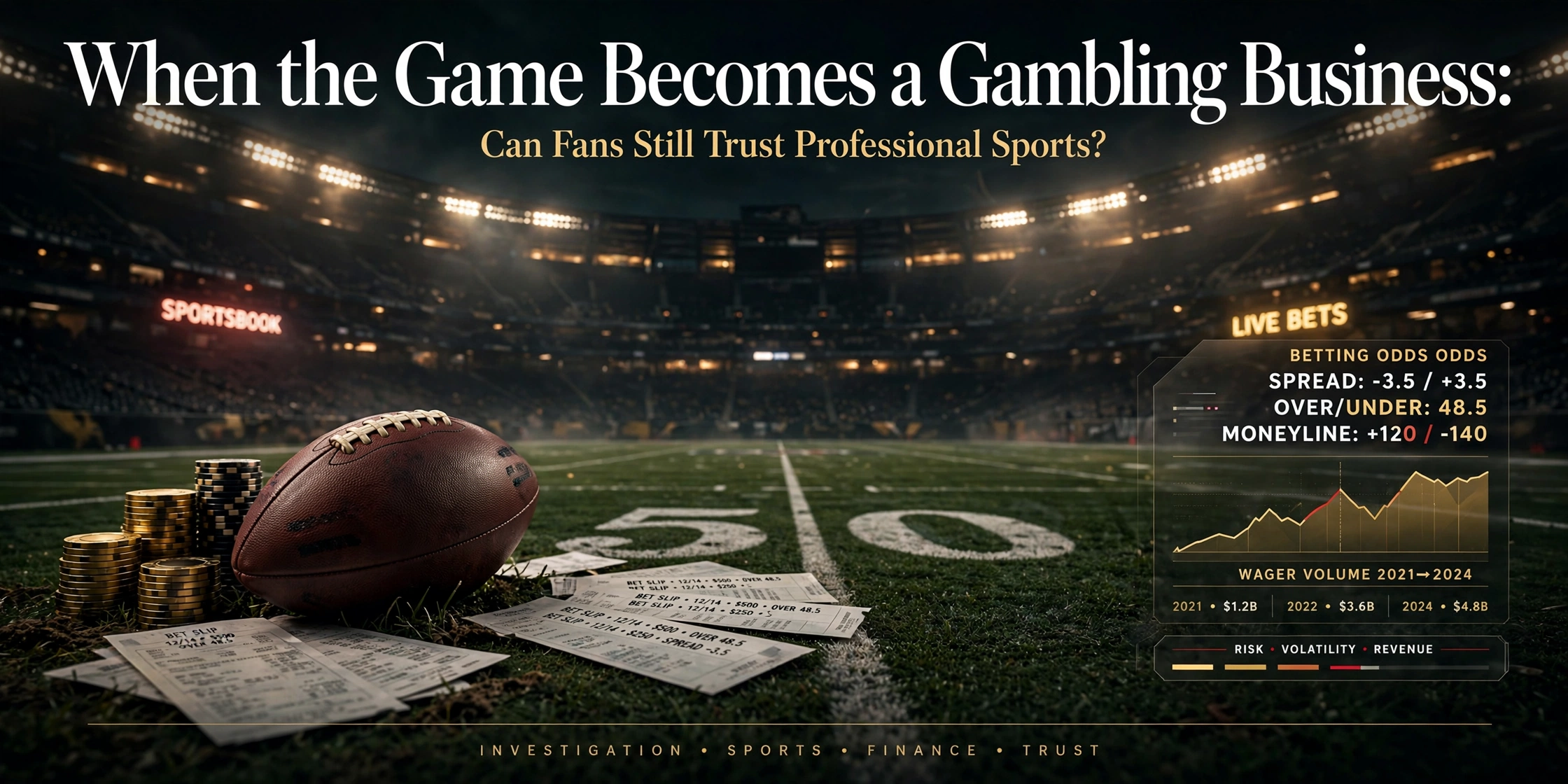
WHAT HAPPENS WHEN EVERY PLAY BECOMES A BET?
Let's have a conversation about professional sports that people might not agree on, but one that deserves to be discussed.
Is the NFL still just about football, or has the business of betting become so deeply connected to the game that fans have legitimate reasons to question where the priorities are?
We're living in an era where you can watch a football game and place a wager on the winner, the final score, the point spread, the next touchdown, a quarterback's passing yards, a running back's rushing attempts, or whether a player will catch another pass.
You don't even have to wait until the game starts. Betting apps encourage people to place wagers before kickoff, during halftime, and sometimes after every major play. Parlays combine multiple predictions into one bet, while live betting allows people to keep putting money down as the action unfolds.
Sports used to be something families gathered around to enjoy. Now, for some viewers, every missed field goal, questionable penalty, dropped pass, and last-minute comeback carries a financial consequence.
And when that much money becomes attached to the outcome of a game, people are naturally going to ask questions.
Who is protecting the integrity of the competition, and how can ordinary fans know that those protections are working?
THE MONEY HAS CHANGED THE WAY PEOPLE WATCH SPORTS
Think about how the experience has changed.
A fan can watch their favorite team win and still lose money because the team failed to cover the spread. Another fan can correctly predict the winning team but lose a parlay because one player fell short of a statistical target. Someone else can spend an entire game watching individual player statistics instead of enjoying the actual competition.
The betting industry has created an environment where fans can have dozens of financial interests inside a single game.
That creates a different relationship between the viewer and the sport. People aren't just cheering for a team anymore. They're watching individual performances, tracking odds, refreshing applications, and calculating whether the next possession will make them money.
And the more emotionally invested someone becomes, the easier it can be to keep wagering in an attempt to recover losses.
Sports betting is no longer something that happens quietly in the background. It's advertised, discussed during broadcasts, promoted through sponsorships, and integrated into the way many people consume sports.
That doesn't prove that games are manipulated. But it does raise questions about the incentives surrounding the industry and the responsibility that comes with encouraging millions of people to wager on athletic competition.
WHEN BILLIONS ARE AT STAKE, TRUST MATTERS
Let's be clear: there is a difference between questioning the integrity of sports and claiming that a league is rigging games.
There is no basis to treat the claim that the NFL or betting applications control game outcomes as established fact without credible evidence. A surprising final score, a controversial call, or a team losing after leading by 20 points does not automatically prove manipulation.
Football is unpredictable. Players make mistakes. Coaches make questionable decisions. Referees sometimes get calls wrong. A team can dominate for three quarters and collapse in the fourth.
But the public should not have to choose between blindly trusting every decision and assuming that everything is corrupt.
There should be meaningful ways to examine credible allegations, investigate suspicious betting patterns, disclose conflicts of interest, and hold people accountable when rules are broken.
The legitimacy of a sport depends not only on fair competition, but also on whether the public has good reasons to trust the process that protects it.
DO BETTING APPS CONTROL THE GAMES?
This is where the conversation needs to be precise.
Sportsbooks set odds, establish betting markets, and adjust their prices as money comes in and new information becomes available. They can manage their exposure by changing odds, limiting certain wagers, or taking other actions permitted by their rules and applicable regulations.
But setting odds is not the same thing as controlling a football game.
A betting application does not automatically have the power to tell a quarterback to throw an interception, direct a referee to call a penalty, or force a kicker to miss a field goal simply because a particular outcome would benefit the sportsbook.
Those are different claims, and the distinction matters.
Still, fans can reasonably ask whether the relationships between leagues, broadcasters, sportsbooks, and other commercial partners are transparent enough. They can ask how suspicious activity is detected, who investigates it, and whether those investigations are sufficiently independent.
They can also ask whether the people and organizations responsible for protecting the sport face meaningful consequences if they fail.
We shouldn't confuse unanswered questions with proof of a conspiracy. But neither should the existence of a large, profitable industry make legitimate questions off-limits.
THE REFEREE CAN CHANGE A GAME WITHOUT THE GAME BEING RIGGED
One reason suspicions spread so quickly is that a single decision can change the entire financial outcome of a game.
Imagine a team scoring a late touchdown, only for a penalty to bring it back. Imagine a questionable pass-interference call extending a drive. Imagine a flag being thrown on a crucial third down, a disputed spot on fourth down, or a field goal being decided by inches.
Now imagine that thousands of people have money riding on what happens next.
Some bettors will lose because of that call. Others will win. People who already distrust the system may interpret the same play as evidence that something suspicious is happening.
But one controversial call cannot tell us whether a referee made an honest mistake, applied a rule incorrectly, or acted improperly. Those possibilities require different kinds of evidence.
That's why transparency matters. Consistent officiating standards, accessible explanations of major decisions, independent review, and meaningful disciplinary processes can help the public evaluate what happened.
When explanations are unclear or accountability appears inconsistent, speculation fills the gap.
People become suspicious when the stakes are high and the answers are difficult to find.
THE CONFLICT OF INTEREST DESERVES MORE ATTENTION
Professional sports leagues want audiences, media revenue, sponsorships, and long-term fan loyalty. Sportsbooks want customers who continue using their platforms. Broadcasters want engaging programming that keeps viewers watching.
These interests can overlap in ways that make sports betting more visible and commercially valuable.
The concern is not that every partnership is corrupt. The concern is that commercial incentives can create pressure to prioritize betting engagement without giving enough attention to the risks faced by consumers.
When a league promotes betting-related content while also assuring fans that competition integrity is protected, the public deserves to understand the safeguards behind those assurances.
Who monitors suspicious betting activity? How are conflicts disclosed? What happens when a player, official, employee, or other insider violates gambling rules? Are investigations conducted independently enough to inspire confidence?
These questions should be answered through clear policies and public accountability, not just reassuring advertisements.
THE FANS ARE TAKING THE FINANCIAL RISK
There is another part of this conversation that deserves attention: the ordinary person placing the bet.
A sportsbook has data, pricing models, risk-management systems, and teams of professionals working to manage its business. A casual bettor may have nothing more than a favorite team, a prediction, and the belief that they understand what they are watching.
Even knowledgeable fans cannot reliably predict every injury, turnover, coaching decision, or unexpected play. The odds are not guarantees, and a winning streak does not mean the next wager is safe.
When someone loses money, the consequences are personal. Rent still has to be paid. Groceries still need to be purchased. Bills do not disappear because a parlay missed by one leg.
And because betting apps make it easy to place another wager immediately, a person who is frustrated by a loss can be tempted to chase it.
That's a dangerous cycle. The desire to recover lost money can lead to even greater losses.
Fans should understand that betting is not a reliable income strategy, and no one should feel pressured to gamble to prove their loyalty to a team or their knowledge of the sport.
IF THE SYSTEM IS FAIR, IT SHOULD WELCOME SCRUTINY
The answer to public distrust cannot simply be telling fans to stop asking questions.
Professional leagues, sportsbooks, regulators, and broadcasters all have a role in maintaining public confidence. That means making the rules understandable, explaining how integrity monitoring works, investigating credible reports, and publishing meaningful information about violations when doing so does not compromise an investigation.
It also means maintaining clear boundaries between the people who govern competitions and commercial interests that profit from betting activity.
Independent oversight is especially important because an organization investigating itself may not inspire the same confidence as an investigation with appropriate outside scrutiny.
And when wrongdoing is established, consequences should be proportionate, consistent, and publicly explained to the extent possible.
These safeguards would not prove that every game is fair, nor would they eliminate every mistake. But they would give fans stronger reasons to trust the process than simply being told that everything is fine.
SPORTS SHOULD NOT BECOME A PRODUCT THAT FANS FEEL FORCED TO SUSPECT
There is something sad about reaching the point where a fan watches a close game and immediately wonders whether the ending was legitimate.
Part of the excitement of sports is not knowing what will happen. The underdog can win. A star can have a terrible night. A last-second shot can change everything. That's what makes competition compelling.
But unpredictability only works when people believe the participants are competing honestly and the rules are being enforced fairly.
If every surprising result becomes a conspiracy theory, sports lose something valuable. If legitimate concerns are dismissed without investigation, they lose something valuable too.
The challenge is to preserve the difference between an unexpected outcome and evidence of misconduct.
We need independent oversight, responsible betting practices, transparent partnerships, and consequences for proven violations. We also need fans who are willing to examine evidence rather than automatically treating every bad beat as proof that the game was fixed.
THE QUESTION IS BIGGER THAN THE NFL
This conversation applies to professional sports generally. Football, basketball, baseball, hockey, and other competitions are increasingly connected to a betting marketplace that can turn nearly every moment into a wager.
That creates a responsibility to protect the integrity of the games and the people who watch them.
We should be able to enjoy sports without feeling that we must gamble to participate. We should be able to criticize officiating without automatically being labeled conspiracy theorists. And we should be able to demand evidence when credible concerns arise without treating suspicion itself as proof.
Because once fans stop believing that the competition is genuine, the damage reaches beyond any single team, sportsbook, or season.
You can lose a bet and still have watched a fair game. You can disagree with a referee without proving corruption. But when an entire industry profits from the public's willingness to wager on the outcome, transparency and accountability are not optional luxuries. They are essential to maintaining trust.
So here's the question worth discussing:
Have sports betting partnerships improved the fan experience, or have they created a level of commercial influence that requires stronger independent oversight?
Let's talk about the incentives, the evidence, and the safeguards—not just the final score.









Comments
No comments yet, be the first submit yours below.