No Government Position Should Become a Lifetime Career: One Year of Service, Then Let Someone Else Lead

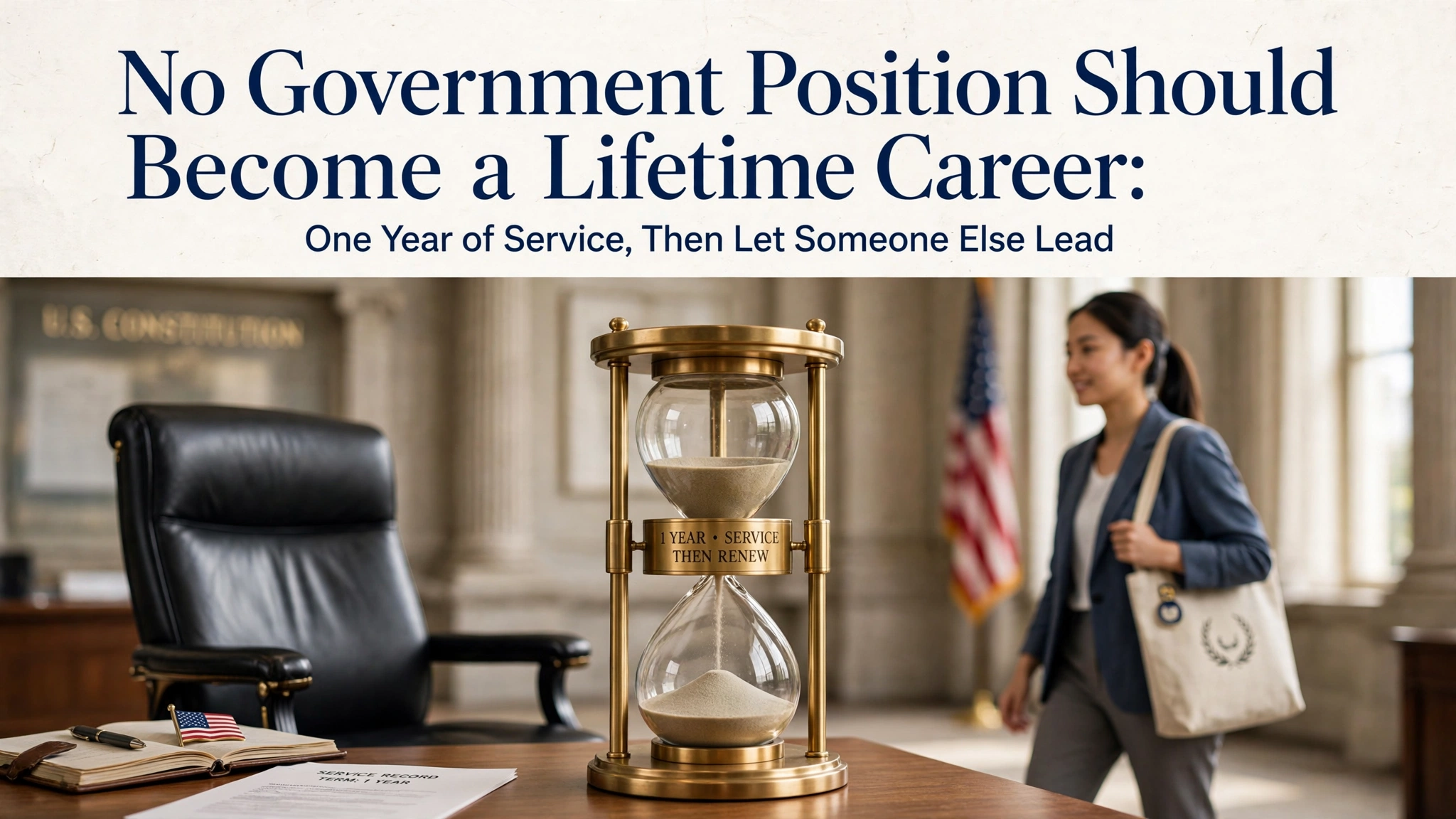
Imagine getting elected or appointed to serve the public, then spending decades in the same government office. At what point does public service stop being about serving the people and start becoming about protecting your position? Maybe it's time to rethink how long anyone should be allowed to hold power.
I've always thought there was something worth questioning about a system where people can enter government, hold onto the same position for decades, and continue making decisions that affect millions of lives.
Meanwhile, ordinary people are expected to work, adapt, change careers, compete for opportunities, and prove themselves over and over again. But in government, some positions can become long-term careers, with the same names appearing on ballots year after year.
And that raises a legitimate question: Should government service have a time limit, or should holding public office be something a person can do for practically their entire adult life?
My proposal is simple: limit the time someone can hold a government position to one year, then require them to step aside and let someone else serve.
Think about what that would mean. Instead of allowing the same individuals to occupy positions for decades, government would have a regular opportunity to bring in new people, new experiences, and different perspectives.
People who understand the challenges of raising children, paying rent, running a small business, working hourly jobs, caring for relatives, and trying to save money could have more opportunities to participate in the decisions that shape their communities.
Government would no longer be treated as a permanent seat at the table. It would become a temporary responsibility entrusted to someone by the public.
Public office should be understood as a responsibility to the people, not personal property that someone gets to hold indefinitely.
One concern with long political careers is the possibility that maintaining the position can become a priority in its own right. When reelection, party relationships, fundraising, and political alliances are part of the job, officials may face competing pressures when making decisions.
That doesn't mean every long-serving official is corrupt or that experience has no value. Experienced public servants can develop important institutional knowledge, understand complex policies, and build relationships that help government function.
But experience should not automatically mean that the public has to keep the same person in the same position indefinitely.
A system should be able to benefit from experience while still creating meaningful opportunities for new leadership.
Imagine how different political participation might look if more people believed they had a realistic opportunity to serve. Teachers, nurses, tradespeople, small-business owners, parents, and other community members might see public office as a temporary contribution rather than a career path that requires decades of political networking.
That could encourage more people to learn about local issues, understand how decisions are made, and take an active role in their communities.
However, there is an important question that a one-year limit would have to answer: would elected officials have enough time to learn the job and accomplish anything meaningful?
Government decisions are complicated. Budgets, infrastructure projects, public safety policies, and legislation often take years to develop and implement. Replacing every officeholder annually could disrupt long-term projects, increase administrative costs, and shift influence toward unelected staff, lobbyists, or outside organizations with more experience navigating the system.
Those are not minor concerns. Any proposal for shorter terms would need to consider them seriously.
There is also a difference between elected representatives, appointed officials, career civil servants, and government employees. They perform different functions, and a rule that makes sense for one category may be inappropriate for another.
For example, career civil servants often provide continuity and technical expertise regardless of which elected officials are in office. Replacing every government employee after one year could eliminate valuable knowledge and make public services less reliable.
That means the debate should be specific about which positions are subject to term limits and why.
The objective should be to prevent permanent concentrations of power without destroying the experience and stability needed to govern effectively.
One alternative worth considering is a system of strict term limits for elected positions, combined with transparent performance reviews, stronger ethics rules, restrictions on conflicts of interest, and clearer accountability for how public money is spent.
Another possibility is a one-year term for certain local or advisory roles, where responsibilities can be clearly defined and transitions can be managed without disrupting essential services.
Different offices may require different approaches. The important thing is that the rules should be designed around the public interest rather than the convenience of the people who currently hold power.
And if someone serves for only one year, there should still be a way to evaluate what they accomplished. Did they fulfill their responsibilities? Were their decisions transparent? Did they listen to constituents? Did they handle public resources appropriately?
Short tenure alone doesn't guarantee integrity. A dishonest person can do damage in a year, just as a dedicated public servant can accomplish meaningful work in a short period.
Accountability must exist regardless of how long someone holds office.
We should also ask whether the public has enough information to evaluate its representatives. People need access to clear records of votes, spending, policy decisions, conflicts of interest, and campaign financing. Without transparency, replacing one officeholder with another may change the name on the door without changing the forces influencing the decisions behind it.
New leadership matters, but so do the rules governing leadership.
And perhaps that is the bigger issue: government should never be designed around the assumption that one person is indispensable.
No official should be above scrutiny because they have been around for decades. No office should become so dependent on one individual's relationships that replacing them feels impossible. And no citizen should feel that political participation belongs exclusively to people who have spent their lives inside the system.
A healthy democracy needs both institutional experience and opportunities for renewal. The challenge is making sure neither one comes at the expense of the public's ability to hold power accountable.
So yes, I believe the idea of a one-year limit deserves a serious discussion, particularly as a way to question the assumption that government office should become a lifelong occupation.
But the details matter. Which offices should have limits? Should officials be allowed to return after a break? How would transitions work? How could we prevent powerful private interests from gaining even more influence over inexperienced newcomers? And how do we preserve expertise while making room for fresh leadership?
Those are the questions that turn frustration into a workable public policy proposal.
Because this conversation shouldn't be about whether we like or dislike a particular politician. It should be about the structure of public service itself.
When people entrust someone with public authority, there should be clear expectations, meaningful accountability, and a reasonable path for new voices to enter the process.
The people are supposed to be the source of government's authority. Government positions should never become more important than the people those positions exist to serve.
What do you think? Should every elected government position be limited to one year, should different offices have different term limits, or should voters retain the option of reelecting someone they believe is doing a good job?
Let's discuss the system, the safeguards, and the consequences—not just the names of the people currently occupying the seats.










Comments
No comments yet, be the first submit yours below.