The Walk Sign Says You Can Cross—It Doesn't Say You're Safe! E-Bike Riders and Pedestrians Need to Wake Up 🚦

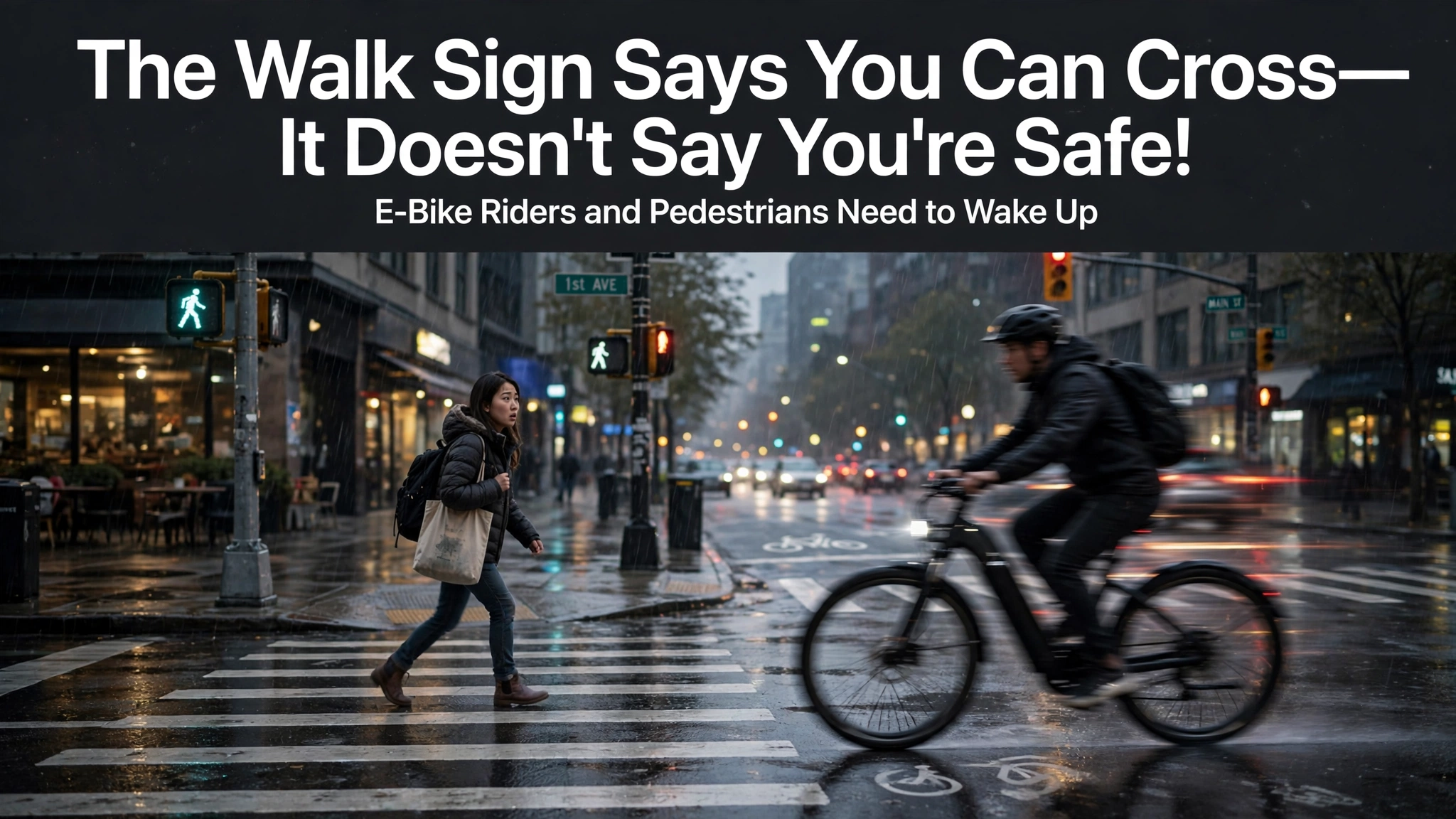
That little walking person on the traffic signal is permission to begin crossing under the signal's rules. It is NOT a force field. 😂 A green walk sign doesn't stop a turning car, guarantee a driver sees you, or prevent somebody from running a red light. And if you're riding an e-bike, the beginning and the end of an intersection crossing are two places where you need to pay especially close attention.
Let's talk about something people don't think about enough until they're suddenly standing in the middle of an intersection wondering whether a driver sees them.
Intersections.
Whether you're walking, riding an e-bike, using a regular bicycle, or pushing a scooter, intersections can be some of the most unpredictable places on the road. Everybody is moving in different directions, drivers are watching traffic, pedestrians are watching signals, and cyclists are trying to figure out whether a vehicle is about to turn directly across their path.
And one of the biggest mistakes a person can make is assuming that because the walk signal is on, the intersection must be safe.
The signal tells you when you may begin crossing. It doesn't guarantee that every driver will obey the rules or that every vehicle has seen you.
A driver might be looking left for a gap in traffic while turning right. Another might be watching oncoming cars instead of the crosswalk. Someone else might be distracted, impatient, or trying to beat the light. Even a driver who sees the pedestrian signal may not notice a person already entering the crossing.
The light can be working perfectly while a dangerous situation develops right in front of you.
That's why looking both ways isn't something you stop doing just because the signal tells you it's your turn.
And if you're riding an e-bike, there's another layer to this conversation.
You're not moving at the same speed as somebody walking. You're not necessarily moving at the same speed as a person on a traditional bicycle, either. Depending on your bike, your speed, and the traffic around you, you can cover a surprising amount of distance in just a few seconds.
That means timing matters. Visibility matters. And knowing what's happening around you matters a whole lot more than assuming everyone else is going to do the right thing.
Let's talk about the two parts of a crosswalk that deserve your attention: the beginning and the end.
When you first enter a crosswalk, you're moving into an area where vehicles may be turning, approaching the stop line, or looking for a gap in traffic. A driver turning right might be watching for cars coming from the left instead of looking for you. A driver turning left might be concentrating on oncoming traffic and fail to notice someone crossing from the opposite side.
You're entering their field of movement, and they may not be looking in your direction.
That's why the first few seconds matter. Before stepping off the curb or riding into the intersection, look for turning vehicles. Try to establish that drivers have noticed you, but remember that eye contact isn't a guarantee they understand your intentions or will yield.
And don't assume a vehicle that has slowed down is necessarily stopping for you. It might be preparing to turn, waiting for another car, or simply moving slowly before accelerating again.
Give yourself a moment to assess what's happening. Being legally allowed to cross doesn't mean you have to enter a situation that looks unsafe.
Now let's talk about the other end of the crosswalk.
People often feel relieved once they've almost reached the opposite curb. The hard part must be over, right?
Not necessarily.
Depending on the intersection, you may still have to cross another lane where vehicles can turn, watch for cars entering from a driveway, or deal with drivers who are focused on getting through the intersection before the signal changes. You may also have to navigate a curb ramp, uneven pavement, pedestrians, or other obstacles as you reach the sidewalk.
On an e-bike, that final stretch can be particularly important because you're managing momentum, balance, steering, and your exit path. A rider who is already thinking about getting back up to speed might stop scanning for danger a little too early.
Don't mentally declare the crossing finished until you're actually clear of the traffic lanes.
The beginning is where you're entering the conflict. The end is where you still need to make sure you've exited it safely. And the middle isn't a guaranteed safe zone, either.
Every lane you cross is another opportunity for a vehicle and a vulnerable road user to occupy the same space at the wrong time.
That's why I don't think the right way to approach a crosswalk is to ask, "Do I have the walk signal?" and stop there.
The better question is, "Do I have the signal, and is it safe to proceed right now?"
Those are two different questions.
And before somebody says, "Pedestrians have the right of way," let's clear something up. Having the right of way does not make you physically invulnerable. Traffic laws establish duties and priorities; they don't change the laws of physics.
You can be completely in the right and still get seriously hurt by a driver who fails to yield.
Being cautious isn't admitting that the driver owns the road. It's recognizing that avoiding a collision matters more than winning an argument about who had the right of way.
Now, e-bike riders have an additional responsibility to understand how they're supposed to cross in their particular location. Depending on local law, the type of crossing, and the way the bicycle infrastructure is marked, a rider may need to dismount and walk the bike, or may be permitted to ride through a bicycle crossing. A pedestrian walk signal does not automatically mean that every cyclist has permission to ride across under every circumstance.
Know the rules where you ride. And if you do dismount, remember that you're still responsible for watching the traffic around you.
Another thing worth considering is speed. An e-bike can make a short trip feel effortless, but that convenience can create a false sense of security. You might be comfortable riding at 20 mph on an open path, yet an intersection is not an open path. You have less time to react, and a vehicle turning across your route can change the situation in an instant.
Slow down as you approach intersections. Keep your hands ready to brake. Avoid assuming a driver has seen you. And don't accelerate into a crossing simply because the light has changed.
If your view is blocked by a parked vehicle, a large truck, or another obstruction, recognize that the same obstruction may prevent a driver from seeing you, too.
At night, visibility becomes even more important. Use appropriate lights and reflectors, wear visible clothing when practical, and remember that being illuminated doesn't guarantee that a driver will recognize your position or speed correctly.
And please, put the phone away. You cannot give an intersection your full attention while reading a notification, replying to a message, or checking directions every two seconds.
That notification can wait. Your safety cannot.
We also need to stop treating every intersection like a race. You don't win a prize for being the first person across. If a driver is behaving unpredictably, let them pass when it's safe to do so. If the crossing doesn't look clear, wait for a better opportunity. A few extra seconds are a small price to pay compared with the consequences of a collision.
And drivers, this conversation applies to you, too.
When you're turning, check the crosswalk and bicycle crossing before moving. Don't focus exclusively on other motor vehicles. Yield as required by law, watch for people who are already crossing, and never assume a pedestrian or cyclist will stop simply because you want to turn.
Someone on a bicycle or e-bike may be moving faster than you expect. Someone walking may be hidden by your vehicle's blind spots. And someone using a mobility device may need more time to cross than you think.
Take the time to look. Give people room. And don't turn across someone's path just because you think you can squeeze through.
Everybody using the road has a responsibility to reduce the chance of a collision. Having a green light, a walk signal, or the right of way doesn't eliminate that responsibility.
Ultimately, the goal isn't to make people afraid to walk or ride their bikes. E-bikes can be useful transportation, and walking is part of everyday life. The goal is to understand that intersections are shared spaces where a moment of inattention can have serious consequences.
So the next time that little walking symbol lights up, don't treat it like a personal security guarantee. Look left. Look right. Check for turning traffic. Pay attention as you cross. And keep watching until you're safely out of the roadway.
Because the walk sign might tell you when to start, but it can't watch the intersection for you.
Here's the question: Do you think pedestrians and e-bike riders rely too heavily on traffic signals, or do drivers need to do a better job watching crosswalks and yielding to people who have the right of way?
And for the e-bike riders out there: Have you ever had a driver turn across your path even though you had the signal? What do you do to stay safe at intersections?
Let's talk about it. Because getting across the road isn't about being brave, being fast, or proving who's right. It's about making it to the other side in one piece. 🚲






Comments
No comments yet, be the first submit yours below.