All These Different Types of Sexuality Are Confusing—And Apparently, I Need a Dictionary Just to Have a Conversation

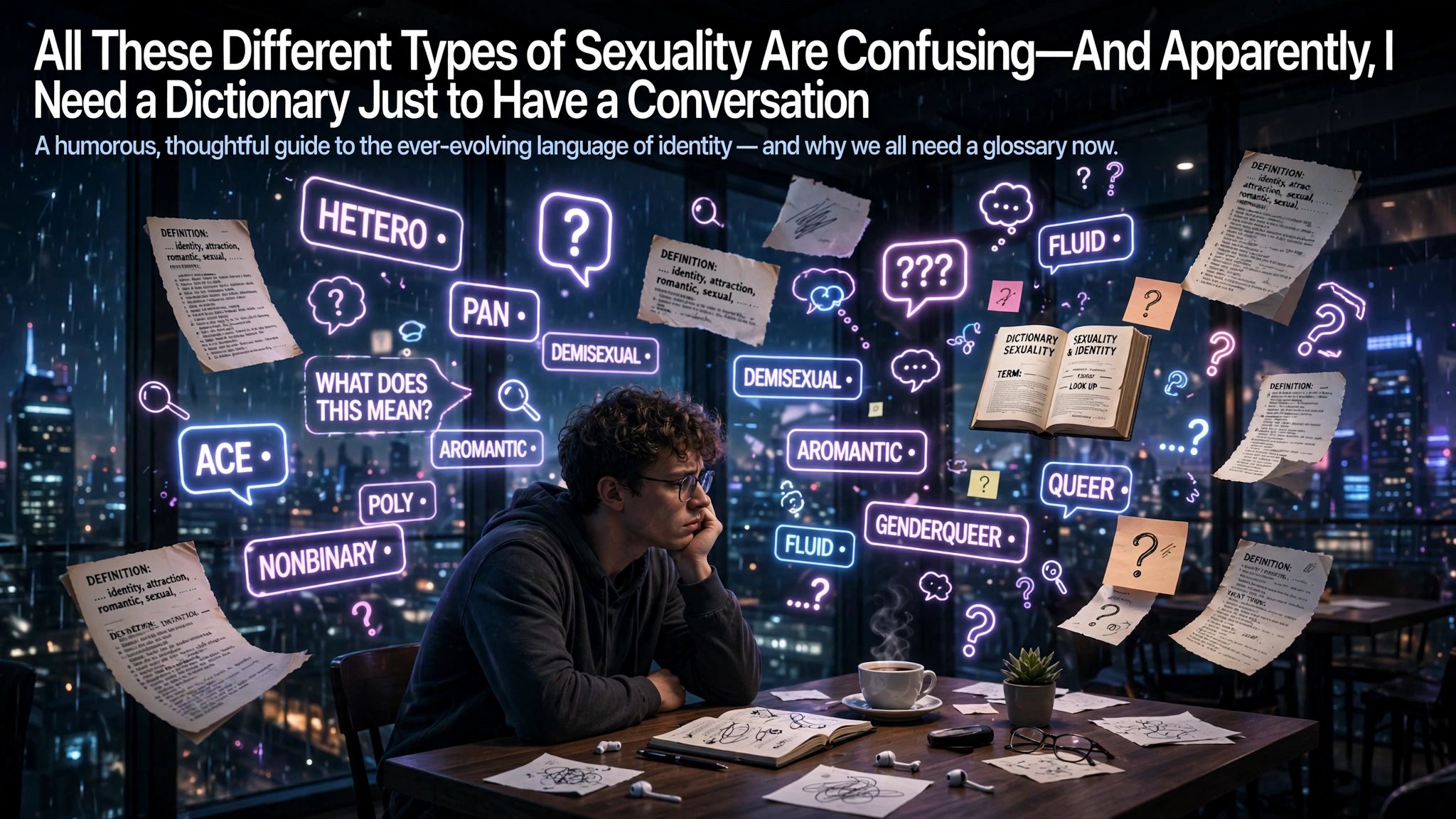
At this point, introducing yourself shouldn't require a glossary, a pronunciation guide, and a software update. Somewhere along the way, human attraction became a vocabulary lesson, and people are expected to know every new term before they're allowed to have a conversation.
Let's be honest: the terminology surrounding sexuality and identity can get complicated. Heterosexual, homosexual, bisexual, pansexual, asexual, demisexual, queer, and a growing list of other terms. Some describe who someone is attracted to. Others describe how someone experiences attraction, romantic connection, or their own identity.
And if you're somebody who hasn't kept up with all the terminology, you might find yourself wondering whether you're having a conversation or taking a final exam in human sexuality.
So let's break some of it down.
THE DIFFERENT TYPES OF SEXUAL ORIENTATION
- Heterosexual (Straight): Someone attracted to people of a different gender.
- Homosexual (Gay or Lesbian): Someone attracted to people of the same gender.
- Bisexual: Someone who experiences attraction to more than one gender.
- Pansexual: Someone who experiences attraction regardless of gender.
- Omnisexual: Someone who can be attracted to all genders, while gender may still influence their attraction.
- Polysexual: Someone attracted to multiple genders, but not necessarily every gender.
- Asexual: Someone who experiences little or no sexual attraction. That doesn't automatically mean they don't want romantic relationships or intimacy.
- Graysexual: Someone who experiences sexual attraction rarely or under limited circumstances.
- Demisexual: Someone who experiences sexual attraction only after developing a strong emotional connection.
- Queer: An umbrella term some people use for identities outside traditional heterosexual or cisgender categories.
- Androsexual: Someone attracted to masculinity or masculine-presenting people.
- Gynesexual: Someone attracted to femininity or feminine-presenting people.
- Sapiosexual: Someone who describes their attraction as being strongly influenced by another person's intellect.
- Cupiosexual: Someone who experiences little or no sexual attraction but may still desire a sexual relationship.
THEN THERE'S ROMANTIC ATTRACTION
Here's where things get even more interesting. Sexual attraction and romantic attraction aren't necessarily the same experience.
- Aromantic: Someone who experiences little or no romantic attraction.
- Demiromantic: Someone who experiences romantic attraction after developing an emotional connection.
For example, someone could be asexual but still want a romantic relationship. They might want companionship, affection, commitment, and someone to build a life with without experiencing sexual attraction in the conventional way.
Apparently, even the heart and the bedroom have separate departments.
AND THEN THERE'S GENDER IDENTITY
This is another category that people frequently mix up with sexual orientation, even though they're different concepts.
- Cisgender: Someone whose gender identity aligns with the sex they were assigned at birth.
- Transgender: Someone whose gender identity differs from the sex they were assigned at birth.
- Nonbinary: Someone whose gender identity doesn't fit exclusively into the categories of man or woman.
- Genderfluid: Someone whose gender identity may change over time.
- Agender: Someone who identifies with no gender or a lack of gender.
These terms describe gender identity, not necessarily who someone is sexually attracted to.
A transgender person can be heterosexual, homosexual, bisexual, pansexual, or identify another way. A nonbinary person can also have any sexual orientation.
SO WHY DOES IT ALL FEEL SO COMPLICATED?
I think part of the confusion comes from treating several different concepts as if they're all interchangeable.
Sexual orientation describes attraction. Romantic orientation describes romantic attraction. Gender identity describes how someone understands their own gender. Those are different dimensions of human experience.
And here's something else worth acknowledging: some of these labels overlap. Two people can use different terms to describe experiences that sound remarkably similar. Meanwhile, two people using the exact same label may experience attraction very differently.
That doesn't automatically make the terminology meaningless. Sometimes people simply find a more precise word for something they've experienced their entire lives.
But it does raise an interesting question: Are we making communication easier by creating more specific terminology, or are we making everyday conversations harder for people who haven't learned the vocabulary?
There's a difference between respecting someone and understanding every label they use.
You can treat somebody with dignity without having a complete academic understanding of their identity. You can ask what a term means without automatically being labeled hateful. And you can disagree about terminology without believing somebody deserves disrespect.
At the same time, people shouldn't have to defend their identity every time somebody encounters a word they haven't heard before.
Respect shouldn't require a vocabulary exam, and curiosity shouldn't automatically be treated like an attack.
Language evolves. People discover words that better describe their experiences. That's part of how communication works. But communication is supposed to help people understand one another, not turn every introduction into a pop quiz.
Maybe we need to bring back something revolutionary: explaining things without insulting people, asking questions without assuming bad intentions, and allowing people to learn without demanding that they already know everything.
Because apparently, before asking somebody out for dinner, we might need to review the glossary, identify the appropriate terminology, and make sure we didn't accidentally skip a chapter.
You don't have to memorize every identity label to understand the basic concept of treating people like human beings. And being respectful and being confused are not mutually exclusive. You can be both.








Comments
No comments yet, be the first submit yours below.