What If Mainstream Music Isn't About Making Great Music Anymore—What If It's About Manufacturing the Next Hit?

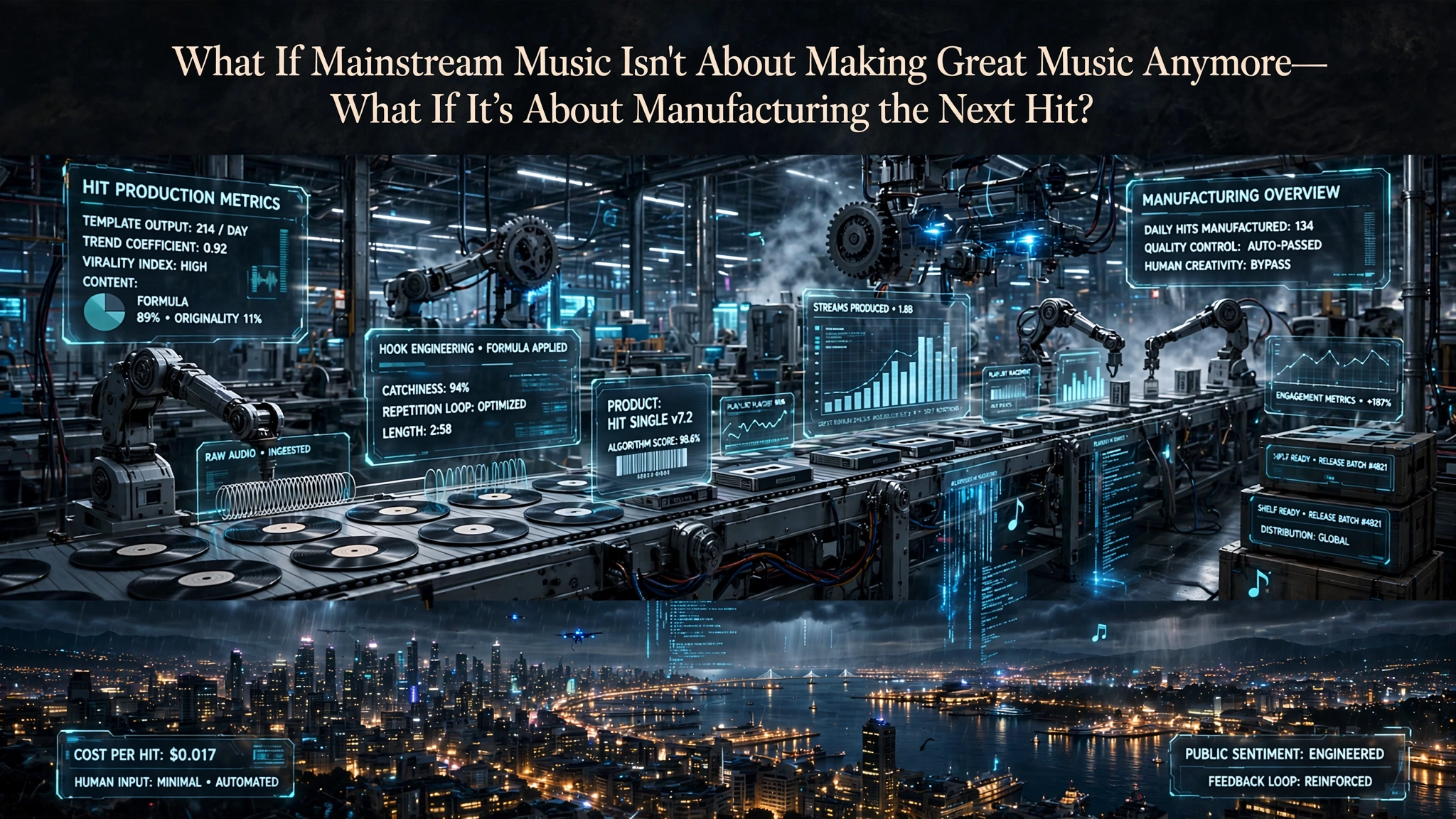
Remember when you could hear a song for the first time and immediately know you were listening to something special? Now it sometimes feels like the music industry is less interested in discovering the next great artist and more interested in manufacturing the next viral moment. We went from making music people couldn't stop listening to making music people can't stop scrolling past.
Let's talk about mainstream music, because something about the industry has changed.
We have more access to music than any generation before us. Millions of songs are available at our fingertips. Independent artists can record from their bedrooms, distribute their music globally, and potentially reach audiences without signing a traditional record deal.
Technology has made music more accessible than ever.
But somehow, the mainstream conversation can feel increasingly repetitive. The same production formulas, familiar songwriting structures, predictable collaborations, and artists chasing whatever sound currently dominates the charts.
Is that because artists aren't creative anymore? Absolutely not. There is incredible talent operating outside the mainstream spotlight.
But perhaps we're confusing what gets promoted with what deserves to be heard.
The music industry doesn't necessarily have to discover the best music. It has to identify music it believes it can sell.
When did the song become secondary to the rollout?
Look at how much attention goes into everything surrounding a release. The announcement, teaser clips, influencer campaigns, snippets, countdowns, music videos, interviews, controversy, and social media challenges.
Sometimes the promotional campaign becomes a bigger event than the actual music.
An artist can spend weeks building anticipation around a 15-second snippet. People memorize the preview, create theories about the release, and turn it into a trend before they've even heard the complete record.
Then the song drops, everybody talks about it for three days, and the internet moves on to the next thing.
Congratulations. You successfully launched a moment. Did you make a timeless record? That's a different conversation.
Viral doesn't automatically mean valuable.
A song can become popular because of a dance, a funny lyric, a controversial line, or a catchy ten-second section. None of that automatically makes the full song bad, but it does raise an interesting question about what we're rewarding.
Are people discovering music because they genuinely enjoy listening, or are they participating in a trend because everybody else is?
There's nothing wrong with a song becoming popular through social media. But when artists start creating music primarily around the possibility of going viral, creativity can become constrained by the demands of the algorithm.
Instead of asking, "What do I want to create?" the question becomes, "What will make people stop scrolling?"
And those aren't necessarily the same creative questions.
Record labels understand business. Artists understand expression. Sometimes those interests collide.
Major labels invest substantial money into recording, promotion, distribution, and artist development. They also take financial risks. Naturally, they want releases that have commercial potential.
But commercial potential can encourage familiar formulas. If a particular sound is generating streams, there's an incentive to find more artists who can reproduce it.
That's how entire waves of music can begin sounding similar.
One artist breaks through with a particular style. Suddenly, everybody wants that sound. Producers start recreating similar beats. Artists adjust their delivery. Marketing teams start looking for the next version of the same success.
Meanwhile, somebody creating something completely different might struggle to get the same attention.
It's not necessarily a conspiracy. It's a business incentive. But business incentives can influence culture in ways that deserve criticism.
Streaming changed the economics of music, but it also changed how people consume it.
We're living in an era where listeners can skip a song in seconds. Artists are competing for attention in an environment where the next recommendation is always waiting.
That creates pressure to capture listeners immediately.
Intros get shorter. Hooks arrive quickly. Songs are frequently designed with memorable moments that can be clipped, shared, and reused.
None of those choices automatically make a record inferior. Some incredible songs are short. Some incredible songs have immediate hooks.
But music doesn't always need to behave like an advertisement competing for your attention.
Sometimes a song needs time to develop. Sometimes the second verse is better than the first. Sometimes the bridge changes everything. Sometimes the production needs room to breathe.
Not every record needs to introduce itself, explain itself, and go viral before the first 30 seconds are over.
Where did the album experience go?
There was a time when people anticipated entire albums. They listened to the track sequence, discovered unexpected favorites, studied the lyrics, and connected with the project as a complete body of work.
That experience still exists, and plenty of artists continue making cohesive albums. But streaming has also encouraged playlist-driven listening, where individual tracks often compete for attention independently of the project they came from.
Sometimes an album feels less like a complete artistic statement and more like a collection of potential singles.
And that's unfortunate because an artist's identity shouldn't have to fit inside a three-minute marketing opportunity.
The biggest names aren't necessarily the only names worth listening to.
This is where independent music becomes important.
Some of the most interesting artists aren't receiving mainstream radio rotation. They're building their own audiences, releasing music independently, experimenting with different sounds, and finding listeners who appreciate what they're creating.
They might not have a major label budget. They might not have celebrity collaborations. They might not have a marketing department planning every move.
But they have something equally important: the freedom to create without constantly chasing somebody else's formula.
And that brings me to a bigger point.
If we're always waiting for mainstream platforms to tell us what music deserves our attention, we're giving somebody else control over our musical discovery.
There's an entire world of music outside the charts. Independent artists need listeners, not just compliments. They need people to actually play the records, share the releases, visit their websites, and support the work.
Maybe the future of music isn't about replacing mainstream artists. Maybe it's about giving listeners more reasons to look beyond the mainstream.
Because great music doesn't automatically become great because a label spent millions promoting it. And independent music doesn't automatically become inferior because it didn't receive a million-dollar marketing campaign.
We need artists who take risks, producers who experiment, songwriters who tell stories, and listeners who are willing to discover something unfamiliar.
I'm not against mainstream music. I'm against the idea that mainstream attention should be the final measurement of musical value.
We don't need another manufactured moment. We need more music that makes people feel something long after the moment is over.







Comments
No comments yet, be the first submit yours below.