Microsoft 365 Goes Down and Suddenly Your Digital Office Doesn't Exist—The Problem With Renting Your Productivity

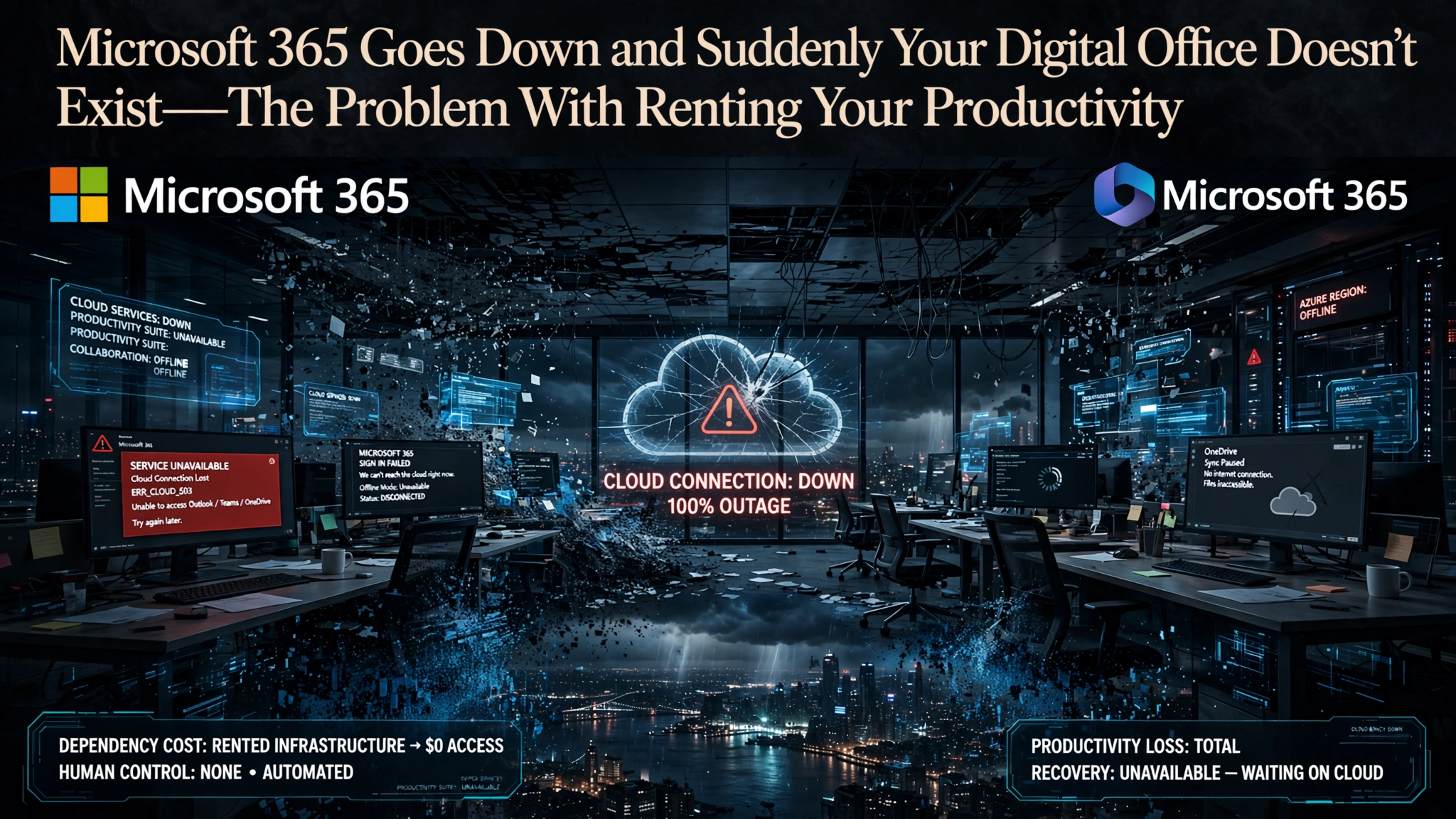
Imagine paying Microsoft every month to manage your email, documents, calendars, business communications, and productivity tools. Then one afternoon, Microsoft has an outage and suddenly you can't access the tools you depend on to get your work done. You don't own the infrastructure, you don't control the servers, and you can't fix the problem. You're just sitting there waiting for somebody else's engineers to bring your digital life back online.
Well, today Microsoft reminded everybody what happens when your entire workflow depends on somebody else's infrastructure.
On November 12, 2026, Microsoft experienced a widespread outage affecting Outlook and other Microsoft 365 services. Users reported problems accessing their mailboxes, sending and receiving email, and connecting to services including Teams, Copilot, and SharePoint.
Downdetector recorded nearly 130,000 Outlook problem reports shortly after 1 p.m. Eastern. Microsoft acknowledged connectivity problems involving Exchange Online and said elevated infrastructure load was contributing to the errors.
Microsoft later identified issues involving server health checks and elevated processor usage while it worked to restore affected infrastructure.
Now here's where I want to take this conversation beyond another technology outage.
What happens when the company providing the tools you need to operate your business becomes the reason you can't operate your business?
Your office might be in the cloud, but the cloud still has somebody else's power switch.
Think about how much modern business depends on Microsoft.
Your email is in Outlook. Your documents are in OneDrive. Your meetings are in Teams. Your spreadsheets are in Excel. Your business files are in SharePoint. Your employees communicate through Microsoft accounts.
You've essentially moved your entire office into Microsoft's ecosystem.
That might be convenient, but convenience comes with dependency.
When everything works, nobody questions the arrangement. You log in, open your applications, and get to work. But when the infrastructure experiences problems, the convenience disappears and you're reminded that access to a service isn't the same thing as owning the system behind it.
You're paying for access, not immunity from outages.
And this isn't exclusively a Microsoft problem. Google Workspace, Amazon Web Services, cloud hosting providers, and countless other platforms can experience outages, too.
The issue is how much of our daily lives and business operations we've concentrated inside systems we don't control.
We've replaced physical infrastructure with subscriptions and sometimes forgotten that the infrastructure still exists somewhere.
Somebody owns the servers. Somebody maintains the databases. Somebody controls the network. Somebody decides when systems are updated, changed, or taken offline.
And when something goes wrong, your monthly subscription doesn't magically give you control over the recovery process.
The bigger problem is that one outage can affect multiple parts of your operation.
Imagine a company that depends on Outlook to receive customer orders, Teams to communicate with employees, SharePoint to access documents, and Copilot to assist with everyday tasks.
One infrastructure problem can create a chain reaction across departments.
Employees can't access information. Customers can't get responses. Meetings get interrupted. Work gets delayed. Deadlines don't magically move because a cloud provider is experiencing technical difficulties.
And the company still has payroll, operating expenses, customers, and responsibilities to handle.
That's the hidden cost of digital dependency. The subscription price might be predictable, but the business consequences of an outage aren't always included in the monthly bill.
Here's something independent developers should be thinking about.
Do you actually need to outsource every part of your operation?
I'm a fan of building your own infrastructure where it makes practical sense. You can run your own web server, manage your own database, control your application code, and maintain your own content management system.
That doesn't mean self-hosting eliminates outages. Your internet connection can fail. Your server can crash. Your hardware can break. Your building can lose power. You become responsible for backups, security, maintenance, and recovery.
But there's a difference between having a problem with infrastructure you control and having a problem with infrastructure you cannot access or repair yourself.
At least when you own the system, you have the ability to investigate it, troubleshoot it, and decide how to respond.
Maybe businesses need to rethink what digital independence actually means.
It doesn't mean refusing to use cloud services. It means having a backup plan when those services become unavailable.
Keep independent backups of critical documents. Maintain alternative communication channels. Understand how to access important information without depending on one application. Make sure your business can continue operating when a provider experiences an outage.
And perhaps most importantly, stop treating convenience as a replacement for contingency planning.
The cloud is somebody else's computer, and today a lot of people were reminded of that.
Microsoft will work through the outage. Services will recover. People will eventually get back to their inboxes and meetings.
But the bigger lesson shouldn't disappear when the login screen starts working again.
Because the next outage could involve another provider, another platform, or another critical service your business depends on.
Technology is supposed to make us more productive. It shouldn't leave us completely helpless when somebody else's infrastructure has a bad day.
Build your business around technology, but don't build it so completely around somebody else's technology that you can't function without their permission—or their uptime.











Comments
No comments yet, be the first submit yours below.