E-Bikes Are the Problem? Let's Talk About Cars, Speed, Licensing, and Accountability

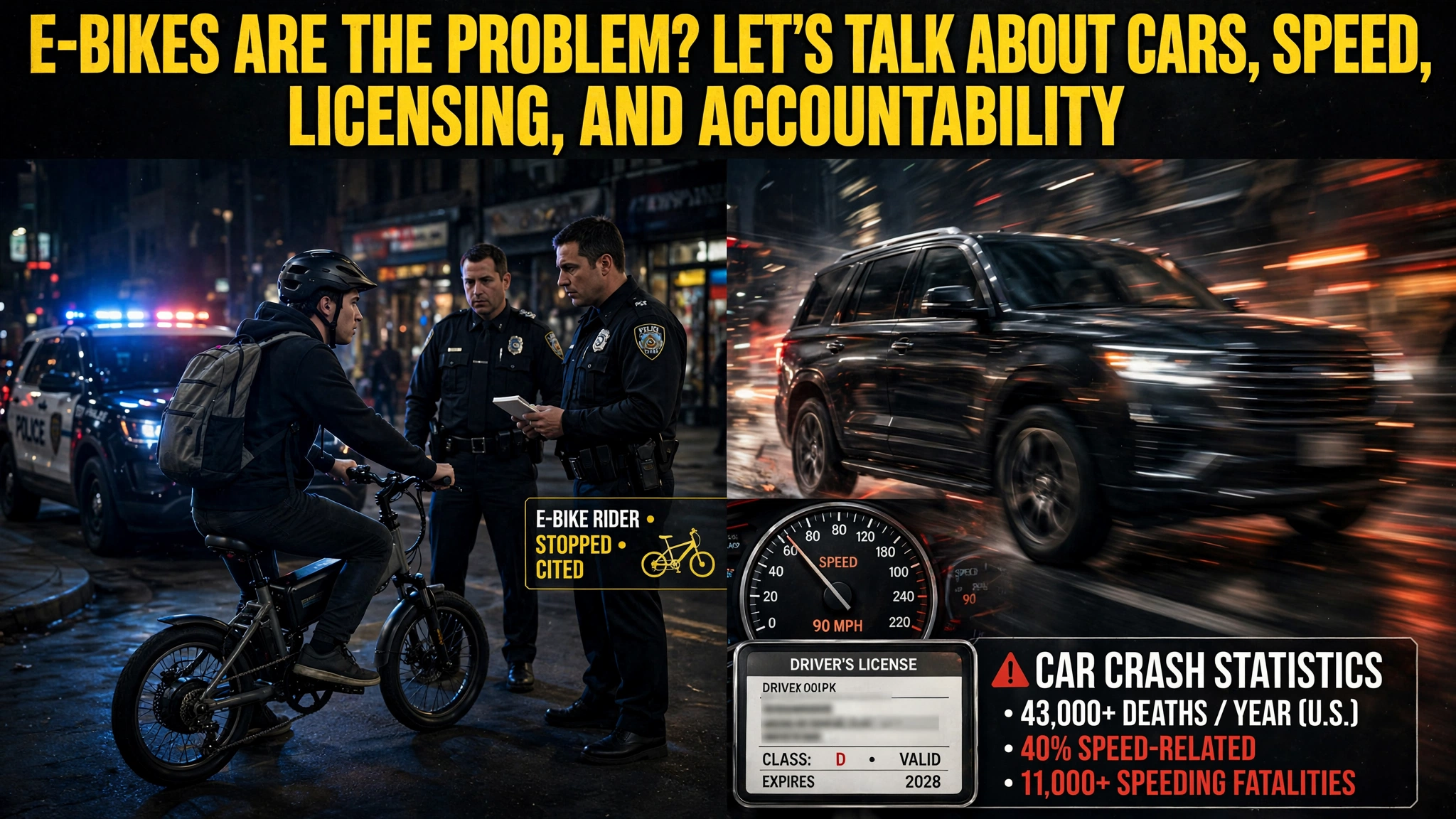
Every time I see a video of somebody riding an electric bike or scooter in the street, I already know what the comments are going to look like: "What happens when they hit my car?" "Who is going to pay for my damages?" "They need a license." "They need registration." "They need insurance."
And honestly, let's talk about that logic for a second, because some of these comments make it sound like e-bike riders are roaming the streets in 4,000-pound battering rams looking for somebody's precious bumper to destroy.
We're talking about a person on a relatively lightweight vehicle, usually weighing a fraction of what a car weighs, and somehow the first concern is the potential damage to the automobile.
Meanwhile, that same automobile can weigh several thousand pounds, travel at highway speeds, and potentially cause life-changing injuries to the person riding that e-bike.
But apparently the bicycle is the emergency.
What Happens When a Car Hits the E-Bike?
This is the part that gets me. People constantly frame the conversation as if the greatest danger on the road is an e-bike crashing into somebody's car.
Let's reverse the scenario.
What happens when the car hits the e-bike?
The car might get a dent. The e-bike might get destroyed. And the person riding the e-bike could end up seriously injured or dead.
That's the reality of physics. A several-thousand-pound vehicle colliding with a person on a lightweight bicycle isn't exactly an equal matchup.
Somehow the person sitting inside a two-ton machine is worried about what happens to their bumper when they collide with somebody sitting on a bicycle.
And before somebody gets offended, no, I'm not saying e-bike riders should be reckless. They shouldn't. If you're riding an e-bike, you should obey traffic laws, pay attention, use proper lighting, ride responsibly, and understand that you're sharing the road with vehicles that can seriously hurt you.
But responsibility goes both ways.
Drivers don't get a magical exemption from paying attention simply because they're sitting inside a metal box.
If anything, the person operating the heavier, faster, more dangerous machine should have an enormous incentive to pay attention to the smaller vehicle around them.
Why Does Every Conversation Suddenly Become "They Need a License"?
Here's where the conversation gets even more ridiculous. Someone sees an e-bike riding down the street and suddenly they're demanding a driver's license, registration, license plates, mandatory insurance, inspections, taxes, and God knows what else.
Why?
What specific problem are those requirements solving?
If someone is reckless, enforce the existing traffic laws. If someone causes damage, establish liability. If someone steals an e-bike, prosecute the theft. If someone rides dangerously, hold them accountable.
But why does the solution automatically become "let's turn the bicycle into a miniature automobile"?
That's the part that doesn't make sense.
Every time somebody invents a cheaper way to get around without a car, somebody immediately asks how we can make it operate more like a car.
Think about how backwards that sounds.
Instead of asking how we can make alternative transportation safer and more accessible, the first instinct is often to pile on regulations until the alternative becomes almost as complicated and expensive as the thing it was supposed to replace.
Let's Talk About Speed
If your argument is that e-bikes are dangerous because they can move quickly, then congratulations: you've accidentally opened an even bigger conversation about automobiles.
Modern cars can be manufactured to reach 100, 150, 200 miles per hour or more.
Motorcycles can reach astonishing speeds.
Sports cars are literally marketed based on acceleration and top speed.
Manufacturers brag about how quickly these vehicles can go from zero to sixty.
And these machines are allowed to share public roads where the legal speed limit might be 35, 45, 55, 65, or 75 miles per hour.
So we have vehicles capable of going more than twice the legal speed limit sitting in people's driveways, and we're having national-level arguments about whether somebody on an electric bicycle has too much motor assistance.
Make it make sense.
We Build 200 MPH Cars and Then Panic Over an E-Bike
This is where the whole argument starts looking comical.
We manufacture automobiles capable of going over 100 miles per hour. We manufacture motorcycles capable of going over 150 miles per hour. We manufacture performance vehicles capable of going 200 miles per hour or more.
Then somebody puts an electric motor on a bicycle and suddenly everyone becomes a transportation safety engineer.
We build cars capable of going 200 MPH, then look at an electric bicycle and say, "Whoa, that's too much power."
There is absolutely a legitimate conversation to have about appropriate e-bike classifications, speed limits, motor power, and safety.
But let's stop pretending that an e-bike and a high-performance automobile have remotely the same physical risk profile.
A 4,000-pound vehicle traveling at 60 miles per hour carries an enormous amount of kinetic energy. A lightweight bicycle traveling at a much lower speed simply isn't operating in the same category.
Different machines have different risks. Different risks should produce different regulations. That's called common sense.
And Then Comes the Wattage Argument
Another thing people don't seem to understand is that limiting the wattage of an electric bike isn't some magical safety switch.
Motor power affects more than top speed.
It can affect acceleration, hill climbing, carrying cargo, riding against wind, maintaining speed, and the ability to travel practical distances under real-world conditions.
If you're riding on flat pavement by yourself, almost anything might work. Now put that same rider on a steep hill with groceries, a delivery bag, or another load, and suddenly that "low-power" motor doesn't look quite so impressive.
There is a difference between creating reasonable safety classifications and deliberately making a vehicle so underpowered that it becomes impractical.
The Double Standard Is the Real Problem
Nobody is arguing that e-bikes should have unlimited speed. Nobody is arguing that riders should be able to ignore traffic laws. Nobody is arguing that someone who causes an accident shouldn't be responsible for the damage.
That's not the argument.
The argument is consistency.
If we're going to regulate transportation based on speed, weight, power, danger, and potential damage, then let's actually use those factors intelligently.
Don't look at a bicycle and say, "It has a motor, therefore it needs to be regulated exactly like my car."
That's lazy policymaking.
A bicycle with an electric motor isn't automatically equivalent to a 4,000-pound automobile simply because both use motors.
A motor doesn't magically turn a bicycle into a car. Just like putting wheels on a tank doesn't make it a shopping cart.
Cars Already Own the Transportation Infrastructure
Let's also talk about the massive advantage automobiles already have.
Our entire transportation system has been built around cars.
Roads. Highways. Parking lots. Parking garages. Gas stations. Car dealerships. Auto repair shops. Insurance companies. Registration systems. Fuel taxes. Toll roads. Traffic signals.
Billions of dollars and entire industries revolve around automobile transportation.
Then somebody comes along and says, "Wait a minute. I can ride an electric bike several miles without gasoline, without taking up an entire parking space, and without driving a several-thousand-pound machine everywhere."
And suddenly the conversation becomes:
"Does it have a license?"
"Does it have a plate?"
"Does it have insurance?"
"How much power does it have?"
"How fast can it go?"
Maybe we should ask a different question:
Why are we so desperate to make every alternative form of transportation behave like a car?
What About "Who Pays If It Hits My Car?"
This might be the favorite argument in every comment section.
"Who is going to pay for my car?"
Fair question.
But here's the thing: if an e-bike rider causes damage, they should be held responsible for that damage.
Nobody is arguing against accountability.
But let's apply that same energy everywhere.
If a driver hits an e-bike, who pays for the rider's medical expenses? Who pays for the destroyed bicycle? Who compensates someone who can't work because they were injured? Who pays when a distracted driver crosses into a bike lane?
Suddenly the comment section gets real quiet.
It's fascinating how quickly people become passionate about property damage when their bumper is involved but suddenly become philosophers when somebody else's body is involved.
The Person on the E-Bike Is Not Protected by a Steel Cage
Here's another thing that seems to get ignored.
When you're driving a car, you're surrounded by thousands of pounds of metal, airbags, seat belts, reinforced structures, and other safety equipment.
The person on an e-bike doesn't have that luxury.
They're exposed.
They're sitting inches away from the road.
A mistake that results in a minor fender-bender between two cars can become a life-threatening event when one of those vehicles is a bicycle.
The e-bike rider doesn't have a bumper. They are the bumper.
So when somebody says, "I'm worried about what happens to my car if I hit them," they're missing an enormous part of the equation.
Maybe the Real Problem Isn't E-Bikes
Maybe the real problem is that our transportation culture has become so car-centered that anything outside of an automobile seems suspicious.
If you're walking, people complain you're in the way.
If you're riding a bicycle, people complain you're in the way.
If you're riding an e-bike, suddenly you need a license plate.
But put someone inside a 4,000-pound vehicle and apparently the road belongs to them.
That's not a transportation philosophy. That's car dependency.
Maybe the Real Fear Is Change
Here's the uncomfortable part. E-bikes aren't simply bicycles with batteries. They represent an alternative to the traditional automobile model.
A person can potentially travel several miles without buying gasoline. They can avoid searching for a parking space. They can use far less energy. They can navigate congested areas. They can get exercise while traveling. And for some people, an e-bike can be substantially cheaper than owning and operating a car.
That's a pretty disruptive idea when you've built an entire economy around people needing automobiles for almost everything.
And whenever something threatens an established system, the conversation inevitably becomes:
"Is it safe?"
"Should it be regulated?"
"Should it be taxed?"
"Should it require registration?"
Those are legitimate questions.
But they shouldn't become excuses to kill the usefulness of the technology.
Stop Pretending the E-Bike Is the Enemy
If you drive a car, you have every right to expect everyone else on the road to follow the rules.
E-bike riders should expect the exact same thing from drivers.
But let's stop acting like the e-bike is some two-wheeled missile cruising around town hunting for innocent vehicles.
Cars are heavier. Cars are faster. Cars travel farther. Cars consume vastly more energy. Cars occupy more space. Cars cause substantially more physical damage when they collide with vulnerable road users.
And yet somehow the bicycle is the thing we're supposed to be terrified of.
If your biggest argument against e-bikes is "What if it hits my car?" maybe the conversation should also include, "What happens when my car hits the person?"
Let's Regulate Based on Reality, Not Fear
There is nothing wrong with reasonable safety regulations. There is nothing wrong with holding reckless riders accountable. There is nothing wrong with requiring appropriate equipment or establishing sensible classifications for different types of electric bicycles.
But regulation should solve an actual problem.
It shouldn't exist simply because people are uncomfortable watching transportation evolve.
If an e-bike is too fast for a particular class, classify it differently. If a rider is operating recklessly, enforce the law. If somebody causes damage, establish liability. If a vehicle is genuinely unsafe, regulate the unsafe feature.
But don't take an entire category of transportation and bury it underneath so many restrictions that the technology becomes useless.
The Bottom Line
The conversation shouldn't be "Cars versus e-bikes."
It should be about creating a transportation system where cars, motorcycles, bicycles, scooters, pedestrians, and electric bikes can all coexist safely.
But if we're going to have that conversation, let's stop pretending the smallest vehicle on the road is automatically the biggest threat.
Let's stop pretending that a bicycle with an electric motor is equivalent to a high-performance automobile.
Let's stop demanding that every alternative transportation option be licensed, registered, insured, taxed, and regulated into the exact same mold as a car.
And most importantly, let's stop having a one-sided conversation about "What happens if the e-bike hits my car?" while ignoring the far more serious question:
What happens when the car hits the person?
Because if we're actually serious about road safety, we should care about the human being on the other side of the windshield just as much as we care about the paint on the bumper.
That's the conversation worth having.







Comments
No comments yet, be the first submit yours below.