The Paycheck Went Up—So Why Does It Still Feel Like You're Falling Behind?

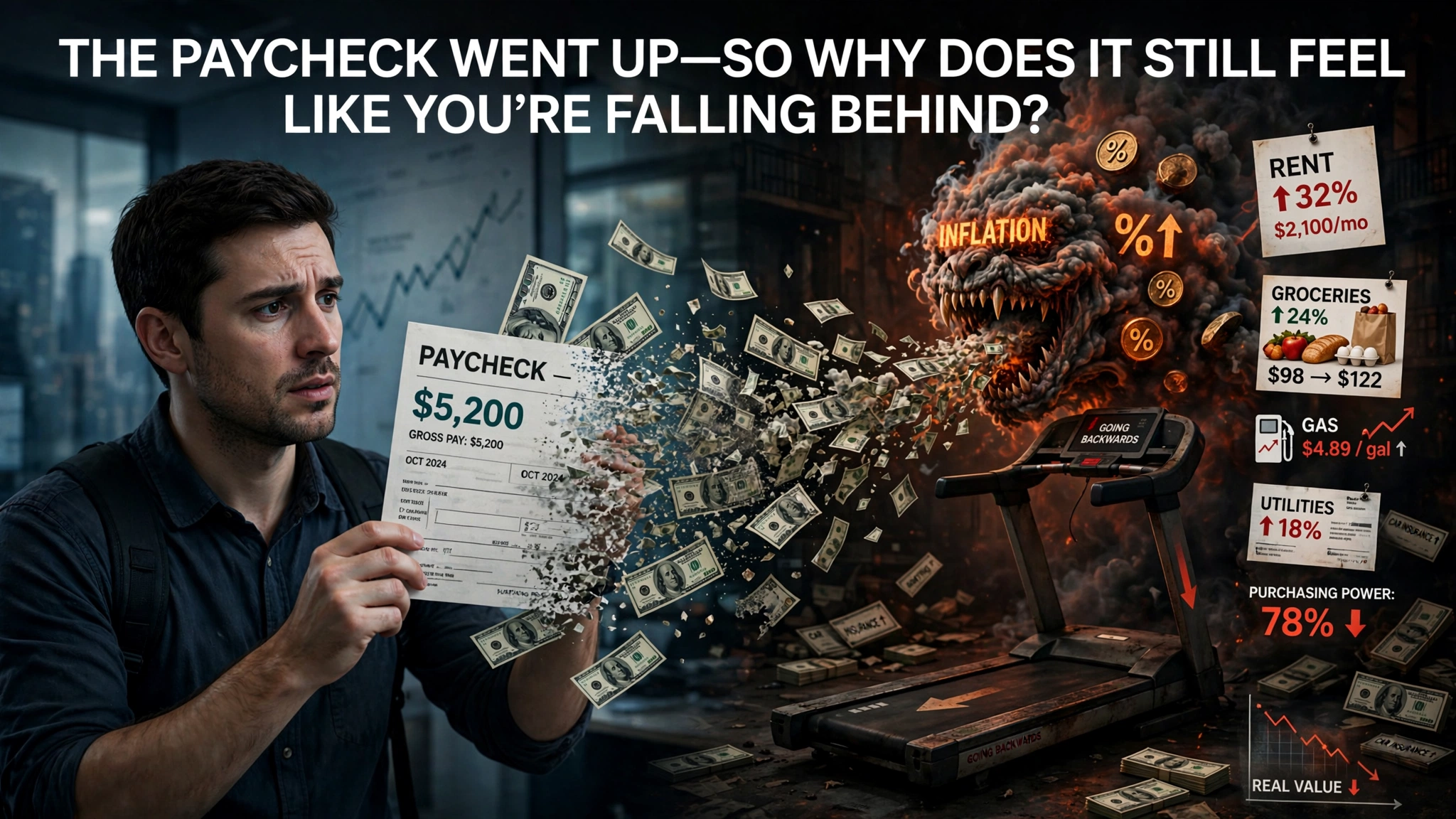
Sometimes making more money doesn't feel like getting ahead. It just feels like paying for a more expensive version of the same struggle.
You get a raise.
For a moment, it feels like you've finally made progress.
Then the rent increases.
The insurance bill goes up.
The grocery bill gets bigger.
The car needs repairs.
The phone bill somehow costs more.
And suddenly that extra money has already been assigned to five different problems.
So you start wondering: “Did I actually get ahead?”
This is one of the strangest parts of modern middle-class life.
Your income can increase while your sense of financial security barely moves.
You can be making more than you did five years ago and still feel like you're standing in the same place.
That's because income isn't the same thing as purchasing power.
And purchasing power isn't the same thing as wealth.
A bigger paycheck can improve your life without necessarily changing your financial position.
If your expenses rise alongside your income, the additional money can disappear before it ever becomes useful.
You aren't necessarily spending recklessly.
Sometimes everything around you simply costs more.
That distinction matters.
Because people often respond to financial pressure by blaming themselves entirely.
“I need to budget better.”
“I need to stop buying coffee.”
“I need to work more hours.”
Personal decisions matter, but they aren't the entire story.
You can be financially disciplined and still live inside an expensive economy.
That's why the goal can't simply be earning more.
The bigger question becomes: What happens to the extra money when you earn it?
Does it immediately disappear into higher consumption?
Does it pay down expensive debt?
Does it build an emergency fund?
Does it purchase an asset?
Does it create another source of income?
Does it give you more choices?
Because the real upgrade isn't always a better lifestyle. Sometimes it's a stronger financial position.
Imagine receiving an extra $300 a month.
You could turn it into a nicer phone, more restaurant meals and a more expensive subscription stack.
Or you could use some of it to eliminate debt, build cash reserves and buy investments.
Neither decision makes somebody a better person.
But they produce very different outcomes over time.
The middle class doesn't just need higher incomes. People need a path from income to ownership.
Because there is a major difference between earning money and having something that continues creating value after the workday ends.
A paycheck pays you for your labor.
An asset can continue working after you stop.
That's why ownership matters.
Stocks.
Businesses.
Property.
Intellectual property.
Skills that increase your earning power.
Cash reserves that prevent emergencies from becoming debt.
The objective isn't to look richer. It's to become harder to financially knock over.
Maybe the next raise doesn't need to become a bigger lifestyle.
Maybe part of it becomes a stronger foundation.
Maybe the goal isn't to finally afford everything you've been missing.
Maybe the goal is to eventually stop feeling like every unexpected expense can knock you backward.
Getting ahead isn't always about having more money coming in.
Sometimes it's about making sure more of the money coming in actually stays with you.
That's when a raise starts becoming progress instead of just another temporary breath before the next bill arrives.










Comments
No comments yet, be the first submit yours below.