Amazon Wants 300,000 Holiday Workers—But What Happens When Christmas Is Over and the Robots Take Over?

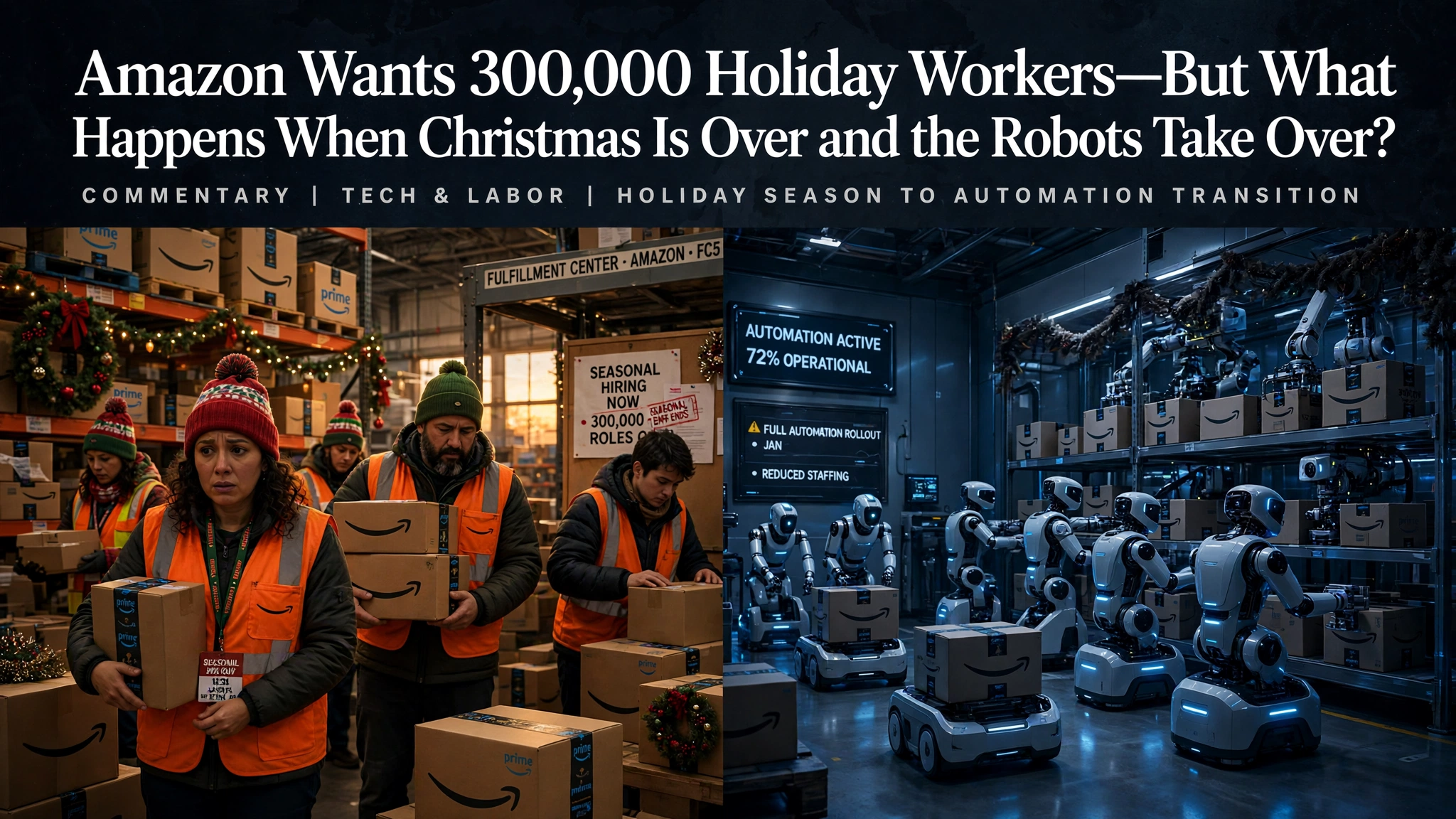
Amazon wants to hire hundreds of thousands of seasonal workers for the holidays. That's a lot of jobs—but here's the question nobody should ignore: What happens when the holidays are over, the seasonal workers are gone, and automation keeps advancing? These companies were welcomed into communities with promises of jobs and economic growth, not promises that technology would eventually make workers less necessary.
Every holiday season, major retailers need more hands to handle the rush. Packages have to be sorted, orders have to be packed, trucks have to be loaded, and customers expect their deliveries to arrive on time. For people looking to earn extra money, seasonal hiring can provide a valuable opportunity.
But let's look beyond the holiday headlines. A company announcing hundreds of thousands of seasonal positions sounds impressive, but how many of those jobs will still exist after Christmas? How many workers will be offered permanent positions? And how many people are simply being brought in to handle a temporary surge before business slows down again?
Seasonal employment isn't automatically a bad thing. People can use it to pay bills, buy Christmas presents, catch up on expenses, or get their foot in the door. The problem is when temporary hiring numbers are celebrated as proof of economic opportunity without discussing how temporary those opportunities actually are.
And there's another part of this conversation we cannot ignore: these corporations were welcomed into communities because they promised to bring jobs, not take them away.
Think about it. When a massive corporation wants to build a warehouse or distribution center, local officials often promote the project as an economic development opportunity. Residents hear about new jobs, increased business activity, and opportunities for local families. Communities make room for these facilities, invest in infrastructure, and sometimes offer tax incentives to attract major employers.
The message is straightforward: Let us build here, and we'll help your community prosper.
But what happens when that same company starts investing more heavily in robotics, artificial intelligence, and automated systems that can reduce the need for human labor? What happens when the business that was once celebrated for creating jobs starts finding ways to operate with fewer workers?
To be clear, Amazon's seasonal hiring announcements do not prove that those specific workers will be replaced by robots. Seasonal jobs have always fluctuated with demand, and automation can also create new types of employment. But the broader shift toward automation raises a legitimate question about the long-term future of warehouse and distribution jobs.
Imagine being a young person in a community where a major employer is considered one of the best opportunities available. You train for the work, depend on the paycheck, and build your life around the expectation that there will be opportunities to advance. Then, over time, the company introduces technology that changes how many workers it needs.
What are you supposed to do? Start over? Pay for new training? Compete for a smaller number of positions? And what happens to the local businesses that depend on those workers spending their paychecks in the community?
When a warehouse employs thousands of people, those paychecks don't stop at the warehouse door. Workers buy groceries, pay rent, purchase vehicles, support restaurants, and spend money at neighborhood businesses. Those wages circulate throughout the local economy.
If employment shrinks significantly, the effects can reach beyond the people who lose their jobs. The local economy can feel the consequences, too. A business that once benefited from a large workforce may see fewer customers. Families may struggle to cover expenses. And a community that expected long-term economic growth may have to reconsider its future.
Now, here's where local governments and corporate leaders need to answer some serious questions. If a community offers tax incentives or other public benefits to attract a major employer, what happens if the number of jobs falls well below expectations? Were those incentives tied to actual job creation? Are there accountability provisions? Does the community have any way to evaluate whether the deal delivered what residents were promised?
These aren't anti-business questions. They're responsible economic questions. Businesses have every reason to improve efficiency, compete, and invest in new technology. But communities also have a legitimate interest in making sure economic development agreements produce meaningful benefits for the people who live there.
And let's be honest: workers are expected to adapt to everything. They must learn new systems, increase productivity, meet tighter deadlines, and compete with new technology. Meanwhile, corporations are under no obligation to guarantee that every position will exist forever. That's the reality of a changing economy—but it doesn't mean workers shouldn't demand better preparation, training opportunities, and a fair chance to benefit from the productivity improvements they help make possible.
Automation could make dangerous jobs safer, reduce repetitive tasks, and lower costs. Those are real potential benefits. The question is whether those benefits will translate into better opportunities for workers, or whether the gains will primarily flow to the businesses that own the technology.
Imagine a future where technology allows a warehouse to process twice as many packages with half the labor. That's an enormous productivity improvement. But if fewer people are needed to do the work, what happens to the people who depended on those jobs? Could companies invest more in retraining, higher-skilled positions, better wages, or shorter working hours? Could local governments negotiate stronger commitments when public incentives are involved?
Those are conversations worth having now, before entire communities find themselves reacting to changes they could have anticipated.
Because the original pitch was about jobs, opportunity, and economic growth. It wasn't simply about building enormous facilities, increasing corporate profits, and hoping the local workforce would figure everything else out.
And this issue goes far beyond Amazon. It applies to every major employer that enters a community promising opportunity while the economy around it changes. If businesses benefit from public support, residents deserve transparency about the agreements being made and honest discussions about the future of the jobs being created.
A company doesn't have to promise that every job will exist forever. But communities should be able to ask whether the economic benefits they were promised are actually being delivered.
So here's the question: If corporations are welcomed into communities because they promise to create jobs, should they have a greater responsibility to help those communities adapt when automation changes the workforce—or should communities simply accept that the jobs they were promised may eventually disappear?
Because if the promise was economic opportunity, the conversation shouldn't end when the building opens. It should continue as long as that company benefits from being there.










Comments
No comments yet, be the first submit yours below.