Is the Death Penalty Really Worse Than Life in Prison Without Parole? Let's Talk About It.

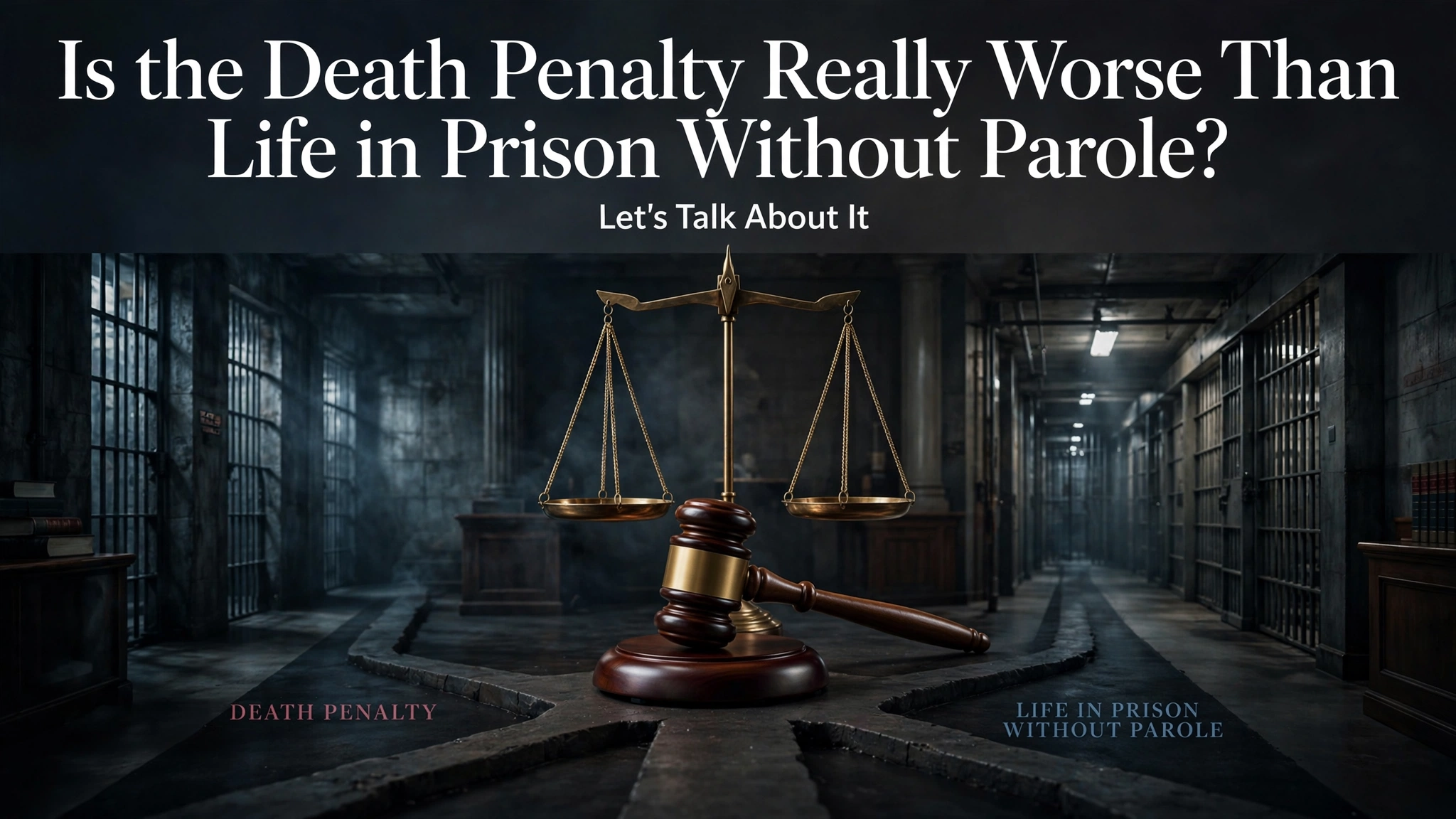
Here's an uncomfortable question: Is being sentenced to death really worse than being sentenced to spend the rest of your life in prison? Because when I think about it, I'm not sure the death penalty is the harsher punishment in every situation. One sentence ends your life. The other sentence can leave you waking up behind bars every single day, knowing you'll never experience freedom again. Which one is truly harder to live with?
We spend a lot of time debating whether the death penalty is cruel and unusual punishment, whether the government should have the power to execute someone, and whether capital punishment belongs in a modern justice system. Those are serious questions, and they deserve serious consideration.
But there's another side to this debate that doesn't always get the same attention: What does it actually mean to spend the rest of your life in prison with no possibility of release?
Imagine waking up every morning knowing that your sentence has no expiration date. There is no countdown to freedom. No parole hearing to look forward to. No realistic plan to return home, rebuild your life, see the world again, or enjoy the ordinary things most people take for granted.
Years turn into decades. People you love grow older. Children become adults. The outside world changes, technology advances, and life continues without you. You might spend your entire remaining life watching the world move forward from behind a prison wall.
With a death sentence, the government sets an endpoint. With life without parole, the sentence itself can become your entire future.
Of course, that doesn't mean every person would choose death over imprisonment. Some prisoners find meaning in religion, relationships, education, writing, or helping others. Some continue to hope for legal relief. Others would do anything to remain alive, even if freedom is never an option. People experience suffering differently, and we shouldn't pretend there's one universal answer.
But I understand why someone might look at the two punishments and question which one is more severe. Is it worse to know your life will end through an execution, or to know that you will remain alive for decades with no opportunity to return to society?
Then there's the question of time. Capital cases can involve years of appeals, uncertainty, and confinement while a person awaits execution. Life without parole can also mean decades of imprisonment. Neither punishment is necessarily quick, simple, or emotionally straightforward.
And here's where the conversation becomes even more complicated: What happens when the justice system gets it wrong?
An execution cannot be reversed. If new evidence later proves that an innocent person was convicted, the government cannot give that person their life back. Someone sentenced to life imprisonment may also lose decades they can never recover, but exoneration can at least make release possible.
That risk is one of the strongest arguments against capital punishment. The question isn't just whether someone deserves punishment for a terrible crime. It's whether the government can be trusted with a punishment that leaves no opportunity to correct a fatal mistake.
Supporters of the death penalty may argue that certain crimes are so horrific that the most severe punishment is justified. Opponents may argue that the possibility of wrongful convictions, unequal application, and irreversible state action makes execution unacceptable. Others question whether either punishment achieves the goals people expect from it.
Meanwhile, life without parole raises its own moral questions. If someone will never be released, what is the purpose of keeping that person incarcerated until death? Is it public safety, accountability, deterrence, or simply punishment? And how should society weigh those goals against the cost and human consequences of decades of imprisonment?
These aren't easy questions, and a person's answer may depend on the crime, the evidence, the rights of victims and their families, and their beliefs about justice.
But I think we should be able to discuss the comparison honestly without assuming that every person views death as the worst possible outcome or that life imprisonment is automatically the more humane alternative.
Because punishment isn't measured only by whether someone survives. Sometimes the debate is about what kind of life remains after the sentence is handed down.
So here's the question I want people to debate: If someone is convicted of a crime that carries the possibility of execution or life in prison without parole, which punishment do you believe is more severe—and why?
And more importantly, should the government have the power to make that decision irreversible when the justice system, like every human institution, is capable of making mistakes?









Comments
No comments yet, be the first submit yours below.