What If the Grays Aren't Visiting Earth—What If They're Abducting Humans for a Reason?

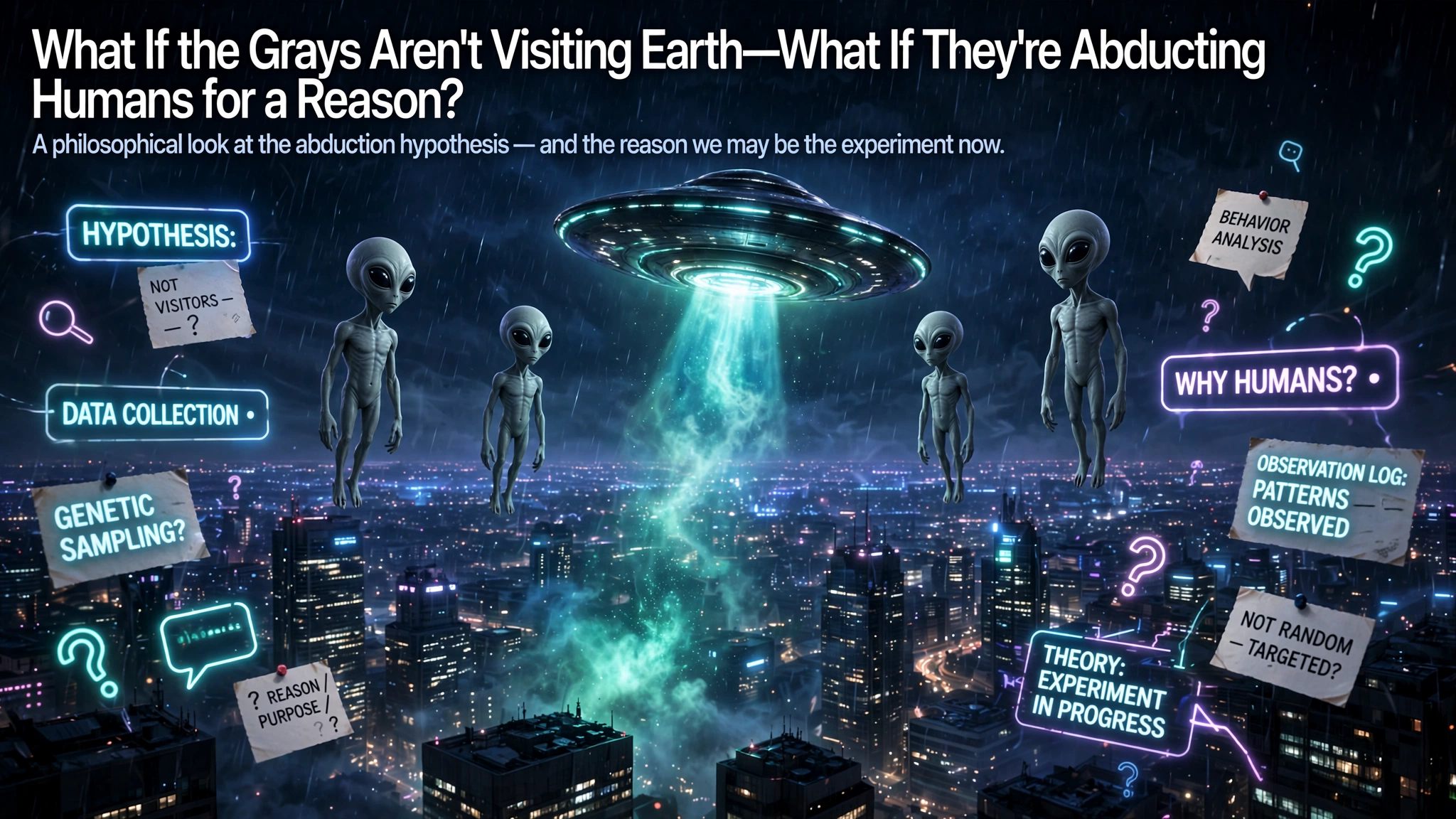
Imagine waking up in the middle of the night, looking toward your bedroom door, and seeing a small, gray-skinned figure with enormous black eyes standing there. You try to move, but your body won't respond. Then suddenly, you're no longer in your bedroom. You're on a table inside a spacecraft, surrounded by beings who seem far more interested in studying you than speaking to you. Now here's the uncomfortable question: What if the stories about the Grays aren't random encounters? What if there's a reason behind the alleged abductions?
For decades, people have reported encounters with strange beings commonly described as the Grays: small humanoid figures, oversized heads, enormous dark eyes, thin bodies, and barely visible mouths. They're among the most recognizable figures in modern UFO folklore.
The stories often follow a familiar pattern. Someone claims they were taken from their bedroom, transported aboard an unidentified craft, examined by unfamiliar beings, and eventually returned. Some describe missing time. Others report strange dreams, unexplained memories, or the feeling that something happened to them that they cannot fully explain.
But let's separate the mystery from the evidence. There is no independently verified proof that extraterrestrial Grays are abducting humans. Sleep paralysis, false memories, dreams, psychological experiences, and cultural influences can help explain some reported encounters. That doesn't mean every person telling a story is deliberately making it up. It means an experience can feel completely real without establishing that an alien spacecraft was involved.
BUT WHAT IF WE ENTERTAIN THE POSSIBILITY?
Imagine a civilization capable of traveling between star systems. If such beings existed and had the technology to reach Earth, their scientific capabilities could be centuries, thousands of years, or even millions of years beyond ours.
Why would they need to abduct people?
Are they studying human biology? Are they examining our reproductive systems? Are they collecting genetic information? Are they monitoring how our species develops? Or are humans simply interesting biological specimens to a civilization that has already mastered things we haven't even figured out?
Think about how humans study animals. We capture wildlife, attach tracking devices, collect samples, monitor migration patterns, and conduct research without explaining our intentions to the animals. From the animal's perspective, we're mysterious creatures with incomprehensible technology.
Now reverse the relationship.
What if we're the wildlife?
ARE THEY INTERESTED IN OUR GENETICS?
One of the most common themes in abduction folklore involves medical examinations and reproductive experiments. Some accounts describe examinations involving blood, tissue, or reproductive systems. Others include claims about hybrid offspring or genetic manipulation.
These claims remain unverified, but they raise an interesting hypothetical question: If an advanced civilization wanted to understand human biology, would studying our genetic makeup be one of the most valuable ways to do it?
We already use genetic research to understand inherited diseases, evolution, reproduction, and biological differences. A civilization with vastly more advanced biotechnology might have scientific questions we haven't even developed the vocabulary to ask.
Of course, imagining a possible motive isn't evidence that the activity is happening.
WHY THE BEDROOM?
Another recurring detail in abduction accounts is that encounters supposedly happen while people are sleeping.
Why not approach someone during the day? Why not land in a public parking lot? Why not make contact with an entire government agency?
One possible explanation doesn't involve aliens at all: sleep paralysis can create vivid experiences of a presence in the room, an inability to move, and frightening visual or auditory hallucinations. Throughout history, different cultures have interpreted these experiences through the supernatural, religious, and extraterrestrial lenses.
But if we stay inside the hypothetical, perhaps nighttime encounters would offer privacy, reduce the chance of witnesses, and minimize disruption.
Then again, if a civilization can cross interstellar distances, you would think it could figure out how to knock on a door.
WHAT IF THEY'RE NOT HOSTILE?
Not every abduction story describes violence or an obvious threat. Some accounts portray the beings as clinical, detached, or simply uninterested in human emotions.
And that might be more unsettling than an aggressive encounter.
Imagine being examined by something that doesn't hate you, doesn't love you, and doesn't particularly care whether you're frightened. You're simply part of an observation.
That's a disturbing possibility to consider because intelligence and morality aren't necessarily the same thing. Being technologically advanced wouldn't automatically make a civilization compassionate, ethical, or interested in our well-being.
Humanity has already demonstrated that scientific progress doesn't always come with moral progress.
WHY WOULD THEY KEEP COMING BACK?
Some people who report abduction experiences claim that encounters happened more than once. In UFO folklore, recurring encounters are sometimes interpreted as long-term monitoring or ongoing experimentation.
Could an advanced civilization be observing particular individuals over time? Could they be tracking environmental changes, human development, or something about our species?
Or could recurring experiences be connected to sleep disorders, memory reconstruction, expectations, and stories people have encountered throughout their lives?
Those are very different explanations, and we shouldn't confuse speculation with confirmation.
THE BIGGER QUESTION IS WHETHER WE WOULD EVEN RECOGNIZE FIRST CONTACT.
We tend to imagine extraterrestrial contact as a dramatic event: a massive spacecraft hovering over a major city, world leaders making announcements, and television networks interrupting programming.
But what if contact, assuming it ever happens, looks nothing like Hollywood?
What if it's indirect? What if it's something we initially misunderstand? What if the technology is so unfamiliar that we struggle to identify what we're seeing?
And what if the most important question isn't whether aliens are visiting Earth, but how humanity would respond if we ever received undeniable evidence that we weren't alone?
We can debate the Grays, examine eyewitness accounts, investigate unexplained sightings, and question what governments know. But extraordinary claims still require extraordinary evidence. A frightening story isn't proof, and an unexplained experience isn't automatically extraterrestrial.
Still, the thought experiment is fascinating.
Because if another civilization ever does arrive here, I hope they understand one thing: humanity has enough problems already. We don't need extraterrestrial roommates conducting midnight medical examinations without leaving a business card.









Comments
No comments yet, be the first submit yours below.