We Teach Children to Ask Permission for Everything, Then Wonder Why Adults Are Afraid to Make Decisions

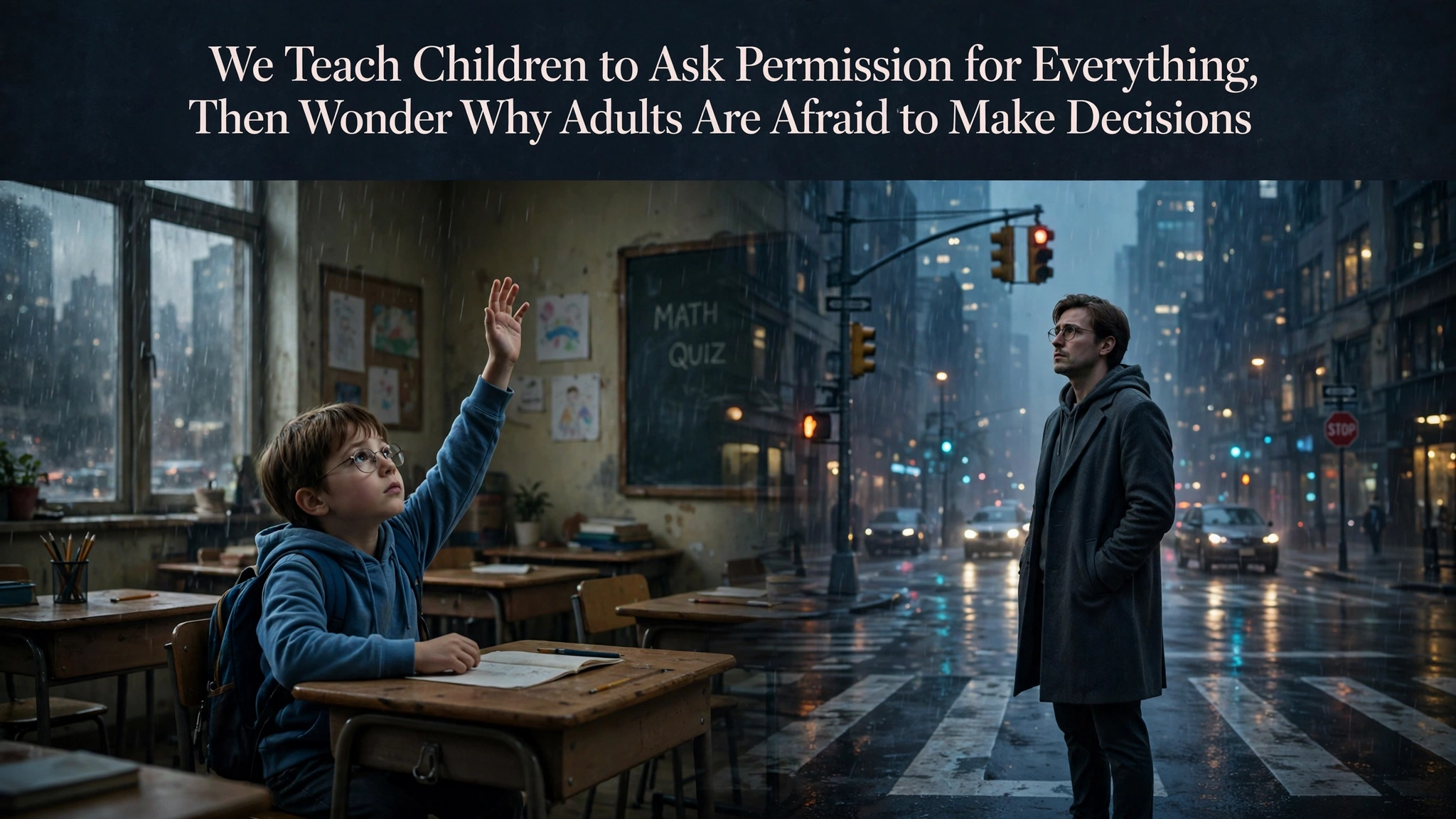
As children, we're told when to wake up, when to eat, when to speak, when to sit down, when to use the bathroom, when to ask questions, and when we're allowed to leave. Then we spend the next twenty years being evaluated on how well we follow instructions. Eventually, we become adults who need permission to take a vacation, approval to spend our own money, and reassurance before making decisions. And somehow, we're surprised when people struggle to think independently.
Think about the average school day. A bell tells you when to arrive. Another tells you when to leave. You're assigned a seat, given a schedule, instructed when to speak, and evaluated on whether you follow directions.
There's a reason schools need structure. Children need supervision, routines, boundaries, and opportunities to learn how to function alongside other people.
But there's another conversation worth having: How much of that structure teaches independence, and how much teaches compliance?
WE START TRAINING PEOPLE TO FOLLOW INSTRUCTIONS BEFORE THEY FULLY UNDERSTAND WHY.
A child raises their hand because they're expected to wait for permission to speak. They ask to use the restroom. They ask whether they can get a drink of water. They ask whether they can move to another area of the classroom.
Again, some of these rules exist for legitimate reasons. Teachers are responsible for keeping classrooms safe and organized.
But imagine spending twelve years in an environment where nearly every activity is controlled by somebody else's schedule, only to graduate and be told that you're now responsible for managing your own life.
You've spent years learning how to follow a schedule. Now you're expected to create one.
You've spent years being told what information matters. Now you're expected to determine what's worth learning.
You've spent years being evaluated by other people's standards. Now you're expected to develop your own.
That's a significant transition, and not everybody receives the tools to make it successfully.
THE DIFFERENCE BETWEEN DISCIPLINE AND OBEDIENCE.
Discipline teaches you how to manage yourself. Obedience teaches you how to respond to authority.
They can overlap, but they're not the same thing.
A disciplined person understands why a rule exists and can apply good judgment when circumstances change. A person trained only to obey may struggle when the instructions stop coming.
Think about the employee who refuses to solve a simple problem because nobody authorized them to make a decision.
Or the person who knows a process is inefficient but continues following it because that's how the company has always done things.
Or the manager who values employees who never question anything, then complains when nobody takes initiative.
We can't spend years rewarding people for never challenging instructions and then act confused when they become uncomfortable making independent decisions.
WHY ARE WE SO AFRAID OF MAKING THE WRONG DECISION?
Part of it comes from how mistakes are treated.
In many environments, being wrong carries embarrassment, punishment, or public criticism. People learn that the safest option is to avoid taking risks.
Instead of asking, "What can I learn from this?" they start asking, "What will happen if I get this wrong?"
That mindset can follow people into adulthood.
They hesitate to start businesses, change careers, learn new skills, express opinions, or pursue opportunities because they're waiting for somebody to confirm that they're making the correct choice.
And the world doesn't exactly make that easier. Social media gives everybody an audience, so even ordinary mistakes can feel like public performances.
People aren't just afraid of failing anymore. They're afraid somebody will screenshot the failure.
THE WORKPLACE CONTINUES THE LESSON.
After school, many people enter workplaces where the same dynamics continue in a different form.
You have supervisors, policies, approval processes, performance reviews, attendance requirements, and organizational hierarchies.
Some of that is necessary to operate a business responsibly. But workplaces can also discourage independent thinking when employees are punished for questioning inefficient processes.
Companies say they want problem-solvers, but sometimes what they really want is somebody who solves problems without questioning the system that created them.
They want initiative, as long as it doesn't interfere with the chain of command.
They want creativity, as long as it follows the approved template.
They want leadership, as long as nobody forgets who's in charge.
That's not developing independent thinkers. That's developing employees who know how to operate inside somebody else's boundaries.
WHAT WOULD HAPPEN IF WE TAUGHT CHILDREN TO QUESTION THINGS RESPONSIBLY?
Imagine a learning environment where students aren't simply rewarded for remembering information but are encouraged to challenge it, investigate it, and explain their reasoning.
Where asking why isn't treated as disrespect.
Where mistakes become opportunities to understand a problem instead of automatic reasons for embarrassment.
Where children learn how to manage money, evaluate information, resolve disagreements, understand contracts, recognize manipulation, and make decisions with consequences.
Traditional academic subjects matter. Reading, writing, mathematics, science, and history are essential. But practical judgment and independent thinking deserve serious attention too.
We shouldn't just prepare children to pass examinations. We should prepare them to navigate a world that doesn't come with an answer key.
THE BIGGER QUESTION
Are we teaching children how to become capable adults, or are we primarily teaching them how to function within systems designed by other people?
There's nothing wrong with structure. There's nothing wrong with authority. And not every rule is an attempt to control somebody.
But healthy systems should eventually help people develop the judgment to operate without constant supervision.
Parents should teach children how to make responsible choices, not simply how to avoid getting in trouble. Schools should encourage curiosity alongside discipline. Employers should reward thoughtful initiative instead of treating every question like an act of rebellion.
Because the goal shouldn't be to raise adults who need permission to think.
Teach somebody how to follow instructions and they'll know how to complete an assignment. Teach somebody how to think independently and they'll know what to do when the instructions are wrong, incomplete, or never arrive in the first place.










Comments
No comments yet, be the first submit yours below.