When Killing Becomes a Job: What Happens to the People Who Carry Out Executions?

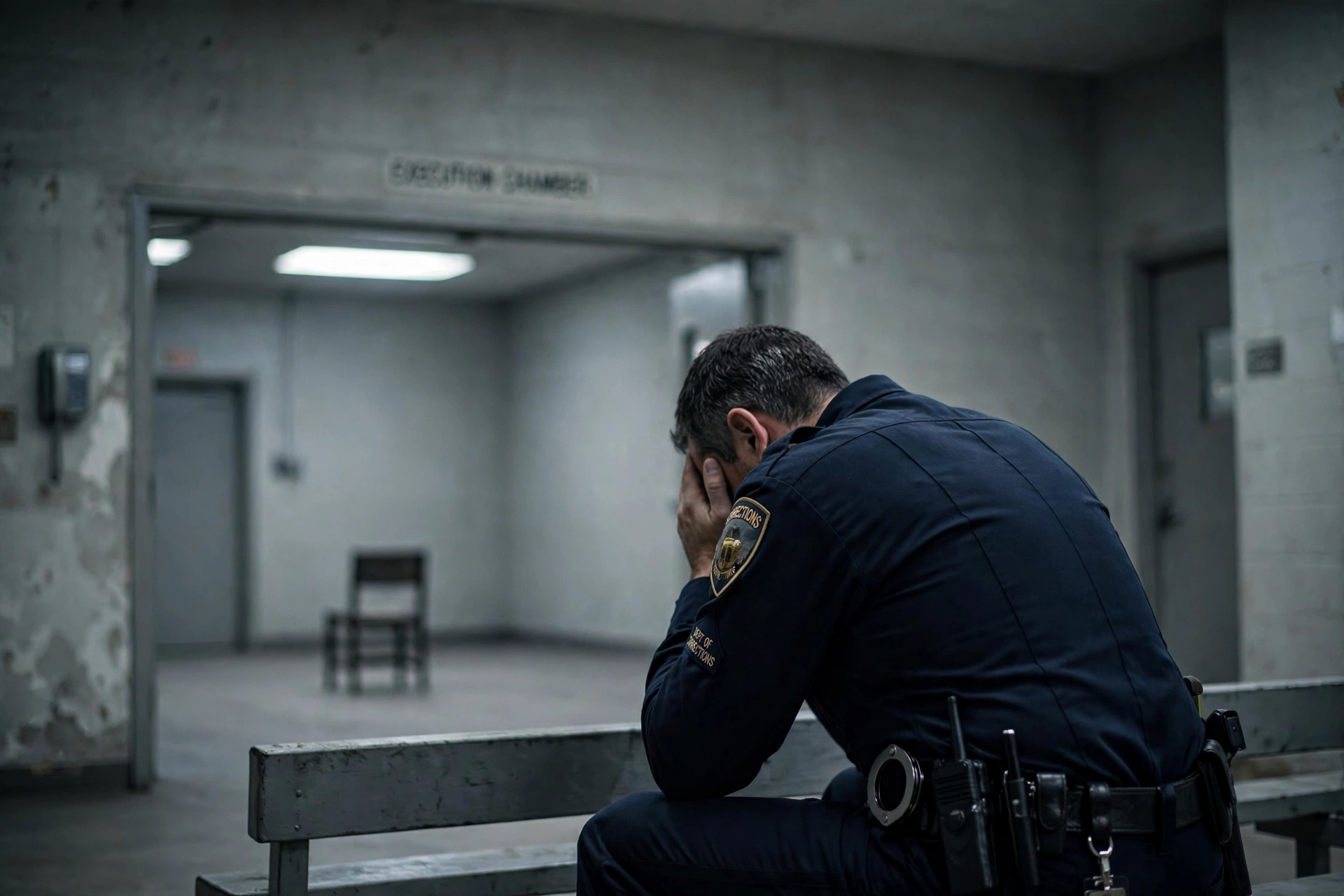
There is a strange line in society: we can call something murder when an individual does it, but lawful when the state authorizes it.
I remember an episode of Tales from the Crypt built around a disturbing idea: the man responsible for carrying out executions was secretly a serial killer.
The twist wasn't simply that he was killing people.
It was that the system had given him a legal environment in which to do it.
As long as he was carrying out executions under the authority of the state, the killing had a legal purpose.
Then he was fired.
And the desire to kill didn't disappear when the job did.
That's where the fictional story becomes psychologically interesting.
What happens when the authority that separates a violent act from a criminal act disappears?
The episode obviously isn't evidence about real executioners.
It's fiction.
But fiction sometimes asks questions that institutions don't like asking directly.
What does repeatedly participating in executions do to the people involved?
Does performing an execution eventually become routine?
Does repetition create emotional distance?
Does following a legal procedure make the act psychologically different from committing violence independently?
And what happens when the person walks away from the execution chamber and returns to ordinary life?
The death penalty doesn't only involve the person being executed. It also creates a group of people whose job is to make the execution happen.
That distinction matters.
When people debate capital punishment, the conversation usually focuses on the person sentenced to death.
Was the crime severe enough?
Was the conviction reliable?
Should the punishment be death?
Should the state have that authority?
Those are major questions.
But there is another question sitting underneath all of them:
What does it mean to turn execution into a procedure performed by human beings?
Someone has to prepare the equipment.
Someone has to verify the identity.
Someone has to administer the process.
Someone has to monitor what happens.
Someone has to determine whether the procedure has been completed.
Someone has to clean the room afterward.
The paperwork gets completed.
The facility returns to normal.
The employees go home.
That's one of the strangest things about institutional violence: after something enormous happens to one human being, everyone else may simply go back to work.
That doesn't necessarily mean the people involved don't care.
It doesn't mean execution personnel become violent outside their jobs.
And it would be irresponsible to assume that every person involved experiences the process the same way.
People respond differently to traumatic or morally difficult work.
Some may experience emotional distress.
Some may compartmentalize.
Some may view the work primarily as carrying out a legal duty.
Others may leave the profession.
The point is not to invent a psychological profile for executioners.
The point is to recognize that the human beings carrying out the punishment are part of the ethical equation.
When a government authorizes an act, the authorization doesn't eliminate the human experience of performing it.
This is where that old Tales from the Crypt premise becomes useful as a thought experiment.
Imagine someone whose job requires repeatedly participating in executions.
Eventually, the extraordinary becomes procedural.
There are forms.
Schedules.
Protocols.
Checklists.
Training.
Security procedures.
Legal requirements.
And because everything is structured, the individual doesn't have to personally decide whether the person deserves to die.
That decision has already been made somewhere else.
That is one of the defining features of institutional power: responsibility can be distributed across so many people that no single person feels like the entire decision belongs to them.
The judge imposes the sentence.
The courts review it.
The governor may have a role.
Corrections officials administer the process.
Medical personnel may be involved depending on the jurisdiction and procedure.
Staff members carry out individual tasks.
The state records the outcome.
Everyone has a role.
But nobody individually represents the entire system.
That separation can make an enormous moral decision feel like a sequence of ordinary tasks.
And that's bigger than the death penalty.
Human institutions have always found ways to divide responsibility.
One person writes the order.
Another approves it.
Another carries it out.
Another documents it.
Another explains it.
The more divided the process becomes, the easier it can become to forget that the final result is still happening to a real human being.
That's why executioners deserve to be part of the conversation.
Not because they should automatically be condemned.
Not because they should automatically be sympathized with.
But because they are human beings being asked to perform one of the most extreme functions a government can authorize.
If society believes an execution is necessary, it should also be willing to examine what that necessity requires human beings to do.
There is another uncomfortable question.
What happens when someone becomes accustomed to having the authority to take a life?
The fictional executioner in Tales from the Crypt represents the darkest version of that question.
Remove the uniform.
Remove the legal authority.
Remove the institution.
What remains?
Again, fiction cannot answer that question about real people.
But it can force us to ask whether institutions merely control violent impulses or whether they can sometimes create environments where extraordinary actions become psychologically normalized.
The frightening question isn't whether an executioner is secretly a killer. It's whether any institution should ever become so comfortable with killing that the human element disappears from the process.
That is where the conversation becomes bigger than capital punishment.
It's about power.
It's about authority.
It's about obedience.
It's about compartmentalization.
And it's about what happens when morality gets converted into procedure.
Because a procedure can be followed perfectly and still leave society with a difficult question afterward.
Just because something is legal doesn't mean we should stop examining what it does to the people who participate in it.
The law answers whether the state permits the act.
It doesn't automatically answer what repeated participation does psychologically.
It doesn't answer whether the workers involved carry those experiences home.
It doesn't answer whether society should understand the emotional consequences of the work.
And it certainly doesn't answer the philosophical question at the center of that old television episode:
When a person is given permission to kill, where does the authority end and the person begin?
Maybe that's the question worth remembering the next time we talk about an execution.
We usually look at the person in the chair.
We should also remember the people standing around it.
Because whatever position someone takes on the death penalty, one fact remains:
A human being has to carry it out.
And understanding what that means may be just as important as debating whether the punishment itself should exist.











Comments
No comments yet, be the first submit yours below.