So Many Jobs Available, Yet Somehow They All Pay the Same Damn Wage

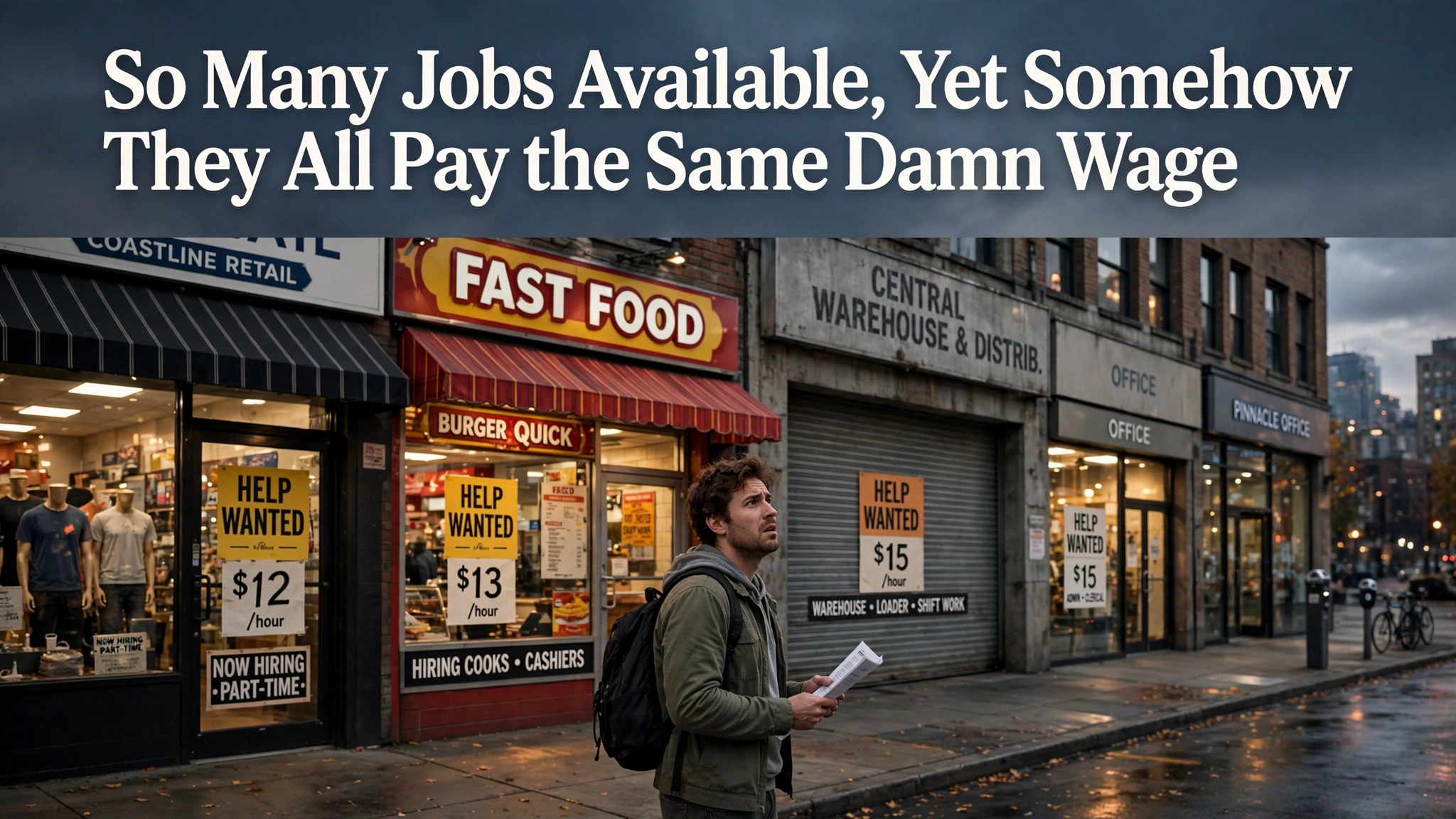
Everywhere you look, somebody is hiring. Restaurants are hiring. Warehouses are hiring. Retail stores are hiring. Delivery companies are hiring. Healthcare facilities are hiring. Everybody has a HELP WANTED sign, but somehow, when you look at the paycheck, it feels like you're applying for the same job with a different uniform.
Let's talk about this job market because something doesn't add up. We're constantly told there are jobs everywhere, employers can't find workers, and opportunities are waiting for anybody willing to work. Okay, great. But why does it feel like so many of these opportunities lead to the same hourly wage?
You can work in a warehouse lifting boxes all day. You can stand behind a register dealing with customers. You can work in a restaurant moving nonstop during a dinner rush. You can stock shelves, clean buildings, load trucks, or spend hours on your feet doing physically demanding work.
Different environments. Different responsibilities. Different kinds of stress. But sometimes the pay is so similar that changing jobs barely changes your financial situation.
You're not necessarily choosing between different lifestyles anymore. You're choosing which version of struggling you're willing to tolerate.
And the frustrating part is that every employer has a different explanation for why the pay is what it is. One company says it offers competitive wages. Another advertises weekly pay. Another promises flexible scheduling. Another talks about opportunities for advancement.
But when you calculate what you actually take home, you start wondering whether the benefits are designed to make the job better or simply make the paycheck sound more attractive.
Weekly pay is nice, but it doesn't magically create more money. Getting paid every Friday doesn't help much if the money is already spoken for by Monday. Flexible scheduling sounds great until your hours fluctuate so much that you can't predict your income. And advancement opportunities don't pay your bills today if you're stuck waiting years for a promotion that may never come.
Let's also stop pretending every worker can simply walk into a better-paying career tomorrow. People have children to support, rent to pay, transportation to maintain, and responsibilities that don't pause while they pursue a certification or go back to school.
Sometimes people take the job that's available because they need income immediately. They don't have the luxury of spending six months training for something better while their bills sit patiently on the kitchen table.
The problem isn't that people don't want better opportunities. It's that many people can't afford the transition from one paycheck to the next.
And employers know that people need work. That doesn't mean every employer takes advantage of workers, but it does mean the need for a paycheck can limit how much negotiating power someone has. If several nearby jobs offer similar wages, quitting one for another may not accomplish much.
You might leave one company because the manager is disrespectful, only to discover that the next company pays the same amount and has its own problems. Now you're learning a new system, proving yourself all over again, and hoping the grass is actually greener instead of just being a different shade of the same mess.
Meanwhile, the cost of living keeps demanding more money. Rent doesn't care that your new job pays only fifty cents more per hour. The grocery store doesn't give you a discount because you work hard. Your car insurance doesn't decrease because you accepted a position with a better job title.
Everything has a price, but not every job offers a meaningful path toward affording it.
And here's where the conversation gets uncomfortable: if an economy has plenty of job openings but a large number of workers still can't comfortably cover basic expenses, should we celebrate the number of available jobs without examining the quality of those jobs?
Employment statistics matter, but the existence of a job doesn't automatically mean that job provides economic security. We should care about wages, hours, benefits, stability, working conditions, and whether someone can realistically advance.
A job can be better than unemployment and still not be enough to build a stable life.
That distinction matters because people are often treated as if accepting any available job should end the conversation. You have a job, so what's the problem? You're working, so why are you complaining?
Because working and getting ahead are two different things.
Somebody can work forty hours a week, show up on time, do everything expected of them, and still have very little money left after essential expenses. They aren't necessarily lazy. They aren't necessarily irresponsible. They may simply be earning too little relative to the costs they're facing.
Of course, workers still have decisions to make. Learning valuable skills, comparing total compensation, pursuing credentials that employers actually reward, and looking for industries with stronger wage growth can all help. Sometimes changing jobs is the right move. Sometimes a career transition is worth the investment.
But we shouldn't turn every discussion about low wages into a lecture about individual ambition. Employers, industries, policymakers, and the broader economy also influence what workers earn and what their money can buy.
If every available job pays roughly the same, telling people to get another job isn't much of a solution. The real question is which opportunities actually change their financial future.
Maybe the next job offers a path into management. Maybe it teaches a skill that commands higher pay. Maybe it provides health insurance that saves hundreds of dollars a month. Maybe it offers predictable hours that make it possible to attend school or build a business on the side.
Those differences matter. The highest advertised hourly rate isn't always the best overall opportunity, but neither should workers be expected to accept vague promises of future success in exchange for low pay today.
We need to stop measuring the strength of the job market by how many companies are hiring and start asking what those jobs actually provide to the people doing them.
Because a HELP WANTED sign is not proof that a worker has found a way forward. It's proof that an employer needs somebody to do a job.
And if the worker can't afford to live comfortably despite working full-time, we shouldn't automatically congratulate the system for creating employment. We should ask what needs to change.
There are plenty of jobs. There are plenty of people willing to work. What we need more of are opportunities where working harder actually creates a realistic chance of getting ahead.
Now let's debate it: are employers paying what the work is worth, or have so many entry-level jobs settled around similar wages that workers are being forced to choose between different employers without seeing much difference in their quality of life?









Comments
No comments yet, be the first submit yours below.