The Government Calls It Public Service—So Why Do Politicians Get Richer While the Public Gets Poorer?

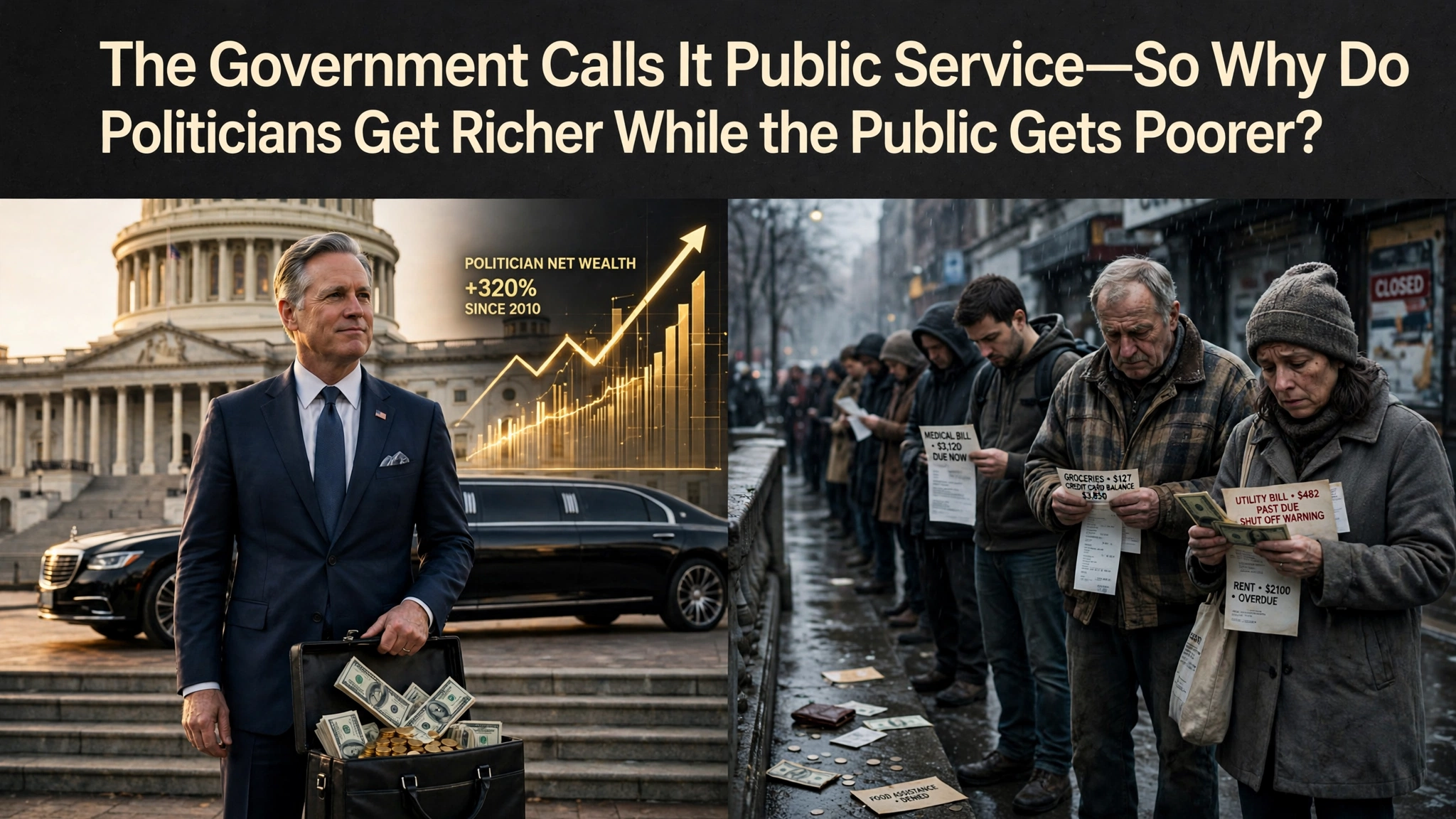
Imagine working one job for decades, paying taxes out of every paycheck, struggling to afford healthcare, and worrying about whether you'll ever retire comfortably. Now imagine the people making decisions about your money earning government salaries while some build substantial personal wealth during their time in office. We're told to trust the process, respect the office, and wait for change. But when does public service start looking a little too much like a private investment opportunity?
Let's have a conversation that should make people on both sides of the political aisle uncomfortable. Why do we treat political office like a lifelong career when the people elected to represent us are supposed to be serving the public?
The average worker has to prove their value. They have performance reviews, supervisors, deadlines, and consequences when they fail to do their job. If they consistently underperform, they might lose their position. If the company struggles, they might lose their benefits or get laid off.
But when politicians fail to deliver, what happens? Sometimes they lose an election. Other times, they get reelected, blamed for nothing, and handed another opportunity to make promises they may never fulfill.
Why do we demand accountability from employees but tolerate so little measurable accountability from the people making decisions that affect millions of employees?
Now, to be fair, governing is complicated. No single elected official controls the entire economy, and not every broken promise is proof of corruption. Laws take time, legislatures disagree, and some problems have no easy solutions.
But that doesn't mean politicians should be exempt from serious scrutiny. If somebody asks for your vote by promising lower costs, better healthcare, safer communities, and more economic opportunity, voters have every right to ask what actually changed after that person took office.
And here's where the money question enters the conversation.
Members of Congress receive salaries paid by taxpayers. Many also have personal investments, assets, and financial interests. Federal ethics rules require disclosures and impose certain restrictions, but the public continues to debate whether the safeguards are strong enough to prevent conflicts of interest and the appearance of insider advantage.
Think about the optics. A politician participates in decisions affecting entire industries. Those industries employ lobbyists, influence public policy, and sometimes benefit financially from legislation. Meanwhile, the politician may have investments whose value is affected by those same industries.
Even when no illegal activity has occurred, the public has a legitimate question: How can citizens confidently trust decisions when the decision-makers may have financial interests connected to the outcomes?
That's not a question exclusive to Republicans or Democrats. It's a question about transparency, ethics, and whether the rules are designed to protect the public's confidence in government.
And let's stop pretending this is only about how much politicians earn. The bigger issue is whether political power creates advantages that ordinary workers could never access.
You can work overtime, save diligently, invest a few dollars at a time, and spend years trying to build a modest financial cushion. You might worry about a $500 emergency because it could undo months of progress.
Meanwhile, wealthy individuals and powerful institutions have access to professional advisers, extensive investment opportunities, and networks that most working families will never have. Politicians don't all share the same financial circumstances, but the system can create a troubling gap between people who make the rules and people who must live under them.
And what happens when political office becomes a career rather than a temporary responsibility?
Some elected officials spend decades in government. Experience can be valuable, and voters should be free to reelect representatives they believe are doing a good job. But long tenure can also create entrenched power, deep relationships with lobbyists, and a political class that becomes increasingly disconnected from ordinary life.
When your career depends on staying in office, you may start thinking about reelection before you think about the next generation. You may become more concerned with protecting your political position than taking an unpopular step that would genuinely help the public.
That doesn't describe every politician. It describes a risk worth taking seriously whenever power is concentrated in the same hands for too long.
What if we evaluated representatives more like the people they represent are evaluated at work? Publish clear goals. Track progress. Explain failures. Disclose financial conflicts. Strengthen independent oversight. Make it easier for the public to see whether campaign promises turned into real results.
Some people would go further and support strict term limits. Others would argue that voters should decide when an experienced representative has served long enough. Both sides raise legitimate concerns: term limits can reduce entrenched power, but they can also remove experienced lawmakers and increase the influence of lobbyists or unelected staff.
The answer isn't as simple as declaring every politician corrupt. It's building rules that don't depend on every politician being a perfect human being.
A trustworthy system should make corruption difficult, conflicts of interest visible, and accountability unavoidable—regardless of which party holds power.
Because here's the part that should bother everyone: political arguments often turn citizens against one another while the basic questions about accountability remain unanswered. We argue about party labels, personalities, and viral clips. Meanwhile, we still need affordable housing, functioning infrastructure, reliable healthcare, good schools, and wages that allow people to build stable lives.
You can support a politician and still demand answers. You can disagree with an opposing party and still recognize when its members raise a legitimate concern. Holding elected officials accountable is not betrayal. It's part of the job voters are supposed to do.
These people work for the public. Their authority comes from the public. Their salaries are funded by the public. And when they make decisions that affect our futures, asking questions should be the bare minimum—not something we're discouraged from doing because it might help the other political party.
Stop treating politics like professional sports, where your team can do no wrong. These aren't rival jerseys. These are public servants making decisions about your money, your rights, and your future.
If an elected official delivers results, recognize it. If they fail, ask why. If the rules create conflicts of interest, demand stronger rules. And if they want another term, they should be prepared to explain why they've earned it.
Because public office should be an opportunity to serve—not a guarantee of permanent power.
Now let's hear it: Should elected officials face strict term limits, stronger restrictions on individual stock trading, and measurable public performance reviews—or should voters have the unrestricted ability to keep reelecting the people they trust?







Comments
No comments yet, be the first submit yours below.