Roger Marshall vs. Adam Hamilton: Kansas Doesn't Need Another Campaign Commercial—It Needs Answers. 😂

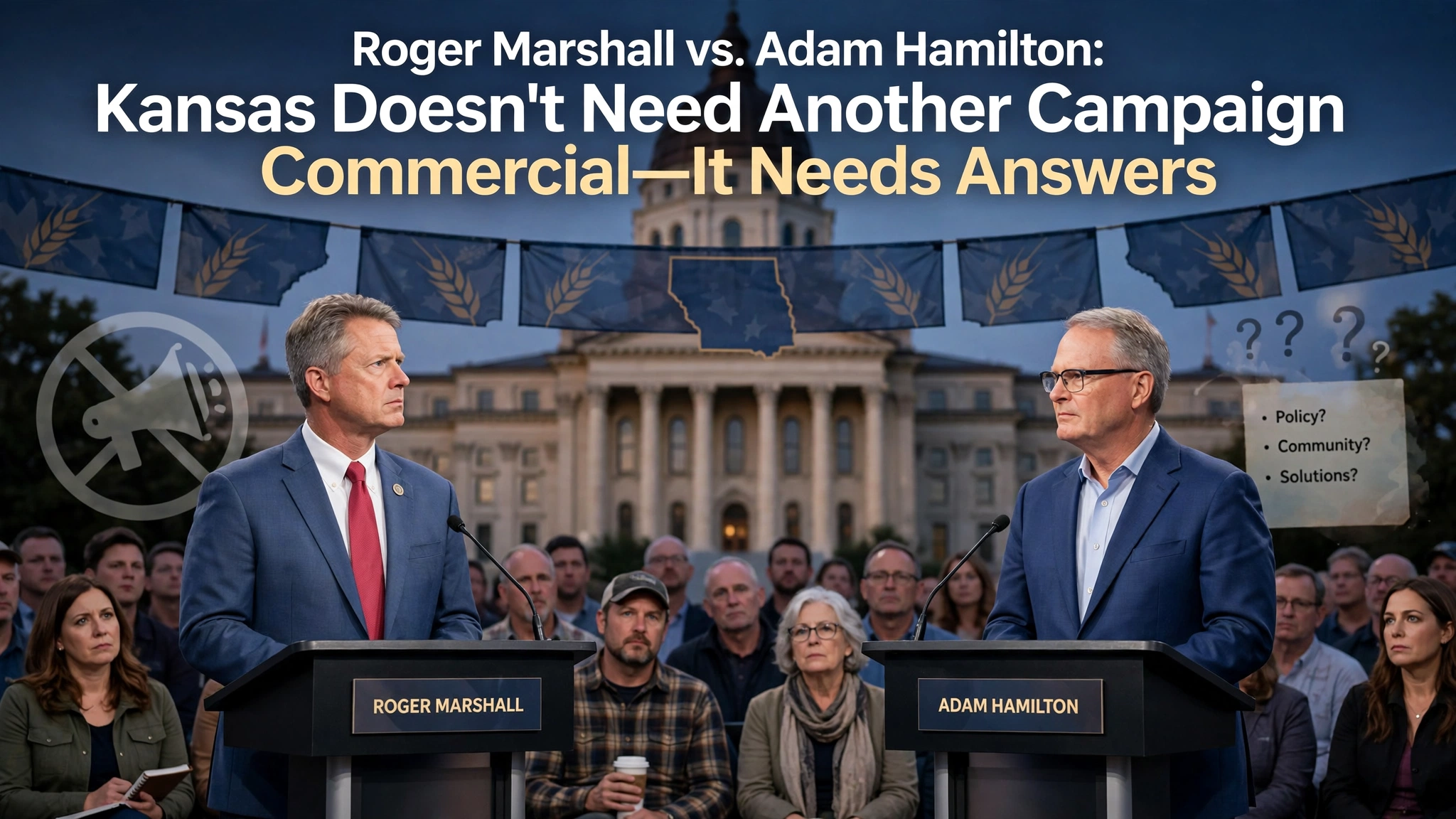
Kansas is about to make a decision that could influence healthcare, taxes, agriculture, energy, immigration, and America's foreign policy. One candidate has an established voting record in Washington. The other is promising a different direction. But here's the problem with American politics: candidates spend millions telling us why the other person shouldn't have the job, while voters are left trying to figure out what either one will actually do with it. 😂
The 2026 Kansas U.S. Senate race between Republican incumbent Roger Marshall and Democratic challenger Adam Hamilton deserves more than party loyalty, campaign commercials, and political arguments on Facebook.
We're talking about a position in the United States Senate. This isn't a popularity contest for the most convincing television personality. The person elected will help decide how federal money is spent, what laws are passed, how healthcare programs operate, how trade policies affect farmers, and how America responds to international conflicts.
So let's put the political advertising aside and examine what these candidates bring to the table.
ROGER MARSHALL: THE ESTABLISHED WASHINGTON RECORD
Roger Marshall is a physician and former OB-GYN who represented Kansas in the U.S. House before entering the Senate in 2021. He has experience in national politics, an established legislative record, and relationships within the Republican Party.
His political approach is conservative. He supports lower taxes, stronger immigration enforcement, domestic energy production, and policies aligned with the Republican agenda.
Marshall argues that his experience gives him the ability to deliver for Kansas. He points to rural healthcare initiatives, agricultural priorities, tax legislation, and housing policy as examples of his work.
There is a legitimate advantage to having a senator who understands congressional procedures and has already developed relationships in Washington. Getting legislation introduced is one thing; building enough support to get it passed is another.
But experience creates another responsibility: voters should be able to examine what that experience has produced.
Marshall supported President Trump's major 2025 tax and spending legislation, commonly called the One Big Beautiful Bill. Supporters point to tax relief, spending priorities, and changes intended to encourage economic growth. Critics point to reductions in federal healthcare spending and the consequences for people who depend on Medicaid.
According to reporting by KCUR, approximately 13,000 Kansans are projected to lose healthcare coverage as a result of the legislation. Marshall disputes the characterization that the legislation cuts Medicaid. That's a significant disagreement that deserves serious examination rather than a campaign slogan.
His healthcare experience as a physician is relevant, but voters should also examine how his legislative decisions affect patients who cannot afford private insurance.
ADAM HAMILTON: THE OUTSIDER PROMISING A DIFFERENT DIRECTION
Adam Hamilton is a Methodist pastor and founder of Church of the Resurrection in Leawood. He has decades of leadership experience in his religious community, but he has not previously served in elected legislative office.
He describes himself as an independent-minded Democrat who wants to work across political differences.
His campaign emphasizes affordability, healthcare access, housing, energy costs, and reducing political division.
Hamilton wants to reverse the Medicaid reductions in the 2025 federal legislation, restore expanded Affordable Care Act premium subsidies, and expand prescription drug negotiations. He also supports protecting reproductive freedom and codifying access to birth control.
On trade, he wants to end President Trump's broad tariffs and require congressional approval for future tariff policies. His argument is that tariffs increase the cost of materials, equipment, and everyday necessities for American consumers and businesses.
He has also proposed tax credits for first-time homebuyers, teachers, firefighters, and other working Americans.
But being an outsider is not automatically a qualification for governing. Hamilton would have to learn the legislative process, build relationships with senators who may disagree with him, and turn campaign proposals into legislation that can actually pass.
His community leadership is part of his background, but voters should distinguish that experience from a congressional voting record that does not yet exist.
THE ECONOMY: WHO HAS A BETTER PLAN FOR YOUR WALLET?
Both candidates talk about affordability, but they disagree about how to achieve it.
Marshall supports the Republican approach of tax relief, domestic production, energy development, and tariffs intended to encourage American manufacturing.
Hamilton argues that broad tariffs can function like additional costs on American businesses and consumers. He wants to remove those tariffs and pursue trade policies that reduce the cost of goods and materials.
Here's the question voters should ask: If tariffs encourage domestic manufacturing, how long will it take for those benefits to reach ordinary households? And if tariffs increase the cost of materials, how much are consumers expected to absorb while waiting?
Neither argument should be accepted without examining the actual economic results.
Tax cuts can leave households with more money, but voters should also examine who receives the largest benefits and how the government pays for the resulting revenue changes.
Ending tariffs may lower some costs, but it doesn't automatically guarantee cheaper groceries, affordable housing, or higher wages.
People aren't looking for another politician to explain why the economy is complicated. They're looking for policies that make everyday life more affordable.
HEALTHCARE: THIS IS MORE THAN A POLITICAL TALKING POINT
Healthcare is one of the most consequential differences between these candidates.
Marshall has argued that Medicaid needs reform, that doctors sometimes avoid accepting Medicaid patients, and that greater price transparency could help patients make informed decisions. He supports work requirements and changes to healthcare administration.
Hamilton wants to reverse the Medicaid reductions in the 2025 legislation, restore expanded ACA subsidies, and increase access to affordable medical care.
There is also a Kansas-specific concern: rural hospitals. Smaller communities often have fewer medical facilities, fewer specialists, and longer distances between patients and treatment.
Both candidates say rural healthcare matters. But voters should examine the actual funding mechanisms, the consequences of Medicaid policy, and whether hospitals in smaller Kansas communities will remain financially sustainable.
Ask a simple question: If someone lives hours away from a major hospital, what happens when their local facility closes?
That isn't a Republican question or a Democratic question. That's a Kansas question.
AGRICULTURE: KANSAS CANNOT AFFORD TO IGNORE ITS FARMERS
Agriculture is central to Kansas's economy. Wheat, cattle, grain, fertilizer, fuel, equipment, and international markets all matter to the people who produce food and support rural communities.
Marshall serves on the Senate Agriculture Committee and has advocated for reducing certain fertilizer costs. He argues that trade pressure can help American producers and manufacturing.
Hamilton has argued that tariffs can hurt farmers by increasing input costs and making it harder to sell agricultural products internationally. He wants to pursue trade agreements and reduce unnecessary trade barriers.
This is where the disagreement becomes particularly important. Farmers can be caught between two competing economic goals: protecting American industries and maintaining access to affordable supplies and international customers.
Voters should ask both candidates how their policies affect the cost of fertilizer, machinery, fuel, and access to export markets.
A politician can give a great speech about supporting farmers. The real test is whether farmers can afford to keep farming.
ENERGY AND DATA CENTERS: WHO PAYS FOR THE FUTURE?
Energy is another issue that deserves attention, especially as electricity demand grows.
Marshall supports an all-of-the-above energy approach that includes oil, natural gas, wind, and ethanol. He emphasizes energy production and maintaining America's competitive position.
Hamilton also supports a broad energy strategy, but wants to restore certain energy-production tax credits and make sure large electricity users, including data centers, pay their fair share of infrastructure costs.
Both candidates have expressed support for establishing guardrails around data centers.
This matters because communities are being asked to accommodate increasingly large facilities that require substantial electricity and infrastructure.
Residents should be asking who pays for new power lines, additional generation capacity, water infrastructure, and other public costs.
If a private company builds a massive facility that increases demand on a local electrical grid, should ordinary residents be expected to help cover the cost?
That's a debate that deserves more attention than it receives.
ABORTION AND PERSONAL FREEDOM
Marshall is firmly opposed to abortion and has supported federal pro-life legislation, including efforts to restrict federal funding for abortion.
Hamilton supports protecting reproductive freedom and legal access to abortion. He has said that although he personally holds an anti-abortion view, he believes government should protect women's ability to make reproductive decisions.
These are fundamentally different approaches to the role of government.
For some voters, this issue alone may be decisive. Others may prioritize economic policy, healthcare, immigration, or foreign affairs.
But voters should understand what each candidate actually supports instead of assuming that every Republican or Democrat holds precisely the same position.
IMMIGRATION AND NATIONAL SECURITY
Marshall supports stronger border enforcement, border-wall construction, and legislation designed to strengthen immigration enforcement.
Hamilton has also discussed border security, but places greater emphasis on addressing immigration through broader policy solutions and maintaining legal pathways.
Voters should consider border security, the treatment of legal immigrants, workforce needs, and the economic role of immigrant labor in industries such as agriculture.
There is a difference between supporting an orderly immigration system and ignoring the economic consequences of how that system operates.
FOREIGN POLICY: WHAT SHOULD AMERICA'S ROLE BE?
The candidates have also disagreed over the war in Iran.
Marshall has supported President Trump's military approach, arguing that preventing Iran from obtaining nuclear weapons is an important national security objective. He has defended the economic costs associated with that strategy.
Hamilton wants the United States to leave the war and argues that continued conflict contributes to instability and higher energy costs. He has also expressed a different approach to weapons transfers to Israel, supporting some restrictions while maintaining that Israel's security matters.
This raises a larger question: How much should American taxpayers be expected to spend on military operations overseas, and what level of risk should the country accept in the name of national security?
There are no simple answers, but the public deserves a clear explanation of the objectives, costs, and potential consequences of military involvement.
SO WHO IS THE BETTER CANDIDATE?
That depends on what you believe the job should accomplish.
If your priorities are conservative policy, lower taxes, stricter immigration enforcement, support for Trump's agenda, and maintaining an experienced Republican voice in the Senate, Marshall's platform is more closely aligned with those priorities.
If your priorities are reversing Medicaid reductions, ending broad tariffs, protecting reproductive freedom, changing America's approach to the Iran war, and bringing a more moderate Democratic voice to Washington, Hamilton's platform is more closely aligned with those priorities.
But there are important questions for both men.
Marshall needs to answer for his voting record and demonstrate how his policies improve the lives of Kansans who are struggling with healthcare expenses, housing costs, and everyday bills.
Hamilton needs to demonstrate how his proposals would be funded, how he would navigate Congress without prior legislative experience, and how he would turn his promises into measurable results.
One candidate has a record that can be evaluated. The other has a platform that voters must evaluate alongside his leadership experience. Those are two different standards of scrutiny, and both matter.
And that's what makes this election important. Voters shouldn't have to choose based on which candidate has the better commercial, the bigger campaign budget, or the most recognizable party label.
Politicians work for the public. The Senate seat is not a family heirloom, a corporate promotion, or a lifetime achievement award. It's a position of public responsibility.
Kansas, here's the question: Would you rather keep an experienced senator whose voting record reflects conservative priorities, or elect a political outsider promising a different approach to healthcare, trade, and government? What issue matters most to you, and what evidence would convince you that either candidate deserves your vote?
Don't just tell people who you're voting for. Explain why. And if you disagree with somebody, bring facts instead of insults. That's how an actual political conversation should work.








Comments
No comments yet, be the first submit yours below.