Why Are We Still Storing Dangerous Materials Above Ground? It's Time to Rethink Underground Hazardous Storage Before the Next Disaster.

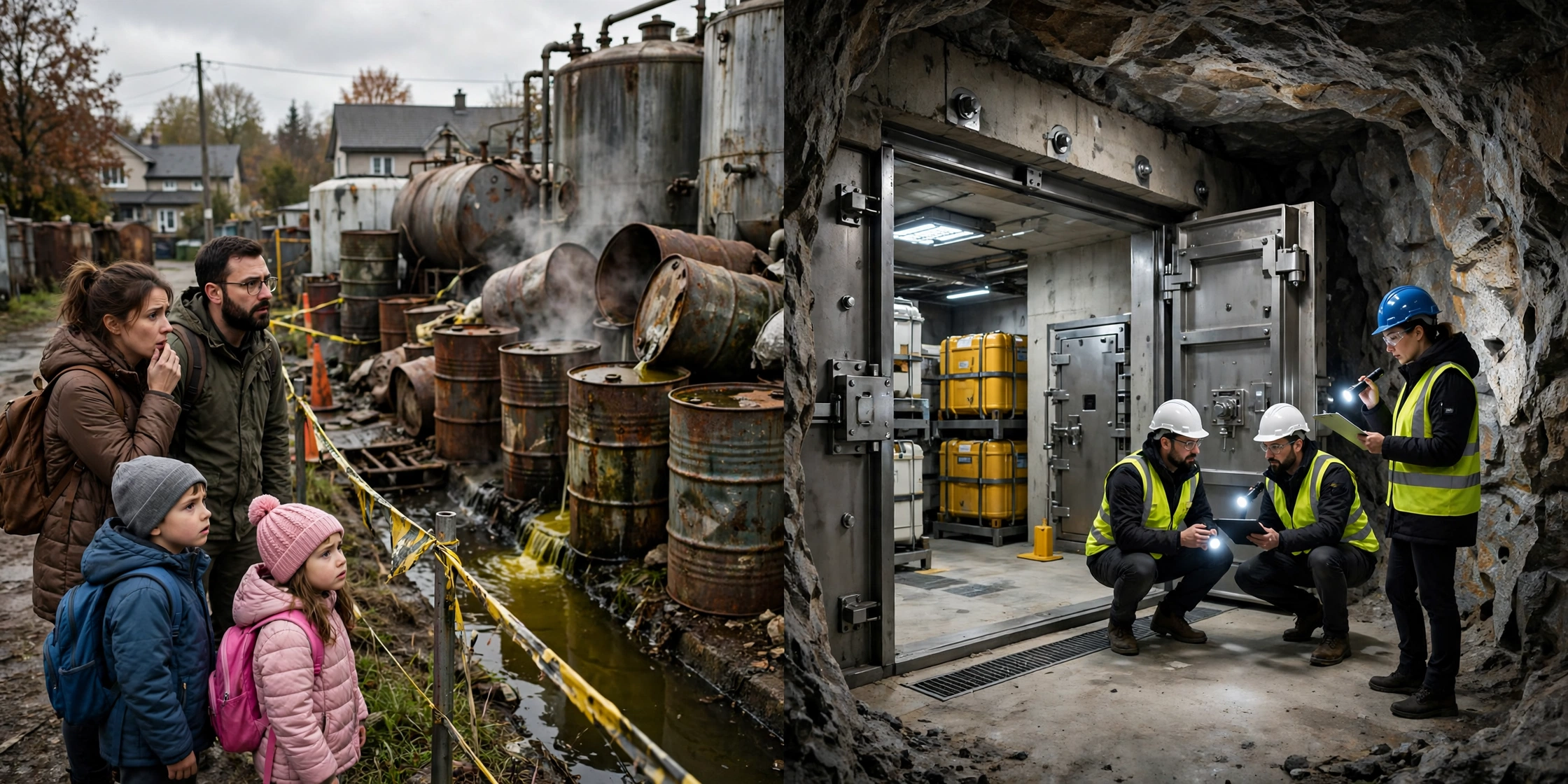
We spend billions building underground tunnels, bunkers, military facilities, and infrastructure designed to protect people from danger. So why aren't we thinking more seriously about how to store the most dangerous materials we manufacture? If one deteriorating stockpile can put an entire community on alert, maybe the problem isn't just how we dispose of hazardous materials. Maybe we need to rethink where and how we store them in the first place.
The situation involving nearly five tons of degraded lead azide at the Iowa Army Ammunition Plant raises a much bigger question than whether a controlled detonation is the right disposal method.
Why are we putting ourselves in situations where dangerous materials can deteriorate, become unstable, and potentially release hazardous substances into the atmosphere in the first place?
We have the engineering knowledge to construct underground transportation systems, military bunkers, reinforced facilities, and entire networks beneath the Earth's surface. We build structures to protect people from tornadoes, storms, explosions, and other threats.
So why shouldn't we be investing more heavily in specialized underground facilities designed specifically for storing extremely hazardous materials?
I'm not talking about digging a hole, dropping some barrels into it, and covering everything with dirt. I'm talking about purpose-built underground storage infrastructure designed by explosives engineers, geologists, environmental scientists, and safety specialists.
The objective should be simple: reduce the possibility that an accident becomes a public disaster.
Why Is the First Line of Protection Always the Community Outside the Facility?
When dangerous materials are stored above ground, the surrounding environment becomes part of the emergency plan.
If something goes wrong, officials may have to evacuate residents, close roads, monitor the air, establish safety perimeters, and determine whether hazardous particles have traveled beyond the facility.
In Iowa, residents have been advised to relocate because of the potential for lead-containing particles to disperse during the planned detonation.
That raises an uncomfortable question: why should an entire community have to become part of the containment strategy?
What if the storage facility itself were designed to provide multiple layers of protection before an emergency ever happened?
Instead of relying primarily on distance, evacuation zones, and emergency response plans, we should be asking how much additional protection could be created by placing certain hazardous materials inside carefully engineered underground structures.
There is already a foundation for this concept. Federal regulations recognize earth-covered magazines as one permitted storage option for hazardous waste munitions and explosives. Those facilities use reinforced construction and earthen covers to help reduce the effects of explosions and prevent propagation to nearby storage units.
However, there is an important distinction: conventional earth-covered explosive magazines are not necessarily designed to contain the full force of an internal explosion or prevent every environmental release. Their design objectives include directing explosive effects and reducing hazards to neighboring units.
That means we shouldn't simply assume existing underground magazines solve the entire problem. We should be asking what the next generation of containment facilities could accomplish.
What If We Designed Underground Facilities Around Environmental Containment?
Imagine a national network of specialized underground hazardous-material storage facilities built specifically for materials that pose extraordinary risks to public safety.
These wouldn't be ordinary warehouses placed beneath the ground. They would be engineered facilities with multiple independent containment systems, environmental monitoring, controlled access, and emergency response capabilities.
The design objective would be to reduce the chances of an accidental release reaching the atmosphere, surrounding communities, groundwater, or nearby ecosystems.
That could include:
- Reinforced underground structures designed for the specific hazards of the materials being stored.
- Separate containment areas so an incident involving one storage unit doesn't automatically threaten neighboring units.
- Environmental monitoring systems capable of detecting leaks, contamination, temperature changes, and other warning signs.
- Engineered drainage and collection systems to prevent contaminated runoff from escaping into surrounding soil or water.
- Remote monitoring capabilities that reduce the need for unnecessary human exposure.
- Emergency response systems designed to isolate an incident and limit its consequences.
- Independent inspections and publicly documented environmental monitoring results.
The important part is that the facility would be designed around the specific material being stored. Not every chemical, explosive, radioactive substance, or industrial waste product can safely be placed in the same type of underground environment.
Some materials require ventilation, temperature control, moisture management, or other specialized conditions. Others may react with water, surrounding materials, or changes in pressure. An underground facility would have to account for those requirements rather than assuming that putting something beneath the surface automatically makes it safer.
But the larger idea is worth exploring: instead of allowing a storage failure to become an environmental emergency, design the infrastructure to limit the consequences of that failure from the beginning.
Underground Doesn't Automatically Mean Safe
There is something important we need to get right about this proposal.
Putting hazardous materials underground doesn't guarantee that an explosion will be contained or that nothing will escape into the atmosphere.
Pressure can damage structures. Explosive energy can travel through rock and soil. Underground facilities require ventilation, access routes, drainage, and carefully engineered systems. A poorly designed underground structure could create additional dangers instead of reducing them.
Even an underground explosion can create a pathway to the surface if gases, dust, or debris escape through openings or fractures.
That's why the objective shouldn't simply be to bury dangerous materials. It should be to develop containment systems that account for the possibility of structural failure, environmental release, and emergency conditions.
We need facilities that are designed, tested, inspected, and independently evaluated before they become the place where the country stores its most dangerous materials.
And if a facility cannot safely contain a particular material, that material shouldn't be stored there simply because underground construction sounds impressive.
Explosions Don't Just Affect the Air. They Affect the Ground Too.
Another part of this conversation that deserves attention is seismic activity.
When an explosion occurs, it releases energy. Some of that energy travels through the surrounding ground in the form of seismic waves. Those waves can be measured by instruments called seismometers, which are used to detect and analyze ground motion.
In other words, an explosion doesn't just create a sound and a visible blast. It can send energy through the ground itself.
That matters when we're discussing large explosive operations, especially those conducted underground.
The public should be asking whether seismic monitoring is included in the planning process for major detonations. What does the geological assessment show? Are there nearby faults? What kind of ground movement is expected? Are instruments being used to distinguish the explosion's seismic signature from naturally occurring earthquakes?
These are reasonable engineering questions, particularly when an operation involves a substantial amount of explosive energy.
Can an Explosion Actually Trigger Earthquakes?
Yes, explosions can produce seismic activity, and under certain circumstances, explosions have also been associated with small triggered seismic events. But we need to distinguish between three things: seismic waves from an explosion, small aftershock-like events near an explosion, and a larger tectonic earthquake.
Those are not interchangeable.
A seismic instrument can record the ground shaking from an explosion without an earthquake occurring. A sufficiently large underground explosion can also disturb nearby rock and produce small aftershock sequences.
In fact, research from the Source Physics Experiment at the Nevada National Security Site examined several underground chemical explosions. The larger tests, involving explosive yields equivalent to 10 and 50 tons of TNT, produced hundreds or more small microearthquakes in the surrounding area during the following days.
Those detected events were very small and were not felt at the test site. Researchers also found that the events were concentrated near the explosion location rather than demonstrating that nearby geological faults had been activated.
That research is important because it shows that underground explosions can produce measurable seismic consequences. It does not prove that every explosion will trigger earthquakes or that an operation like the one planned in Iowa will cause a damaging earthquake.
The distinction matters. We shouldn't exaggerate the risk, but we also shouldn't pretend that the ground is completely unaffected by large explosions.
What Happens If an Explosion Occurs Near an Already Stressed Fault?
Here's where the geological question becomes more interesting.
The Earth's crust is not a solid, motionless block. It contains faults, fractures, and areas where stress has accumulated over long periods of time.
Most earthquakes occur because geological forces eventually cause movement along a fault. But scientists have also studied how human activities can change conditions underground and contribute to seismic events.
Some human activities, such as deep wastewater injection and certain mining operations, have been associated with induced seismicity. Explosions can also generate seismic waves that travel through surrounding rock.
Could those waves interact with a nearby fault that is already close to slipping? Scientists study that possibility under the broader subject of earthquake triggering.
However, the evidence does not support the claim that ordinary industrial explosions routinely trigger large, damaging earthquakes. Research on underground explosions has found that their seismic effects are generally much more limited than the effects of comparable natural earthquakes.
Still, if the government is planning a large underground detonation, geological conditions should be part of the safety assessment. The location of nearby faults, the characteristics of the surrounding rock, the explosive yield, and the depth of the operation all matter.
We should not have to wait until residents report unusual shaking before asking whether the geological risks were evaluated.
Underground Storage Could Also Change How We Think About Emergency Disposal
One of the biggest problems with the Iowa situation is that the material reportedly deteriorated to a point where moving or opening the containers was considered too dangerous.
That leaves officials with a limited number of options, each carrying its own risks.
But what if the material had originally been stored in a specialized facility designed to isolate individual containers, monitor deterioration, and provide more protection against an accidental release?
What if the facility had been designed so that a failure in one storage compartment wouldn't automatically expose the surrounding environment?
What if environmental monitoring could identify warning signs long before a stockpile reached an emergency condition?
These questions point toward a larger principle: prevention should be part of the storage strategy, not something we start thinking about after the material becomes unstable.
Of course, an underground facility cannot eliminate the need for proper maintenance, inspections, and disposal. It also cannot guarantee that an unstable material can safely remain in storage indefinitely. But better infrastructure could give specialists more options and potentially reduce the pressure to choose between two dangerous emergency scenarios.
Why Not Build Specialized Facilities Away From Populated Areas?
Underground construction isn't the only consideration. Location matters too.
Facilities storing exceptionally dangerous materials should be evaluated for distance from residential communities, water supplies, agricultural areas, transportation corridors, and environmentally sensitive locations.
Geology matters just as much. A location with unstable ground, significant groundwater vulnerability, or unsuitable rock formations may be a poor candidate for underground hazardous-material storage.
And there's no point building a facility that protects the surrounding community from an explosion while creating a long-term groundwater contamination problem.
The goal should be to choose locations where the geology, engineering, environmental conditions, and emergency access all support the same objective: keeping hazardous materials isolated and reducing the consequences of a failure.
We Spend Money Responding to Disasters. Why Not Spend More Preventing Them?
Think about the resources involved when a hazardous-material emergency develops.
There are emergency response teams, specialized contractors, environmental assessments, evacuations, temporary housing, road closures, cleanup operations, and long-term monitoring.
And that's before considering the potential cost to residents, local businesses, agricultural operations, and the surrounding environment.
I'm not suggesting that underground construction would automatically be cheaper. Specialized facilities can be expensive, and their design, maintenance, monitoring, and eventual decommissioning all carry costs.
But the financial comparison should include the lifetime cost of storing dangerous materials above ground, the probability and consequences of a failure, and the cost of responding when something goes wrong.
We shouldn't only calculate what it costs to build a facility. We should also calculate what it costs when the facility fails.
And we should stop treating emergency response as a substitute for better infrastructure.
The Next Generation of Hazardous Storage Should Be Built Around Prevention
The Iowa situation should encourage a much larger conversation about how the United States stores explosives, unstable chemicals, and other hazardous materials.
We need to examine whether existing facilities provide enough protection, whether environmental monitoring is adequate, and whether certain categories of materials should be moved into more specialized underground containment systems.
We should also establish stronger requirements for early detection, independent inspections, emergency planning, seismic monitoring where appropriate, and transparent reporting.
And when a government agency proposes a major detonation, the public should receive an explanation of the expected air emissions, ground effects, environmental monitoring, and cleanup plan.
Because a controlled explosion is still an explosion. Calling it controlled describes how the operation is managed. It doesn't mean every environmental or geological consequence can be controlled perfectly.
We have spent generations building infrastructure to move people underground, protect military equipment underground, and transport vehicles underground. Maybe it's time we put the same level of engineering thought into storing the materials that could threaten the people living above them. The goal shouldn't be to become better at cleaning up after hazardous materials become a public emergency. The goal should be to build a system where fewer of those emergencies can happen in the first place.











Comments
No comments yet, be the first submit yours below.