Afterpay, Affirm, and Klarna Make Spending Money You Don't Have Feel Easy—But Those Little Payments Can Become a Big Financial Problem

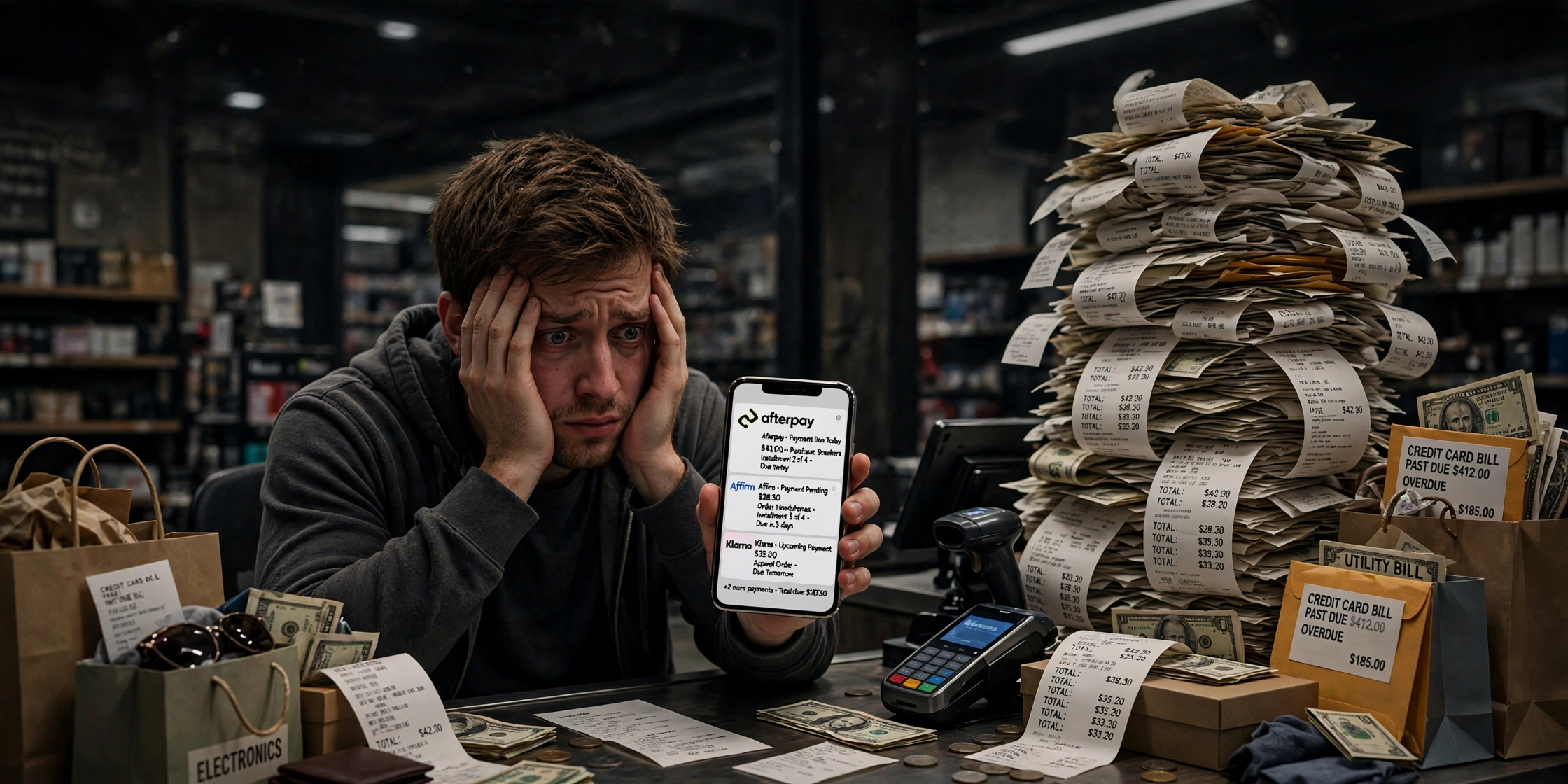
They figured out how to make people feel like they can afford almost anything by breaking the price into four little payments. And somehow, spending money you haven't earned yet feels a lot less expensive when the checkout screen only shows you what you owe today.
Let's talk about Afterpay, Affirm, Klarna, and the entire Buy Now, Pay Later business model. These services have become incredibly convenient. You find something you want, select a payment option, split the purchase into smaller installments, and walk away with the product before you've actually paid for it.
Sounds great, right? No massive payment upfront. No need to wait until payday. You can get those shoes, that television, those clothes, or whatever else caught your attention and deal with the payments later.
But there's a problem with making purchases feel smaller than they actually are: You can eventually lose track of how much money you've committed to spending.
And that's where the convenience starts becoming a financial trap.
They Made Debt Feel Like a Discount
Think about the psychology behind it. You find something for $400. Paying $400 might make you hesitate. You start thinking about your bills, your savings, and whether you really need it.
But then the checkout screen offers you four payments of $100.
Suddenly, that $400 purchase doesn't feel like a $400 purchase anymore. It feels like a manageable little payment. You convince yourself that $100 isn't that bad, so you go ahead and buy it.
Then you find something else. Another four payments. Another purchase. Another payment schedule.
Before you know it, you're making payments on things you bought weeks ago while trying to figure out how much money is still available for the things you need today.
Congratulations. You turned your future paychecks into a waiting room for purchases you already made.
Four Small Payments Can Become One Big Problem
The biggest issue isn't necessarily one individual purchase. It's the accumulation of multiple purchases happening at the same time.
You might have $35 coming out for one purchase, $60 for another, $25 for something else, and $90 for a fourth. None of those payments looks particularly intimidating on its own.
But add them together, and you're suddenly committed to $210 in upcoming payments. And that's before your rent, utilities, insurance, groceries, gas, subscriptions, and everything else that requires money.
The Consumer Financial Protection Bureau examined Buy Now, Pay Later borrowing across six major providers, including Affirm, Afterpay, and Klarna. In its analysis of 2022 borrowers, approximately 63% had multiple simultaneous BNPL loans at some point during the year, and 33% had loans across multiple providers.
That means the problem of stacking payment plans isn't just some imaginary scenario. It's something researchers have documented in actual borrowing behavior.
And when you're using multiple apps, keeping track of everything becomes another responsibility you're adding to your financial life.
Zero Interest Doesn't Mean Zero Consequences
One of the biggest selling points is that some Buy Now, Pay Later plans offer interest-free installments. And to be fair, paying zero interest can be useful when you have the money, understand the terms, and simply prefer to spread out a purchase.
But people hear "interest-free" and sometimes interpret it as "risk-free."
Those are two completely different things.
Depending on the provider and product, missing a payment can result in late fees, account restrictions, collections, or potential credit consequences. Your bank may even charge an overdraft or insufficient-funds fee if an automatic payment comes out when your account doesn't have enough money.
And not every Affirm, Klarna, or Afterpay product has identical terms. Some longer-term financing options may charge interest, and credit reporting practices vary by product and provider. You need to read the actual agreement instead of assuming every payment plan works the same way.
The CFPB specifically warns consumers that missed BNPL payments can eventually reach debt collectors and potentially affect credit reports.
You're Spending Tomorrow's Money on Yesterday's Decisions
Here's the part I think people should pay more attention to: When you use Buy Now, Pay Later, you're making a commitment against income you haven't received yet.
Let's say you get paid every two weeks. You make a purchase today, knowing that part of your next paycheck is already spoken for. Then you make another purchase. Now another portion of the following paycheck is committed.
Eventually, you can reach a point where payday doesn't feel like payday anymore. It feels like a collection agency showing up to collect everything you promised to pay.
And the worst part is that you may not even remember how exciting those purchases were when you originally made them.
That new outfit is sitting in your closet. The headphones are already collecting dust. The television is playing in the background. But the payments are still coming.
The excitement was temporary. The financial commitment wasn't.
They Make It Easier to Buy More Than You Planned
There's another reason retailers like Buy Now, Pay Later options: They can make customers more comfortable spending more money at checkout.
Instead of seeing the full price, you're encouraged to focus on the smaller installment. That changes how the purchase feels, even though the total cost hasn't magically disappeared.
And this is where you need to be careful. A payment plan shouldn't convince you to purchase something that you wouldn't otherwise consider affordable.
If you wouldn't spend $600 on something today, why does agreeing to six smaller payments suddenly make it a smart financial decision?
Breaking a price into installments doesn't make the item cheaper. It just changes when the money leaves your account.
These Apps Don't All Work the Same Way
It's important not to lump every service or loan product into one category without understanding the differences.
Afterpay and Klarna offer pay-in-four options, but they also have different product terms and payment policies. Affirm offers installment financing that can extend beyond four payments, and some of those loans may carry interest.
Credit reporting is another important distinction. Some short-term plans may not routinely report positive payment activity to the major credit bureaus, while other products or longer-term loans may report account activity. A missed payment that reaches collections can create additional credit problems.
In other words, don't assume that because one payment plan didn't affect your credit, another one won't either. Read the terms of the specific transaction.
The Federal Trade Commission also recommends checking fees, credit reporting, return procedures, and what happens if you miss a payment before agreeing to a Buy Now, Pay Later arrangement.
Try This: If You Can't Buy It Without Financing, Maybe You Should Wait
Here's a financial exercise I think more people should try. Before using Afterpay, Affirm, or Klarna, ask yourself whether you could purchase the item outright without disrupting your bills, savings, or other financial responsibilities.
You don't necessarily have to pay for everything upfront. There are legitimate reasons to finance purchases, and a properly managed installment plan can be useful. But if the only reason you're buying something is because the payment looks small enough to ignore, that's a warning sign.
Also, calculate the total amount of all your existing installment payments. Don't just look at what one app says you owe. Look at every payment you've committed to across every service.
And if you have to use another payment plan to keep up with the first one, it's time to stop shopping and start getting those balances under control.
Convenience Shouldn't Cost You Your Financial Freedom
I'm not saying Afterpay, Affirm, or Klarna are automatically bad. There are responsible ways to use installment financing. If you already have the money, understand the terms, and can comfortably handle the payments, spreading out a purchase may make sense.
But there's a difference between using a financial tool strategically and relying on it because your current income can't support your spending habits.
One gives you flexibility. The other can quietly turn your future income into a collection of obligations.
We spend so much time trying to increase our income, build savings, and create financial breathing room. Why would we constantly volunteer pieces of our future paychecks to pay for things we wanted in the moment?
You shouldn't need three different payment apps just to maintain a lifestyle that your paycheck can't comfortably support.
Remember: Buy Now, Pay Later doesn't mean buy now, get it cheaper. It means buy now, and make sure you remember that you still owe somebody money later.
And if you have to work harder next week because of something you bought last week, maybe that wasn't as good of a deal as the checkout screen made it look.








Comments
No comments yet, be the first submit yours below.