The Benefits of Having Your Own Computer Network: Why Digital Independence Matters More Than Ever

Most people use the internet every day without thinking about who controls the systems they depend on. They pay for subscriptions, store files on someone else's servers, rely on outside platforms to communicate, and trust companies to keep their digital lives running. But what happens when you start building and controlling more of that infrastructure yourself?
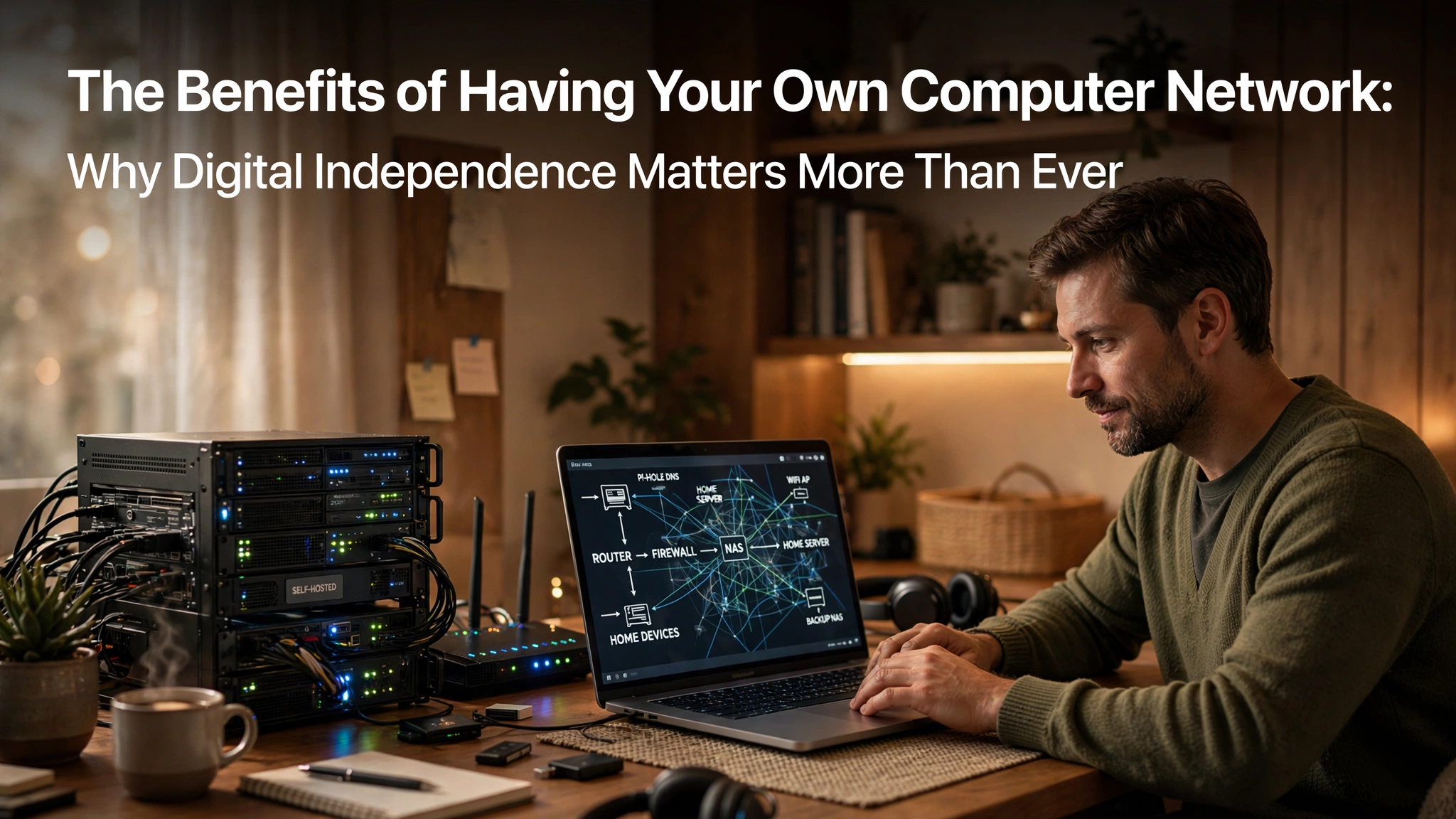
When people hear the words “computer network,” they might picture a large corporation with server rooms, expensive equipment, and a team of IT professionals. But your own network doesn't have to be that complicated. It can begin with a few computers, a router, a home server, shared storage, and the knowledge to make those devices work together.
Whether you're a programmer, a business owner, a content creator, a gamer, or simply someone who wants more control over their technology, building your own network can offer benefits that go far beyond connecting devices to the internet.
The biggest benefit is control. Instead of relying entirely on outside services, you can decide how parts of your digital environment operate, what information stays on your equipment, and which services you make available to yourself or others.
Let's look at why that matters.
1. You Gain More Control Over Your Data
Every time you upload a document, save a photo to a cloud service, or use an online application, you're making a decision about where your information lives and who operates the infrastructure behind it.
Cloud services can be useful and secure, but they also mean you're depending on another organization to manage the storage, access, availability, and policies surrounding your data.
With your own network, you can create shared folders, local storage systems, and private servers for files you want to keep under your control. You can decide which devices have access and establish your own backup procedures.
Imagine having years of music projects, business documents, website files, photographs, and personal records stored on equipment you manage rather than scattered across several subscriptions.
You would have a clearer understanding of where your files are and how they're organized.
However, owning the equipment doesn't automatically guarantee privacy or safety. You still need strong passwords, access controls, updates, encryption where appropriate, and reliable backups. A local server can fail, too, so important data should have an independent backup.
The advantage is that you gain more authority over how your information is managed.
2. You Can Host Your Own Websites and Applications
For programmers and entrepreneurs, this is one of the most exciting benefits.
A personal computer network can provide the foundation for running websites, databases, development environments, internal dashboards, file-sharing tools, and other applications.
Instead of treating every online service as something you must rent from another company, you can learn to operate some of those services yourself.
For example, a developer can run PHP and MySQL locally, test changes before publishing them, store project files centrally, and connect multiple devices to a development environment. A small business might use an internal server for documents, inventory, or tools used by its team.
For people who enjoy building things from scratch, this opens up an enormous range of possibilities.
You can experiment, troubleshoot, and improve your systems without waiting for a hosting provider to add a feature you need.
There is an important distinction, though: a home network is not automatically a reliable public hosting environment. Internet outages, power failures, hardware limitations, residential ISP restrictions, and security risks can affect availability. Public-facing services require careful configuration, and sometimes a commercial hosting provider remains the better choice.
Still, learning to host applications yourself gives you knowledge that can transfer directly into professional development and business operations.
3. You Can Reduce Recurring Technology Costs
Many digital services operate on monthly subscriptions. You might pay for storage, file synchronization, remote access, collaboration tools, backups, media services, and software hosting.
Individually, these payments may seem small. Over several years, however, recurring fees can add up.
Depending on your needs, a self-hosted network can replace some paid services with tools that run on hardware you already own or choose to purchase.
You might create a local media library, central file storage, a private development server, or an automated backup system. Open-source software can make many of these projects possible without licensing fees.
But don't confuse “self-hosted” with “completely free.” Electricity, replacement drives, networking equipment, maintenance, internet service, and your time all have costs. Some commercial services also provide convenience, redundancy, and professional support that would be expensive to reproduce independently.
The smartest approach is to compare the total cost of ownership rather than assuming that every service should be brought in-house.
The goal is to spend money where it creates value and avoid paying repeatedly for things you can manage effectively yourself.
4. Your Devices Can Work Together Instead of Operating in Isolation
A network makes it possible for your computers and other devices to share resources.
You can store files in one central location, access them from multiple computers, print from different devices, transfer large projects across your local network, or run a service that several machines can use.
For someone who works with large media files, software projects, or databases, that can create a more organized workflow.
Instead of keeping different versions of a file on three separate computers, you can establish a central system with a clear backup and versioning strategy.
Local networking can also provide fast file transfers without sending everything through the public internet. The actual speed depends on your network equipment, connection type, and the capabilities of the devices involved.
When your equipment is organized properly, your network becomes more than a way to get online. It becomes a shared environment where your tools support one another.
5. You Develop Skills That Make You More Technically Independent
There is a difference between knowing how to use technology and understanding how it works.
When you build your own network, you have opportunities to learn about IP addresses, routers, DNS, firewalls, ports, file permissions, databases, server processes, backups, and network troubleshooting.
These skills can help you diagnose problems instead of immediately assuming that a third-party service is responsible for fixing everything.
You also become better equipped to evaluate technology products and make informed decisions about security, performance, and infrastructure.
For anyone interested in programming or running an online business, those skills can be particularly valuable. Understanding the relationship between your application, database, server, and network makes it easier to identify bottlenecks and build systems that are more dependable.
You don't need to become a professional network engineer to benefit. Start with a manageable project, document your configuration, and learn one concept at a time.
Every problem you solve adds to your understanding.
6. You Can Automate More of Your Work
One of the most powerful uses for a personal network is automation.
A server can run scheduled scripts, monitor services, organize files, perform backups, process information, or coordinate tasks between applications. Multiple devices can contribute to a workflow rather than requiring you to perform every step manually.
For example, a creator might automate the organization of audio files, maintain a local database of projects, or generate reports from website activity. A small business could automate internal notifications or routine data processing.
If you use an automation platform such as n8n, a self-managed server or network can provide a place to run workflows and connect supported applications.
The benefit isn't simply having more computers. It's being able to design a system that handles repetitive work consistently, freeing you to focus on decisions and creative tasks that need your attention.
Automation does require maintenance. Credentials need protection, integrations can break, and workflows should be monitored. But when designed carefully, these systems can save time and reduce repetitive effort.
7. You Can Improve Your Privacy and Control Access
A properly configured local network can let you keep certain services available only to devices you authorize. You can restrict access to sensitive files, separate personal devices from smart home equipment, and reduce unnecessary exposure to the public internet.
For example, you might keep a database accessible only from your local network rather than exposing its port directly to the internet. You could also create a guest Wi-Fi network that cannot access your main computers and storage.
These practices can reduce the number of ways someone might reach sensitive systems.
But privacy is not automatic. A compromised computer can expose local data, weak credentials can undermine access controls, and an improperly configured remote-access service can create new vulnerabilities.
Security depends on how the network is designed and maintained, not simply on who owns the hardware.
For remote access, use established secure methods such as a properly configured VPN, keep systems updated, and avoid exposing administrative interfaces unnecessarily.
The benefit is the ability to make informed choices about what is accessible, from where, and to whom.
8. You Become Less Dependent on Individual Platforms
One of the biggest risks of building your entire digital life around a single service is that the service can change its rules.
An account can be restricted. A subscription can become more expensive. A feature can disappear. A company can discontinue a product or change how it handles your information.
If your business, creative work, or communication depends entirely on that platform, those decisions can affect you even though you had no control over them.
Owning more of your infrastructure gives you additional options.
You might maintain independent copies of important files, host selected services yourself, keep regular exports of business data, or build workflows that can be moved if a provider becomes unsuitable.
This doesn't mean abandoning every major platform. Online services provide access to audiences, customers, and tools that would be difficult to reproduce independently.
Instead, think about reducing unnecessary single points of failure.
If one service becomes unavailable, what can you still access? If one account is restricted, do you have copies of your important work? If a provider changes its pricing, do you have a reasonable alternative?
Digital independence isn't about doing everything alone. It's about having enough control and backup options that one company's decision doesn't determine your entire future.
9. You Can Create a Private Learning and Experimentation Environment
Your network can become a laboratory for ideas.
You can test new applications, learn database administration, experiment with containers or virtual machines, practice securing services, and build prototypes without immediately putting your production systems at risk.
You can even run separate development and testing environments so that experimenting with a new configuration doesn't interrupt the services you depend on every day.
This is especially useful for self-taught programmers. Rather than limiting your learning to tutorials, you can create real systems, encounter real problems, and discover how the pieces fit together.
You can also practice recovering from failures, which is an important skill in its own right. A backup is only useful if you know how to restore it.
Over time, the network becomes an environment where you can turn curiosity into practical knowledge.
10. You Build a Foundation That Can Grow With You
You don't need to purchase a rack of enterprise servers to get started. A modest computer, a reliable router, and an external drive can be enough for a useful first project.
You might begin with shared storage. Later, you could add automated backups, a development server, local monitoring, or a secure remote-access solution.
As your needs grow, you can upgrade specific components instead of rebuilding everything from scratch.
The key is to build around actual needs rather than buying equipment simply because it looks impressive.
A powerful server that sits idle can be a waste of money. A modest machine that reliably handles your daily tasks can be far more valuable.
Think about what you want your network to accomplish, what data needs protection, how much downtime you can tolerate, and how much maintenance you're willing to perform.
Then build accordingly.
So, Is Having Your Own Computer Network Worth It?
For someone who wants to learn, create, automate, protect important files, or gain more control over their technology, the answer can absolutely be yes.
A personal network can provide greater flexibility, opportunities to reduce certain recurring costs, better coordination between devices, practical technical skills, and more control over selected services and data.
But it also brings responsibilities. You become responsible for maintenance, security, backups, hardware failures, and troubleshooting. Some services are better left with providers that can deliver the reliability and support you need.
The best approach is not to self-host everything simply to prove that you can. It's to understand your options and choose which parts of your digital life benefit most from your own infrastructure.
Start small. Secure your equipment. Back up important information. Document what you build. Expand when there's a clear reason to do so.
In a world increasingly dependent on digital services, understanding how to operate your own systems is a valuable form of independence.
You don't have to own the entire internet to take greater control of your corner of it. Sometimes, the first step toward digital independence is simply learning how to make your own computers work together.









Comments
No comments yet, be the first submit yours below.